Key Takeaways
- The top 10 fintech SEO agencies in 2026 are ScaleTheory, Mint Position, Siege Media, NinjaPromo, CSTMR, Omnius, Sure Oak, Mint Studios, Garit Boothe Digital, and NoGood. The best of them combine compliance-aware content, technical SEO, E-E-A-T signals, and GEO for ChatGPT, Perplexity, and Google AI Overviews.
- At ScaleTheory, we run fully managed Google and AI search programs for fintech and B2B software companies. We helped Gloroots, a global payroll and EOR platform, double its organic MQLs in four months and grow LLM leads from zero to 20+ a month.
- Mint Position and Siege Media are content-led. Mint Position's journalistic SEO took Lula to almost 1,000 organic B2B leads a month, and Siege Media grew Stash's organic traffic by 540%.
- Omnius and Garit Boothe Digital fit B2B fintech teams with a specific gap. Omnius runs SEO and GEO together for European fintech, and Garit Boothe Digital handles technical SEO and links with a CPA on its content team.
- CSTMR and NoGood suit larger fintech brands that need more than SEO, adding brand strategy (CSTMR) or paid media (NoGood). Published starting prices on this list range from $2,000 to over $20,000 a month.
Fintech SEO is a completely different approach when compared with generic SEO for most software companies. Google treats finance content as YMYL (Your Money or Your Life), so pages with thin, outdated, or unsupported claims get pushed down. Content about fees, lending, or payments often needs compliance sign-off before it goes live, which slows publishing. And the people evaluating fintech products, usually CFOs and finance managers, read with far more suspicion than the average software buyer.
Many buyers today ask ChatGPT, Perplexity, and Google's AI Mode to compare payment providers, expense tools, and lending platforms. But Google still carries most of the demand. In our research, How Big Is AI Search?, we found that LLMs account for about 7.9% of global search-equivalent queries, against 92.1% for traditional search engines.
Also in our research, we found that Google's AI Overviews show users AI answers 7 to 8 times more often than LLMS like ChatGPT, Gemini, Claude, Grok, and Perplexity combined.
So a fintech SEO agency that only talks about ChatGPT citations is addressing only part of the problem. You need a partner that can grow your visibility in Google and in AI answers at the same time.
Agencies in this category also work in very different ways:
- Some write journalist-style content.
- Some focus on links from finance publications.
- Some run SEO next to paid media and brand work.
If you sell software outside financial services, our lists of the best B2B SEO agencies and the best SaaS SEO agencies may be a better starting point.
In this guide, we have reviewed the agencies that publish fintech client work with numbers attached. We then reviewed their websites, case studies, services, and pricing. We have also noted where an agency's results are self-reported or came from other external dependable sources.
There is no single best fintech SEO agency. A crypto exchange and a B2B payments platform need very different things, so the breakdowns below focus on who each agency is right for.
Quick comparison of the 10 best fintech SEO agencies in 2026

In-depth analysis of the 10 best fintech SEO agencies in 2026
1. ScaleTheory - Best for fully managed Google and AI search for fintech and B2B SaaS
ScaleTheory is a B2B organic growth agency. We help growth-stage and mid-market software companies, including fintech and finance-adjacent SaaS, grow their visibility in Google and AI search and turn it into qualified leads and pipeline.
We helped Gloroots, a global payroll and EOR platform, double its organic MQLs in four months and start getting 20+ leads a month from AI search.
We spend the first two weeks of every engagement understanding the product, the ideal customer profile (ICP), and the buying process. For fintech clients, that means learning what a CFO checks before approving a payments or payroll tool, which questions a finance manager asks while comparing vendors, and where regulation changes the answer. We then plan content around commercial topics: use cases, feature searches, competitor comparisons, alternatives, and country-specific questions for products sold in several markets.
We run Google SEO and AI search as one program. Our team handles technical SEO, content architecture, internal linking, editorial content, and brand authority. Our internal platform, VisibilityX, tracks how the brand appears in ChatGPT, Perplexity, Gemini, Google AI Overviews, and AI Mode, including mentions, citations, competitor recommendations, and the prompts where the brand is missing.
We also own the execution. Research, briefs, writing, editing, publishing, technical fixes, content updates, and reporting sit with our team. We build your compliance guidelines (restricted claims, required disclaimers, regional rules) into every brief, so your compliance team reviews substance instead of rewriting drafts. You bring product knowledge and business context, and we deliver the program.
Our fintech knowledge also comes from in-house work: our co-founder, Akshay Krishnan, managed SEO for 10+ products in the Zoho Finance suite across the US, UK, Asia, and the Middle East.
Our top 3 services
1. AI search visibility tracking through VisibilityX
We use VisibilityX to monitor brand presence across ChatGPT, Perplexity, Gemini, Google AI Overviews, and AI Mode. It tracks brand mentions, website citations, competitor visibility, and how AI tools describe or recommend the company. For fintech brands, that includes spotting answers that get fees, supported countries, or product details wrong. The findings show where competitors appear instead of you and which content needs work next.
2. Integrated Google SEO and LLM visibility
We build one strategy for Google rankings and AI recommendations. It covers keyword research, buyer-intent mapping, prompt research, topic clusters, new content, and updates to existing pages. We create content around product features, use cases, industry problems, comparisons, and alternatives. We also work on technical SEO, site structure, internal linking, and brand authority, including placements in the publications fintech buyers read and AI tools cite.
3. Fully managed SEO execution
We run the complete program, from research and planning to writing, editorial review, publishing, technical work, and reporting. Our content process combines AI-assisted workflows with editors who check accuracy, search intent, product fit, and sources. In finance, where one wrong figure can create a compliance problem, that review step matters more than in most categories. Your team gets an external SEO and content operation without having to hire one.
Notable clients
We work with B2B software companies in global workforce management, education technology, engineering software, conversational commerce, and customer support.
- Gloroots - An Employer of Record (EOR) and global payroll platform that handles compliance for companies hiring in other countries. We helped double organic MQLs in four months and grow leads from LLM platforms from zero to 20+ a month.
- EdisonOS - An SAT/ACT practice-testing platform for tutors and tutoring businesses. We helped increase SEO's share of pipeline from 36% to 100%, adding $5.5 million in pipeline over 18 months.
- BQP - Quantum-inspired simulation software for engineering, aerospace, defence, and R&D teams. We helped grow organic clicks by 767%, to more than 2,500 a month, in ten months.
- Flowcart - An AI-powered WhatsApp conversational commerce platform. We helped it reach 200+ monthly LLM sessions in four months and 1,100+ monthly organic clicks in five months.
- QuantumDesk - A customer support SaaS for D2C brands. We built its organic presence from no website to 8% AI visibility in four months and 2,600 peak monthly sessions.
AI SEO research content by ScaleTheory
We also publish research and practical guides on Google SEO, AI search visibility, and how brands can improve the way LLMs describe them:
- AI SEO Checklist for SaaS Startups - A step-by-step guide to checking how AI tools understand and represent a brand, finding visibility gaps, and fixing them.
- How to Control Your Brand Narrative in LLMs - How businesses can influence the way ChatGPT, Gemini, and Perplexity describe their products.
- What Companies Winning in AI Search Are Doing Differently - The patterns that separate brands that consistently appear in AI answers from those that don't.
- Pages That Control Your Brand Narrative in AI Search - Which website pages shape how AI tools understand a company and position it against competitors.
- Content Refresh for Visibility Systems - How to update existing content so it gets retrieved in both Google and AI search.
- How to Talk About Your Competitors on Your Website - A practical guide to comparison content that supports visibility and helps buyers evaluate options.
Case study: How we helped Gloroots double organic MQLs in four months
Gloroots is an Employer of Record platform that helps companies hire, onboard, and pay employees in other countries without setting up local entities. Payroll, cross-border payments, and local compliance sit at the center of its product, so its buyers research it the way they research financial software.
Organic search had always been Gloroots' main revenue channel, but traffic and conversions were both falling. It had a large content library, but much of it was outdated and no longer matched what buyers were searching for. At the same time, its buyers had started researching EOR providers in AI assistants, where Gloroots had little presence.
We didn't add more articles to the line-up. We focused on the pages closest to buying decisions, the content that targets high-intent queries and evaluation questions, and rebuilt them for Google. In parallel, we structured content for the AI platforms its buyers were already using.
Within six months, we helped Gloroots achieve:
- 2x organic MQLs within four months, and 3x organic leads within six months.
- Organic clicks up from 4,600 to 6,800 a month in five months.
- LLM sessions doubled, to about 500 a month.
- Leads from AI search up from zero to 20+ a month.

Pricing
Our SEO engagements start at $2,000 per month. Fully managed organic growth engagements, covering SEO strategy, content production, and AI search visibility, start at $4,000 per month.
Pricing depends on your current organic performance, competition, website requirements, content needs, and scope. Book a 30-minute strategy call to discuss what your fintech brand needs.

2. Mint Position - Best for journalist-led fintech content that ranks and gets cited
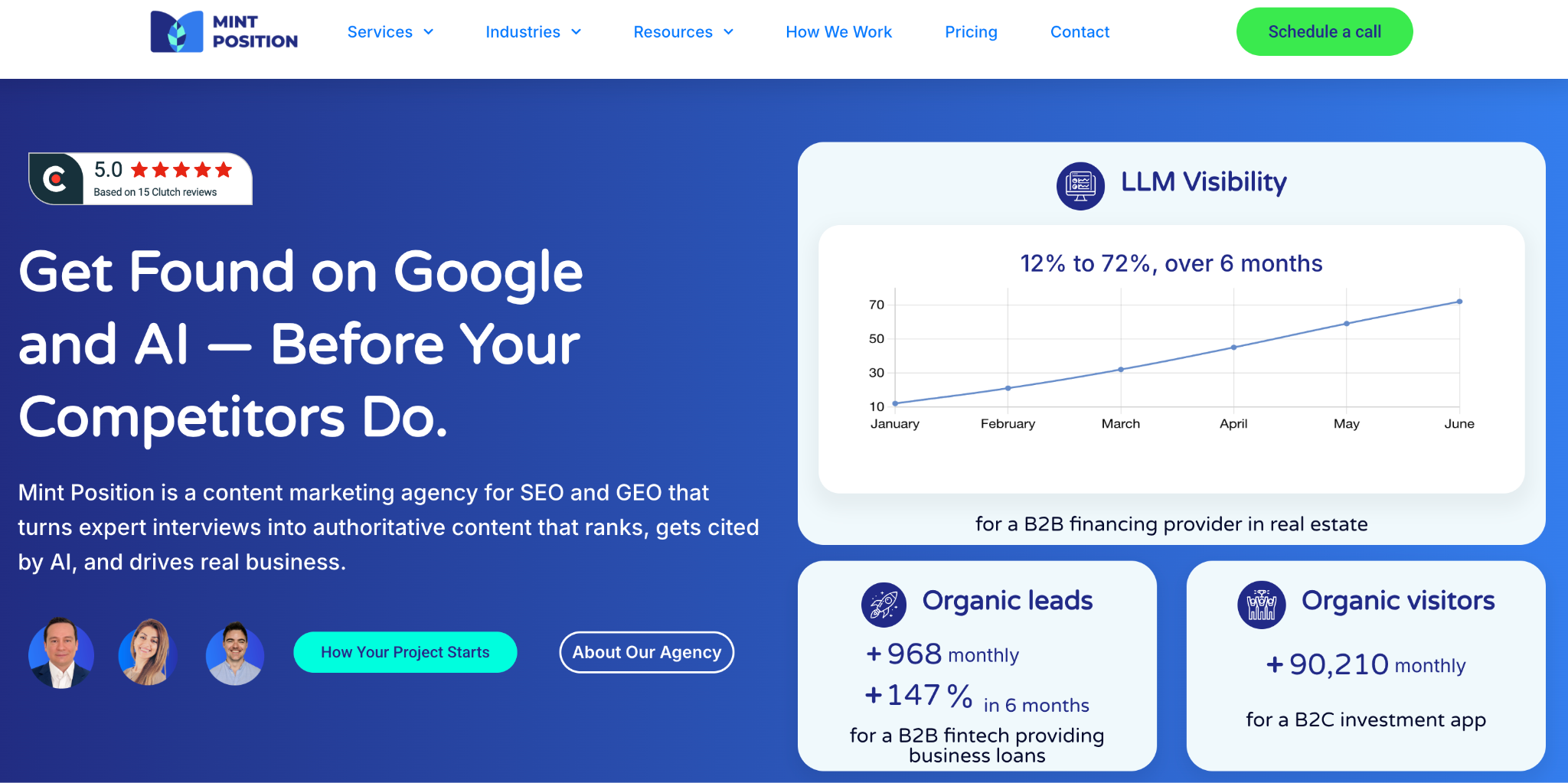
Mint Position is a financial and fintech content marketing agency based in New York and Barcelona. Justin Calderón, a journalist with more than 15 years of experience, founded it in 2020.
Its approach is journalistic SEO: original reporting and expert interviews instead of rewrites of what already ranks. Mint Position's argument is that the same authority signals that earn Google rankings also earn AI citations. Its Consensus Optimization framework builds on that idea by getting a brand mentioned consistently across the sources AI answers draw from.
Mint Position suits fintech brands where credibility is the main hurdle and where the internal team can give writers access to its experts.
Top 3 services
1. Journalistic SEO - Reported articles and expert interviews that give readers information they can't find in the current search results.
2. Consensus Optimization - Building consistent brand mentions across the sources Google and LLMs use when deciding what to rank or cite.
3. GEO audits - A baseline of where the brand appears in ChatGPT, Gemini, and Perplexity, and which sources those answers rely on.
Notable clients
Lula, Duckfund, Sarwa, Reloadly, Berkeley Payments, and Hubpay.
Case study: Lula
Lula, an SME funding provider in South Africa, hired Mint Position for its blog in late 2023 and expanded the work to product and use-case landing pages in 2024. By May 2025, 25 use-case pages and several blog posts ranked #1 for priority keywords, and 34 keywords sat in the top three. Organic B2B leads grew from 700+ a month in May 2025 to almost 1,000 by August 2025. Mint Position also reports that by the end of 2025, Lula was the most-cited domain on ChatGPT for SME funding prompts in South Africa.
Pricing
Mint Position publishes its pricing. Content production with SEO and GEO consultancy starts at $2,600 per month with a three-month minimum, and a one-off GEO audit costs $1,200.
3. Siege Media - Best for fintech content programs that earn links
Siege Media is a content marketing and SEO agency founded by Ross Hudgens, with offices in San Diego, Austin, New York, Chicago, and San Francisco. Fintech is one of the verticals it names on its homepage, and 18 of its 84 published case studies are fintech projects, including Chime, Stash, Bluevine, and Possible Finance.
Its model is educational content that ranks and attracts links on its own merit: content hubs, detailed guides, data studies, and designed assets that other publishers want to reference. In finance, links from credible publications count for a lot with Google, and the same publications often show up as sources in AI answers.
Siege Media is a strong fit for consumer and SMB fintech brands that need to rank for large volumes of banking, credit, and investing searches. B2B fintech companies with a small pool of buyers may get more from a pipeline-focused agency.
Top 3 services
1. Content strategy and production - Topic research, content hubs, and articles planned around search demand and the client's product.
2. Digital PR and link earning - Data-led stories and designed assets pitched to publications to earn editorial links.
3. Product SEO and localization - Optimizing product and landing pages, and adapting content for other markets.
Notable clients
Stash, Chime, Bluevine, Possible Finance, Statrys, and Lexington Law.
Case study: Stash
Siege Media built the "Learn" content hub for Stash, a personal finance and investing app, starting with top-of-funnel banking and investing questions. Within a year, organic traffic grew 540%, the content earned 1,200+ links, and five posts reached page one within four months.
Siege Media also reports $112,446 in added traffic value, which is an SEO estimate rather than revenue. For Chime, it reports 82% growth in blog organic traffic over a year, to 35,587 monthly visitors.
Pricing
Siege Media publishes a minimum of $8,000 per month for content marketing, on a 12-month contract with a 30-day out clause.
4. NinjaPromo - Best for fintech and crypto brands that want SEO, paid, and social in one subscription
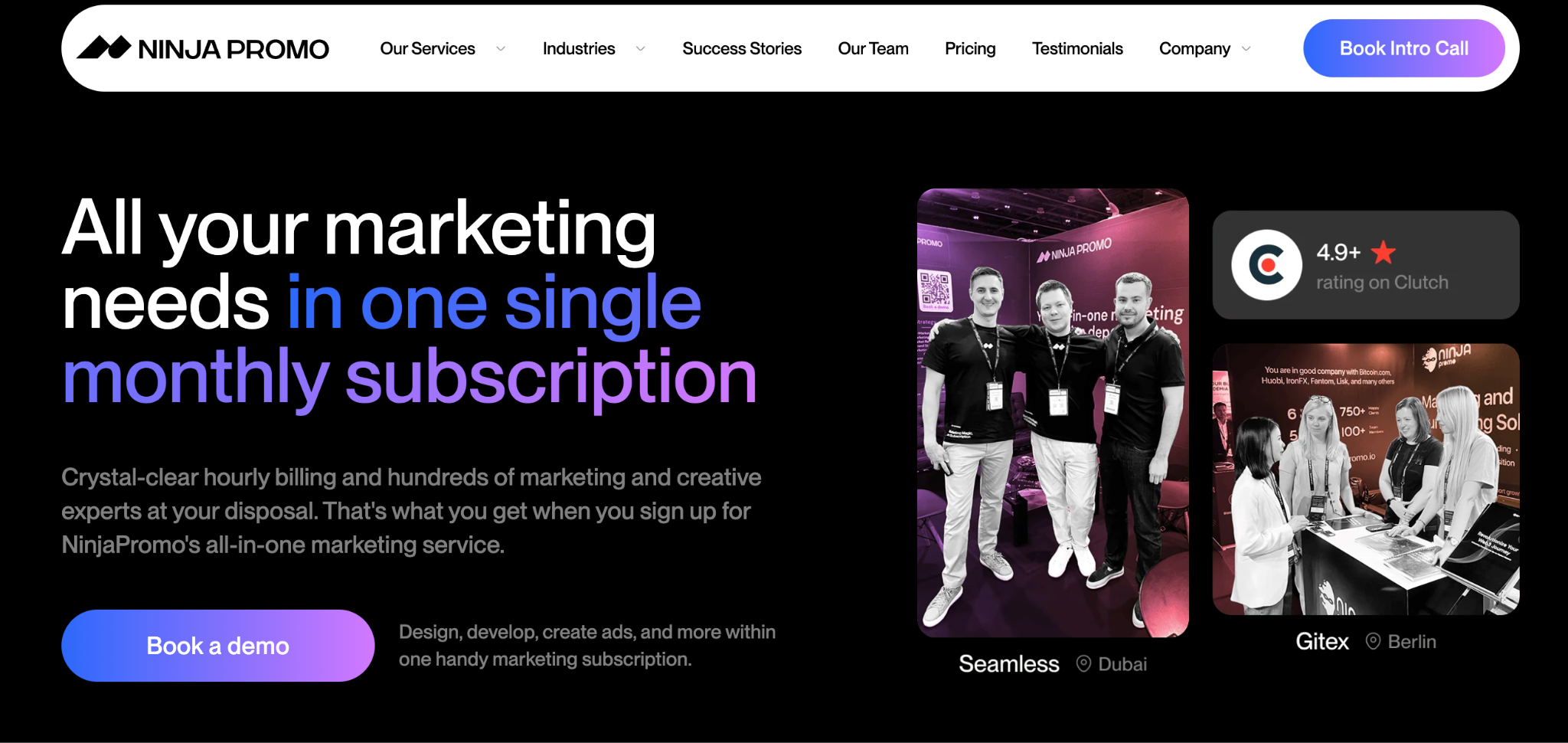
NinjaPromo is a full-service marketing agency for fintech, crypto, and Web3 brands, with 300+ specialists working remotely and offices in London, Dubai, New York, and Singapore. Clients buy a monthly block of hours rather than a fixed scope, and spend those hours across SEO, paid media, social, PR, content, and design.
That model works for venture-backed fintech and crypto companies that want to move budget between channels without managing several agencies. The trade-off is that SEO competes with every other channel for the same hours, so ask how many hours a month will go to organic work.
Top 3 services
1. SEO and GEO - Technical audits, keyword research, content, link building, and E-E-A-T work for Google and AI answers.
2. Paid media and social - Performance ads, influencer campaigns, and social content run alongside SEO.
3. PR and community building - Media placements and community growth, used heavily for crypto launches.
Notable clients
Credible, HTX, Zoomex, DAMEX, and Paypolitan.
Case study: Zoomex
For Zoomex, a crypto trading platform, NinjaPromo ran a site audit, researched 1,000+ keywords, and published 30 SEO articles over two months on an 80-hour subscription. In Q2 2025, the work brought about 1,000 new clicks, 821 of them from positions one to three, and about 1,600 queries were reindexed. NinjaPromo notes that it had no Google Analytics access, so conversions weren't tracked. Its better-known HTX campaign ($20M+ in deposits) came from paid social, PR, and community work rather than SEO.
Pricing
NinjaPromo publishes subscription plans: Starter at $4,000 per month (40 hours), Growth at $7,200 (80 hours), and Scale at $12,800 (160 hours), with discounts for 6- and 12-month terms.
5. CSTMR - Best for banks, lenders, and payments brands that need brand strategy and SEO
CSTMR is a marketing agency that works only with fintech and financial services companies. Co-founders Rory Holland (CEO) and Jack Macy (COO) both came from Credit.com, where Holland was CMO. The agency is SOC 2 Type 1 compliant, which is unusual for a marketing agency and useful when campaign tools handle customer financial data.
Holland's "95-5 rule" holds that only about 5% of a market is buying at any moment, and the rest need to know the brand before they're ready. So CSTMR pairs brand positioning and web design with SEO, and its SEO and GEO work, which it calls Discovery Optimization, aims to build recognition before the buying window opens.
CSTMR fits established lenders, banks, and payments companies going through a rebrand, a merger, or a new website. Teams that only need SEO content would be paying for capabilities they won't use.
Top 3 services
1. Brand strategy and positioning - Messaging, go-to-market strategy, and brand identity for financial services audiences.
2. Discovery Optimization (SEO and GEO) - Search and content strategy that builds category awareness and trust, with GEO in the same program.
3. Web design and performance marketing - Conversion-focused websites, landing pages, and paid media tied to financial product journeys.
Notable clients
LendingTree, UniTeller, Pursuit, GreenPath, loanDepot, nCino, and the American Bankers Association.
Case study: Pursuit
Pursuit (formerly NYBDC), a small-business lender, merged three brands and three websites into one. CSTMR handled the brand, the new site, and the SEO and domain planning for the migration. Organic search traffic rose 30% in the three months after launch, with month-over-month gains of up to 27%, although CSTMR doesn't publish the baseline figures. Its UniTeller engagement, a multi-channel campaign that included multilingual SEO content, reports transactions up 114% year over year in 2021-22 and 149% in 2022-23.
Pricing
CSTMR prices by project. Its Clutch profile lists a minimum project size of $50,000.
6. Omnius - Best for B2B fintech in Europe that needs SEO and GEO together
Omnius is a London-based SEO and AI search agency, with a second office in Dubai, that works only with SaaS, fintech, and AI companies. It treats Google and LLM visibility as one program rather than two services.
Omnius runs its own analytics product, Atomic AGI, which tracks AI search visibility, citations, and competitor presence. Few content-focused agencies have their own data layer like this, and it shapes which pages, topics, and external sources Omnius works on.
It suits Series A to Series D fintech and B2B SaaS companies in Europe, the UK, or the US that compete in crowded categories. Omnius says it takes on about eight new clients a year, so availability can be limited.
Top 3 services
1. Generative Engine Optimization (GEO) - AI crawler access, llms.txt files, schema, and content formatting for AI Overviews, ChatGPT, and Perplexity, plus citation monitoring.
2. Fintech SEO and programmatic pages - Commercial content, technical fixes, and programmatic pages for industries, professions, or locations.
3. Digital PR for AI citations - Earning mentions in the publications AI tools draw from when answering questions about financial products.
Notable clients
ANNA Money, Myos, WorldFirst, Meniga, Payoneer, and Native Teams.
Case study: ANNA Money
ANNA Money is a UK business account and company-formation platform. Between May and September 2025, Omnius built industry-specific content funnels (for landlords, contractors, and ecommerce sellers), programmatic city and profession pages, weekly high-intent content, and entity, schema, and FAQ improvements aimed at AI Overviews. Omnius reports a 60% increase in weekly signups, 164% growth in AI search traffic, 314% more top-three keywords, and growth from 183 to 837 keywords appearing in AI Overviews. For Myos, a Berlin lending fintech, it reports 227.9% more signups in six months.
Pricing
Omnius doesn't publish a standard retainer. Every engagement is scoped individually.
7. Sure Oak - Best for finance link building at scale
Sure Oak is an SEO, AEO, and link-building agency in Brooklyn, New York, founded in 2017 and led by CEO Nick Fraunfelder, who has 25+ years of experience in digital marketing, private equity, and technology. Its strongest fintech work is link building, with editorial placements in finance publications, a category where low-quality links do more harm than good.
All of Sure Oak's case studies are anonymized, which is common with clients in regulated industries. It does mean you should ask for references before signing.
Sure Oak suits B2B fintech companies, lenders, and PE-backed financial businesses where links or technical SEO are holding back growth.
Top 3 services
1. Link building - Monthly packages of editorial links from sites with a domain authority of 30+.
2. Technical SEO - Crawlability, site speed, schema, and site architecture for websites with many product lines.
3. AEO and AI search optimization - Content formatting, FAQs, and entity work to improve citations in AI answers.
Notable clients
AdvancePoint Capital (organic leads up 4x in four months), SoFi (shown as a client logo), and an anonymized $15B+ publicly traded financial services company.
Case study: $15B+ publicly traded financial services company
Sure Oak built links across nine product lines, including mortgages, investing, student loans, and retirement, for a large publicly traded financial services company. Compliance rules blocked GA4 access, so reporting ran through third-party tools. Over three quarters, Sure Oak delivered 1,900+ links, top-three keyword rankings rose 17%, and keyword visibility grew 10% quarter over quarter on a site that already drew 3.26 million organic visits a month.
Pricing
Sure Oak publishes link-building plans at $3,500 per month (9 links), $5,000 (14 links), and $10,000 (28 links). Wider SEO engagements are quoted separately.
8. Mint Studios - Best for bottom-of-funnel fintech content that produces pipeline
Mint Studios is a content marketing agency that works only with financial services and fintech companies. Founder Araminta Robertson worked in-house at fintech companies before launching it, and she hosts The Fintech Marketing Lab podcast.
Before writing anything, the team maps the client's buyer journey and finds the queries decision-makers use when they evaluate products. Articles are built from interviews with subject-matter experts, and conversions are tracked in GA4 and the CRM so the client can see pipeline, not just sessions.
Mint Studios is deliberately narrow. It focuses on bottom-of-funnel content rather than top-of-funnel traffic at scale, which is the right call for fintech companies that need SQLs from organic search and the wrong one for consumer brands chasing reach.
Top 3 services
1. Bottom-of-funnel content strategy - Comparison pages, category explainers, and integration and use-case content for buyers who are evaluating products.
2. SME-led content production - Blog posts and landing pages written from structured interviews with the client's experts.
3. Content optimization and AI visibility - Re-optimizing existing articles for buying keywords and tracking how the brand appears for buying prompts in AI tools.
Notable clients
WorldFirst, Fiska, and Fintel Connect.
Case study: WorldFirst
In 2025, Mint Studios re-optimized 36 existing WorldFirst articles across three regions and shifted them toward buying keywords, drafting with AI and editing by hand. Conversions from the optimized content rose from 32 in 2024 to 107 in 2025, an increase of 234%. 64 of 91 targeted buying keywords reached the top three, and visibility for tracked buying prompts in LLMs grew from 27% to 53.4%. UK monthly conversions grew from near zero to 50+, a figure that covers all channels.
Pricing
Mint Studios says clients typically spend between $5,000 and $20,000 per month.
9. Garit Boothe Digital - Best for technical SEO and link building for SaaS and fintech
Garit Boothe Digital is a SaaS and fintech SEO and GEO agency in South Jordan, Utah, founded by Garit Boothe. Its work centers on technical SEO, fintech content, and outreach link building.
Its content team includes a CPA, which is rare for a small agency and helpful when articles cover tax, credit, or accounting topics where accuracy is checked closely.
Garit Boothe Digital suits SaaS and fintech companies whose main problem is technical issues or a lack of authoritative links, and who would rather work with a small specialist than a large generalist agency.
Top 3 services
1. Technical SEO - Site audits, JavaScript rendering fixes, structured data, canonical cleanup, and internal linking.
2. Fintech content production - Articles and landing pages for financial services audiences, written to rank and to be used as reference material by LLMs.
3. Outreach link building - Earned links from finance and SaaS publications through direct outreach.
Notable clients
FairFigure and Woopra.
Case study: FairFigure
FairFigure is a business credit SaaS. Garit Boothe Digital fixed JavaScript rendering, orphan pages, robots.txt, and canonical issues, rewrote thin posts, targeted lower-competition buyer keywords, and earned links from finance and business credit sites. Over 12 months, unbranded search traffic grew more than 20x. FairFigure reached page one for "business credit builder card" within weeks and started appearing in Google AI Overviews and ChatGPT answers through partners' "best of" lists. The 20x figure is the only published metric; the rest of the results are shown as screenshots.
Pricing
Fintech engagements start at $5,000 per month, and the agency says most fintech clients spend between $5,000 and $10,000.
10. NoGood - Best for well-funded fintech brands running SEO, paid, and AI search together
NoGood is a growth marketing agency founded by Mostafa ElBermawy, headquartered in New York with offices in Miami and Dubai and a team of 70+. It covers AEO, SEO, paid search and social, content, CRO, and analytics, and reports an 84% client retention rate.
Its model is built on testing. NoGood runs experiments across paid and organic channels at the same time, moves budget toward what works, and uses cross-channel attribution to connect spend to revenue. In competitive fintech categories, where slow learning is expensive, that speed pays off.
NoGood is right for established or well-funded fintech brands that need SEO, paid media, and AI search coordinated by one team. With an average retainer above $20,000 a month, it isn't built for early-stage companies looking for a single-channel specialist.
Top 3 services
1. SEO and GEO/AEO - Organic content strategy combined with AI search work, using its own monitoring to track citations across ChatGPT, Perplexity, and Google AI Overviews.
2. Paid media and cross-channel growth - Paid search, paid social, and creative run alongside SEO with shared attribution.
3. GEO experimentation and LLM attribution - Tests on content formats and citation sources, and tracking that ties LLM traffic to signups.
Notable clients
Chime, American Express, Intuit, Truliant Federal Credit Union, and Merlin.
Case study: Chime
For Chime's Instant Loans launch, NoGood optimized 35+ pages across credit, online banking, and loans in one quarter. It ran monthly ChatGPT and Gemini visibility audits, unblocked AI crawlers, pursued citations in NerdWallet and Bankrate, and set up LLM attribution across GA4, Evertune, and Search Console. NoGood reports quarter-over-quarter growth of 60% in LLM sessions, 93% in enrollments from LLM traffic, and 25% in Gemini brand mentions. Social campaigns ran at the same time, so not every gain can be credited to SEO.
Pricing
NoGood doesn't publish packages. Its website says the average retainer is above $20,000 per month.
How to choose the best fintech SEO agency for your business niche
The profiles above show that "fintech SEO" covers very different work. Siege Media and Mint Position win with content. Sure Oak wins with links. CSTMR and NoGood combine SEO with brand or paid channels. Decide which of these you actually need before you start taking sales calls.
1. Check for fintech results, not just fintech logos
A client logo doesn't tell you what the agency did or what changed. Look for case studies that name the client, the timeframe, and a business result such as signups, MQLs, demos, or pipeline. Treat traffic value and impressions as supporting numbers, not proof.
Also ask who will work on your account and whether they've worked in-house at a financial company. People with that background know how compliance approval works and why a CFO will dismiss content that a general software buyer might accept.
2. Ask how compliance review fits into their process
Content that goes live without the right review can create liability in a regulated business. Give the agency your rules in writing: the markets you operate in, the regulations that apply, restricted topics, and required disclaimers.
A good agency builds those rules into its briefs and plans publishing around your review time. A weak one leaves compliance for you to sort out after the draft is written. Test it with a scenario: a lending article needs legal review before it goes live. What happens on their side, and how long does it take?
3. Ask which searches and prompts they would target first
For B2B fintech, early results usually come from comparison pages, alternatives, "best [category] software" lists, integrations, and country-specific questions such as payroll or tax rules in a particular market. If you sell in several countries, ask how they would plan country-specific content instead of translating one page into several languages.
A useful answer names a few pages the agency would create or update and explains who searches for them and what that reader does next. A long list of high-volume keywords is not a strategy.
4. Ask how they measure AI search visibility
Ask which LLMs they track, how they track citations, and what changed for a fintech client they worked with. Ask for a sample report and which AI visibility monitoring tools they use. A good agency will also check whether AI answers describe your fees, licenses, or supported countries correctly, and explain why ChatGPT recommends your competitors instead of you.
Then search for the agency itself in ChatGPT or Perplexity. One answer proves nothing, but an agency selling AI visibility that never appears in AI answers is worth questioning.
5. Ask how they build credibility outside your website
Finance buyers trust their peers. CFOs and finance leaders rely on Slack groups, private communities, industry publications, and review sites when choosing tools. AI tools lean on third-party sources too, which is why NoGood pursued NerdWallet and Bankrate citations for Chime.
Ask the agency how its work builds your presence in those places through digital PR, partner listings, and expert commentary. If every answer is about rankings and traffic, the agency is solving only part of the problem.
6. Compare scope before you compare prices
Published starting prices on this list range from $2,000 per month (ScaleTheory) and $2,600 (Mint Position) to $8,000 (Siege Media) and an average above $20,000 (NoGood). Sure Oak's $3,500 plan covers links only, and NinjaPromo's $4,000 plan is 40 hours shared across every channel. These numbers aren't directly comparable.
Before signing, confirm how many pages are included, who publishes, whether technical work and links are covered, how AI visibility is tracked, whether tools cost extra, and the minimum contract length.
Why ScaleTheory is a strong choice for fintech and B2B software companies prioritizing SEO and AI search visibility
ScaleTheory is built for growth-stage and mid-market B2B companies that want one team to run Google SEO and AI search together, from choosing topics to writing, publishing, updating, and reporting.
We start with the product and the people who buy it, then focus on the searches and prompts most likely to bring in qualified prospects. VisibilityX shows us whether your brand appears in the AI answers that matter and where content or citations are missing.
Then our team makes the changes instead of handing you a list of recommendations. Our in-house experience with the Zoho Finance suite means we already know how compliance review and financial buyer journeys work.
Here is what we have helped our clients achieve:
- Gloroots: Organic MQLs doubled in four months, and LLM leads grew from zero to 20+ a month.
- EdisonOS: $5.5 million in SEO pipeline and 4x more SEO-sourced demos.
- BQP: 767% growth in organic clicks over ten months.
- Flowcart: 200+ monthly LLM sessions within four months.
- QuantumDesk: From no website to 8% AI visibility in four months and 2,600 peak monthly sessions.
If you want a team to run your fintech brand's Google and AI search program, book a 30-minute strategy call to discuss your product, markets, and growth goals.

Frequently asked questions about fintech SEO agencies
What does a fintech SEO agency do?
A fintech SEO agency helps financial technology companies get found in Google and in AI answers from tools like ChatGPT, Perplexity, and Google AI Overviews. Its work usually covers technical SEO, content for commercial and comparison searches, link building, and AI visibility tracking. Unlike a general SEO agency, it should also understand YMYL quality standards and how compliance review affects what you can publish and how fast.
How is fintech SEO different from regular SEO?
There are three main differences. Google holds financial content to a higher quality standard, so thin or inaccurate pages get suppressed. Compliance review slows publishing and limits what you can claim. And fintech buyers, especially CFOs and finance managers, rely heavily on peer recommendations and trusted publications, so building credibility outside your website matters as much as the content on it.
What is YMYL, and why does it matter for fintech websites?
YMYL stands for "Your Money or Your Life." Google uses it to describe topics where bad information could hurt someone's finances, health, or safety, and it applies stricter quality checks to them. For fintech sites, that means content needs clear authorship, accurate figures, cited sources, and regular updates. Finance sites also tend to see large swings after Google's core updates, so it's worth knowing how to recover from a Google core update if your traffic drops.
How much do fintech SEO agencies charge?
Published starting prices on this list range from $2,000 to over $20,000 per month. ScaleTheory's SEO engagements start at $2,000 per month, with fully managed programs from $4,000. Mint Position starts at $2,600, Sure Oak's link-building plans start at $3,500, NinjaPromo's subscriptions start at $4,000, Garit Boothe Digital's fintech programs start at $5,000, and Siege Media's minimum is $8,000. NoGood reports an average retainer above $20,000. Omnius and CSTMR quote each project individually.
How long does fintech SEO take to show results?
It depends on your site's current authority, your competition, and how quickly compliance can approve content. Updating pages that already rank usually shows results first, often within a few months. In the case studies above, Gloroots doubled its organic MQLs in four months, while larger results like EdisonOS's $5.5 million in pipeline came over 18 months. Ask any agency which changes it expects to move first and how it will measure leads while rankings build.
Do fintech companies need GEO as well as SEO?
Yes, if your buyers use AI tools during research, and most B2B finance buyers now do. Google still handles most search demand, but AI answers increasingly shape which vendors make the shortlist. The two overlap a lot, since strong rankings, credible sources, and clear product pages help in both. If AI visibility is your main priority, see our list of the best fintech AEO and GEO agencies or our broader guide to AI SEO agencies.
Which fintech SEO agency is best for B2B fintech companies?
It depends on your gap. ScaleTheory suits B2B fintech and SaaS teams that want fully managed Google and AI search. Mint Studios is strong for bottom-of-funnel content that produces SQLs, and Omnius for SEO and GEO in European markets. Garit Boothe Digital and Sure Oak fit teams whose bottleneck is technical SEO or links. Review each agency's results in categories close to yours before you choose.
How do I know if an agency understands fintech compliance?
Ask them to walk you through their content approval workflow, then give them a scenario: you operate in a regulated lending or payments market, and an article needs legal review before it goes live. What does the process look like on their side?
An agency with fintech experience will have a specific answer. It will have review checkpoints built into its process, plan publishing around approval time, and have a view on balancing speed and accuracy. An agency without that experience will say something general about "working with your team." Find out which one you're talking to before you sign.

I help B2B SaaS companies grow pipeline and visibility through strategy-led SEO, AI-powered execution, and content aligned to buyer journeys across key touchpoints and platforms.. With over 5 years of experience, I’ve led execution across the entire organic funnel, delivering measurable results aligned with business goals.