
Get AI visibility that contributes to revenue
AI search is not a ranking problem. It’s a visibility and narrative problem. We help B2B SaaS companies show up in AI answers that influence buying decisions, and turn that visibility into pipeline
.png)
.png)
.png)
.png)
.png)
.png)
.png)
.png)
.png)
.png)
AI SEO is often executed backwards
Teams start with tactics:

How do we get cited in ChatGPT?
Which prompts should we rank for?
How do we publish more content?
So they chase prompts, mentions, and experiments.
But AI search doesn’t reward these scattered tactics. It rewards authority across the themes that define your category.
AI visibility needs a structured system
Scale Theory focuses on visibility across the themes that define your category.
Instead of optimizing for scattered prompts, we strengthen your presence across the subject areas where your buyers research and evaluate solutions.
This is what we call Targeted AI Visibility.
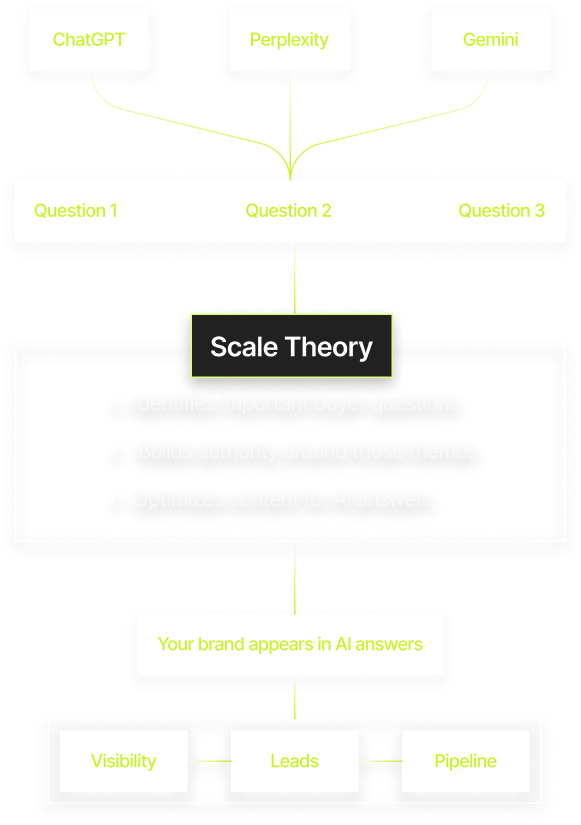
So where does your brand stand?
We start by mapping how your brand appears across the themes that define your category.
This shows:

Where you appear in AI answers
Which high-intent questions you’re missing
Gaps in your authority across key topics
How competitors are positioned
From there, we build a clear plan to improve visibility where it matters.
See where you show up in AI answers
Why AI visibility tools aren’t enough
Most teams exploring AI search end up using tools to track AI visibility. They show where you appear but two challenges remain:


We take a different approach.
Instead of introducing a separate tool into your stack, we use our own internal system, ScaleX, built into how we execute.

Identify
- Map visibility across the themes and questions that define your category
- Surface gaps where your brand is missing or underrepresented

Act
- Build and scale content aligned to those gaps
- Improve structure and reinforce authority across relevant topics

Monitor
- Track how visibility evolves across those themes
- Use insights to guide what to prioritize next
Because this system is part of our workflow, we move directly from insight to execution without added overhead.
Result: continuous improvement in visibility, tied to traffic, leads, and pipeline.
How AI visibility is measured with Scale Theory
We track visibility across the themes, answers, and surfaces that influence buyer decisions.

Theme visibility
Presence across the priority topics and subject areas that define your category.

AI presence
Your brand appearing in relevant AI answers where buyers research solutions.

Brand mentions
How your product is described, positioned, and recommended in those answers.

AI-influenced sessions
Traffic originating from AI search environments and discovery surfaces.

Pipeline impact
Leads and MQLs influenced by AI-driven discovery and research.
Results from companies adapting to modern search
.png)
.png)
.png)
.png)