
.png)
.png)
Key Takeaways
- Google generates approximately 471.9 billion searches every month, compared to approximately 45.9 billion search-equivalent queries across leading LLMs.
- Based on recent Ahrefs research, we estimate that AI Overviews could appear across approximately 70–80% of Google searches. This means approximately 330–378 billion Google searches every month could expose users to an AI-generated answer.
- That's approximately 7–8X more searches with potential AI exposure in Google than search-equivalent queries happening across standalone LLMs.
- AI Overviews are also changing how users interact with search results. Pew found that users clicked traditional search results in 8% of visits when an AI summary appeared, compared with 15% when one did not.
- At the same time, Seer Interactive found that brands cited in AI Overviews received 35% more organic clicks than those that were not cited.
- With only around 32% of Google searches now resulting in a click, visibility within the search experience itself is becoming increasingly important.
We conducted research to understand how often users are exposed to AI-generated answers in Google and compared this with the number of searches happening across standalone LLMs.
In our previous research, we tried to understand how big AI search actually is by comparing the number of sessions and searches happening across the top five LLMs and search engines.
We estimated that ChatGPT, Gemini, Claude, Grok, and Perplexity together generate approximately 49.3 billion sessions every month, compared to 97.3 billion sessions across search engines. That puts the split at 33.6% for LLMs and 66.4% for search engines.
The difference is a lot wider when we compare the number of searches.
We estimated approximately 45.9 billion search-equivalent queries across LLMs every month, while search engines generate approximately 535.2 billion searches. Close to 8% of the search demand happens across LLMs, while 92% still happens across search engines.
Google accounted for the largest share in our analysis, both in terms of sessions and searches.
This led us to the next part of the research: AI Overviews.
When a user searches on Google today, the answer they see can be generated by AI and shown directly within the search results through an AI Overview. I consider AI overviews as another instance where a user is exposed to an AI-generated answer, similar to receiving an answer from an LLM.
So, we wanted to understand how frequently AI Overviews appear in Google searches and, in turn, how often Google users are exposed to AI-generated answers.
How often do AI Overviews appear in Google search results?
The first step for us was to understand the percentage of Google searches where AI Overviews are being triggered.
During our research, we came across multiple studies with different answers to this question. The results varied based on the methodology and dataset considered for each study.
Xponent21 looked at a dataset of 8,000 U.S. keywords across 16 industries. BrightEdge used its own tracked keyword set to measure AI Overview presence and citations across various industries.
But the study that made the most sense for us was the latest research from Ahrefs, primarily because of the recency of the research and the size of the dataset.
Ahrefs analyzed 232.8 million U.S. desktop Google SERP crawls between July and September 2026. The research was primarily focused on benchmarking AI Overview presence for branded searches.
Ahrefs analyzed 232.8 million U.S. desktop Google SERP crawls between July and September 2026. The research was primarily focused on understanding the prevalence of AI Overviews across branded and non-branded searches.
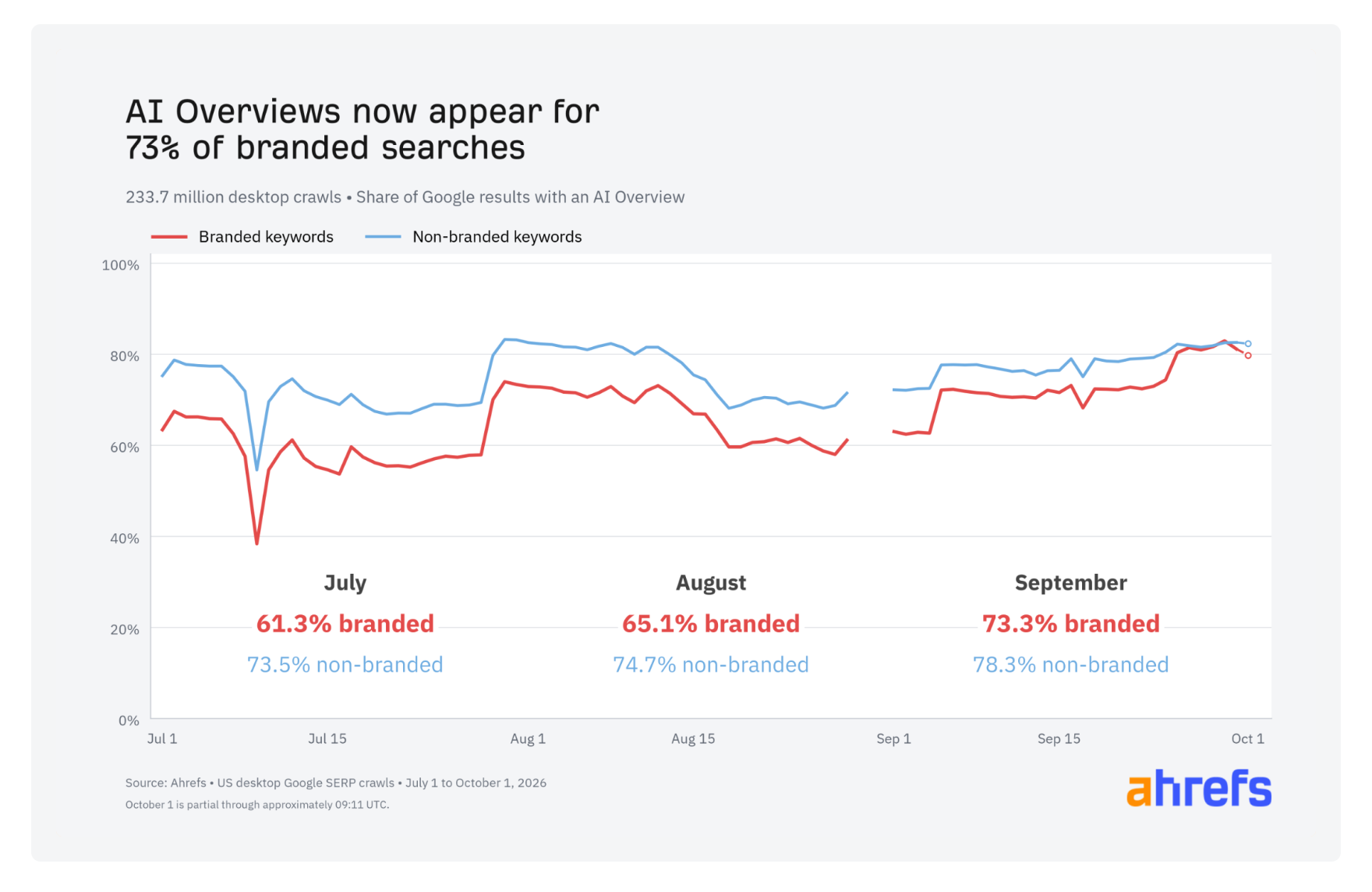
The dataset included:
By September 2026, AI Overviews appeared across 73.3% of branded searches and 78.3% of non-branded searches in the dataset.
The study is based on U.S. desktop search results, so it does not represent every Google search globally. We therefore don't want to extrapolate either percentage as an exact global number.
For this analysis, we are using a broader range of 70–80% as our estimate for the percentage of Google searches where an AI Overview could appear.
In our previous research, we estimated that Google generates approximately 471.9 billion searches every month. Applying the 70–80% range to this number gives us:
Based on this estimate, approximately 330–378 billion Google searches every month could trigger an AI Overview.
How does AI exposure in Google compare with LLMs?
In our previous analysis, we estimated that approximately 45.9 billion search-equivalent queries happen across the top five LLMs every month.
We can now compare this with our estimate of 330–378 billion Google searches per month where an AI Overview could appear.
If we consider these together as the total number of searches where users could be exposed to an AI-generated answer, the split looks like this:
Based on these estimates, there are approximately 7–8X more Google searches where users could be exposed to an AI-generated answer than search-equivalent queries happening across the top five LLMs.
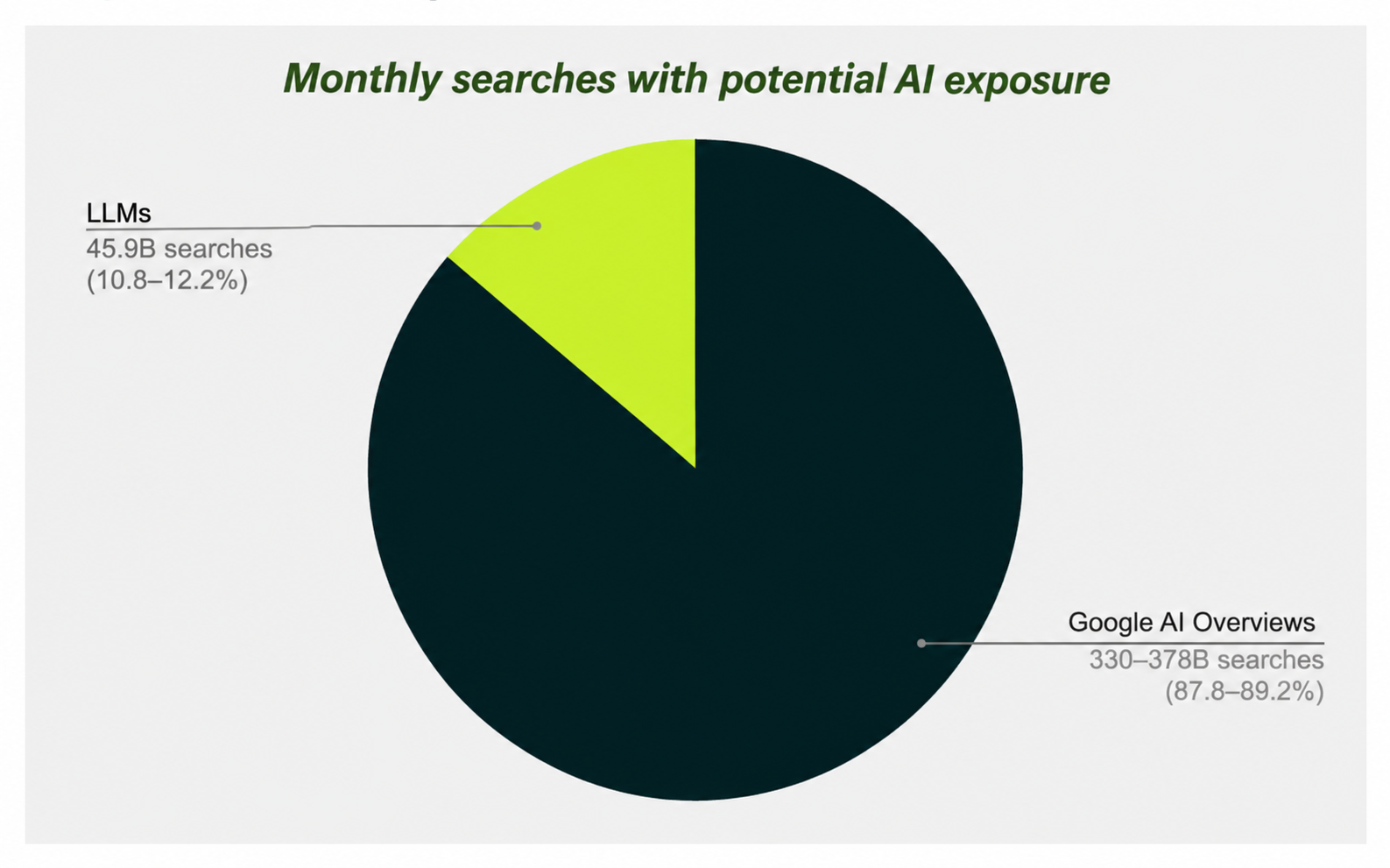
This number was much higher than we expected. We went into the research expecting AI Overviews to account for a larger share of AI exposure, but we did not expect the difference to be this large.
What does the 7–8X difference actually mean?
If you spend enough time on LinkedIn, it is easy to come away thinking that AI search optimization is primarily about increasing your presence across ChatGPT, Perplexity, Claude, and Gemini.
That is also where a lot of companies are currently focusing their efforts and tracking their AI visibility.
But our analysis points to a much larger opportunity within Google itself.
Based on our estimates, there could be 7–8X more Google searches where users are exposed to an AI-generated answer through AI Overviews than search-equivalent queries happening across the top five LLMs.
This becomes even more important when we look at how people are using Google today.
The latest research from SparkToro and Similarweb found that approximately 68% of Google searches end without a click. Looking further into where the remaining clicks go, their analysis suggests that roughly one in five Google searches results in an organic click to the open web.
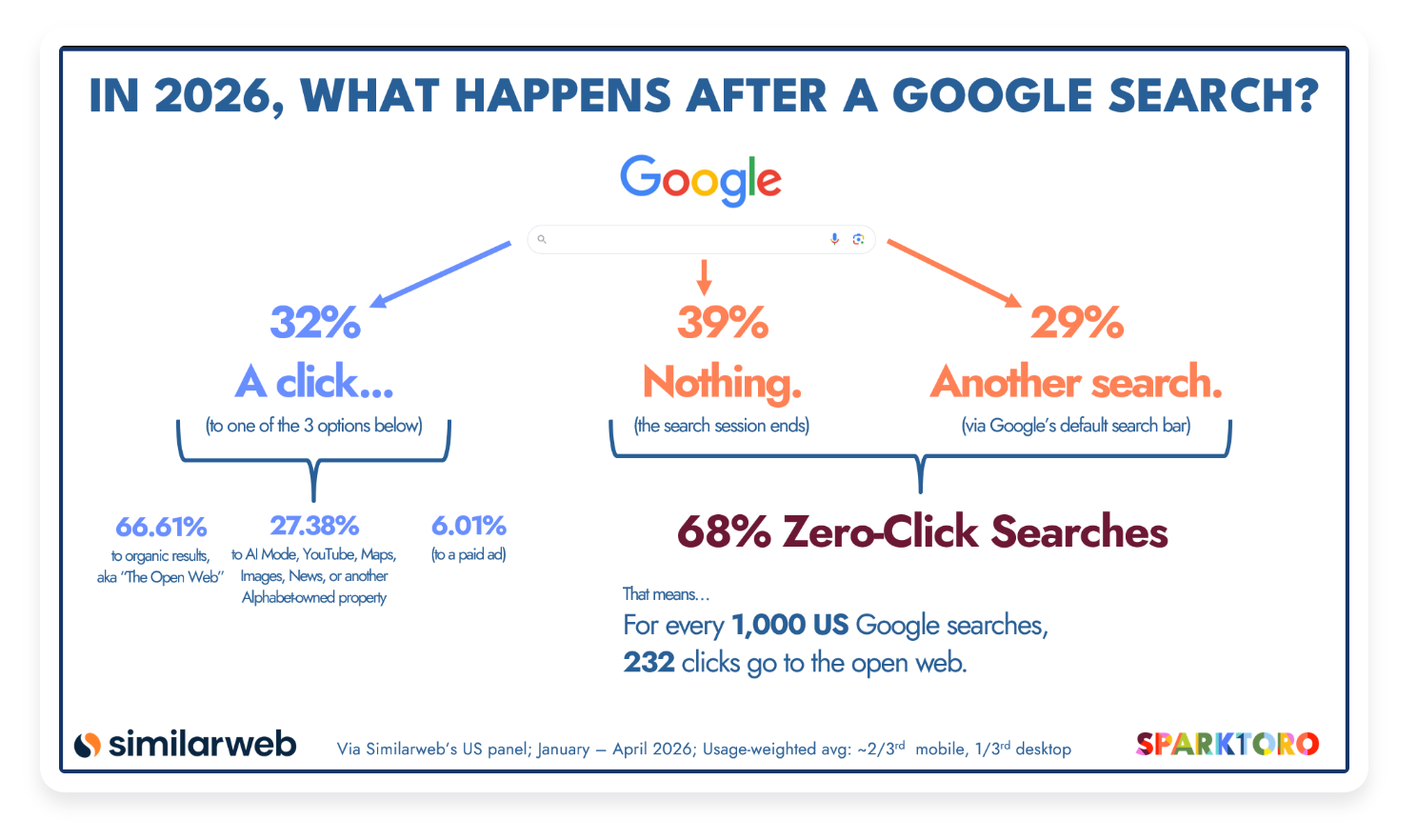
Research from Pew Research Center gives us another data point. Their study found that users were almost 50% less likely to click a traditional search result when an AI summary appeared. They also found that users were more likely to end their browsing session after seeing an AI summary: 26% of visits compared with 16% when no AI summary appeared.
Taken together, these numbers suggest that users are increasingly getting the information they need directly from the Google search results, and AI Overviews are becoming part of that behaviour.
If a user gets the information they need from an AI Overview and never clicks through to the organic results, the brands mentioned within that answer may be the brands they see and remember from that search.
Considering the scale we estimated earlier, we think businesses should be tracking and optimizing their presence in AI Overviews alongside ChatGPT, Gemini, Claude, and Perplexity.
For the core commercial and money keywords that matter to the business, AI Overview visibility should be a priority within the search strategy.

I help B2B SaaS companies grow pipeline and visibility through strategy-led SEO, AI-powered execution, and content aligned to buyer journeys across key touchpoints and platforms.. With over 5 years of experience, I’ve led execution across the entire organic funnel, delivering measurable results aligned with business goals.