
.png)
.png)
Key Takeaways
- AI tools received 49.3 billion monthly sessions in Q2 2026. Search engines received 97.3 billion. By raw sessions, AI is approximately 51% the size of search.
- 80% of AI sessions happen in mobile apps. Any analysis that looks only at web traffic significantly underestimates AI usage.
- Not all AI sessions generate search-equivalent queries. When prompts-per-session and prompt intent are taken into account, LLMs generate approximately 45.9 billion search-equivalent queries per month, compared to 535.2 billion search engine queries.
- ChatGPT drives approximately 80% of all AI sessions on its own (39.5B of 49.3B total). The gap between ChatGPT and every other AI tool is substantial.
- Search engine volume has not declined. Instead, the overall information discovery market has expanded as AI has introduced a new category of search-like interactions.
A lot of marketers and agencies are pushing businesses to focus much more on AI visibility, AI SEO, retrieval, and so on. There are a lot of technical terms and a lot of jargon, but many people still miss the benchmark for how big AI search actually is, what AI search adoption looks like, and how many searches are happening in LLMs compared to Google.
We started this analysis to ensure we have a clear understanding of all of this, which will help us prioritize how we approach and strategize these areas.
Based on our analysis, we found that LLM adoption is widespread. If we consider the total number of sessions across both search engines and LLMs, 33.6% of all sessions occur in LLMs globally, while the remaining 66.4% occur in search engines.
In the United States, LLMs account for approximately 30.6% of all sessions, and in India, LLMs account for around 38.4% of all sessions. This suggests that AI adoption, relative to traditional search, is currently stronger in India than in the US.
Now let us look at the number of search queries. Since not every AI interaction is actually a search, we estimated the number of search-equivalent queries generated by LLMs and compared them with search engines.
Globally, LLMs account for ~8% of all search queries, while search engines account for ~92%. In the United States, LLMs contribute ~7% of total search queries, compared to ~93% for search engines. In India, LLMs contribute ~10% of total search queries, while search engines account for ~90%.
Below, we have provided a detailed breakdown of the methodology we used to arrive at these numbers, along with a few additional insights from the analysis.
Step 1: Calculating the total number of sessions
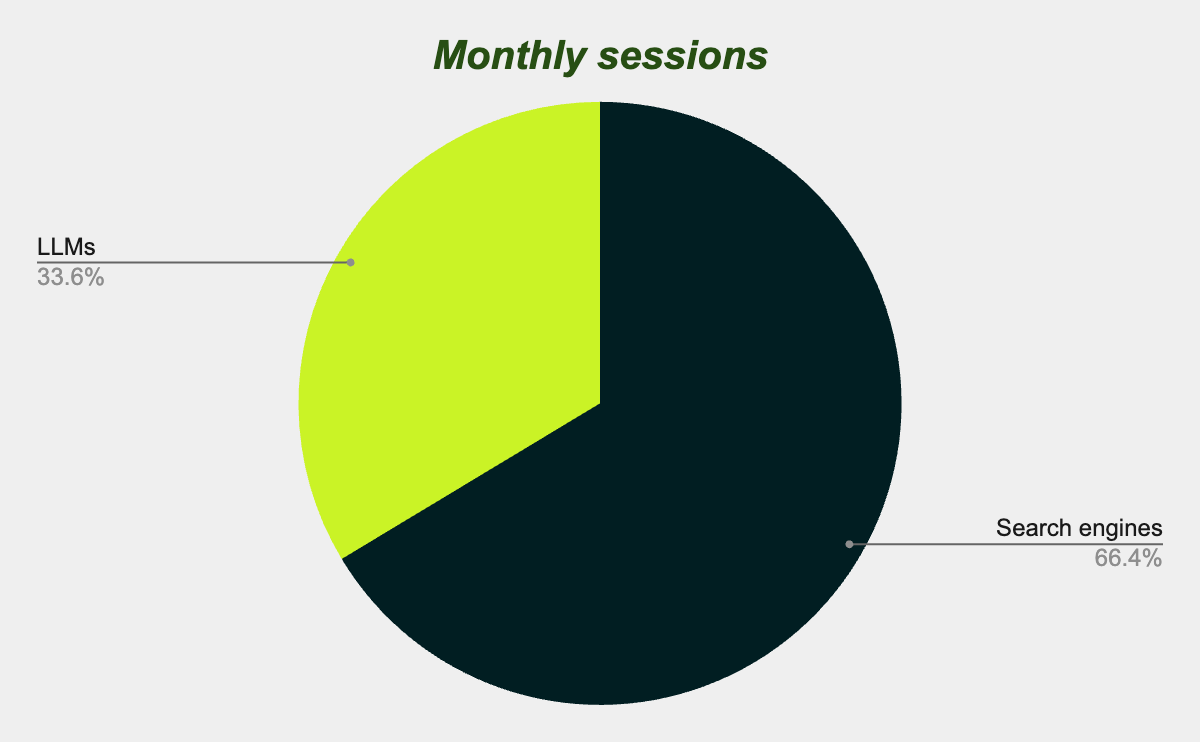
We started by looking at the total number of sessions across both search engines and AI tools. To benchmark these numbers, we used data from Similarweb.
For search engines, we considered only web sessions, as that is where the vast majority of search activity happens. For AI tools, however, we included both web sessions and mobile app sessions to capture their overall usage more accurately.
Based on this analysis, search engines account for a total of 97.3 billion monthly sessions, while AI tools account for 49.3 billion monthly sessions across web and mobile apps.
To understand how adoption varies by geography, we also estimated the distribution of sessions across the United States and India using Similarweb's country-level traffic shares.
Insight 1: 80% of AI sessions are happening in apps
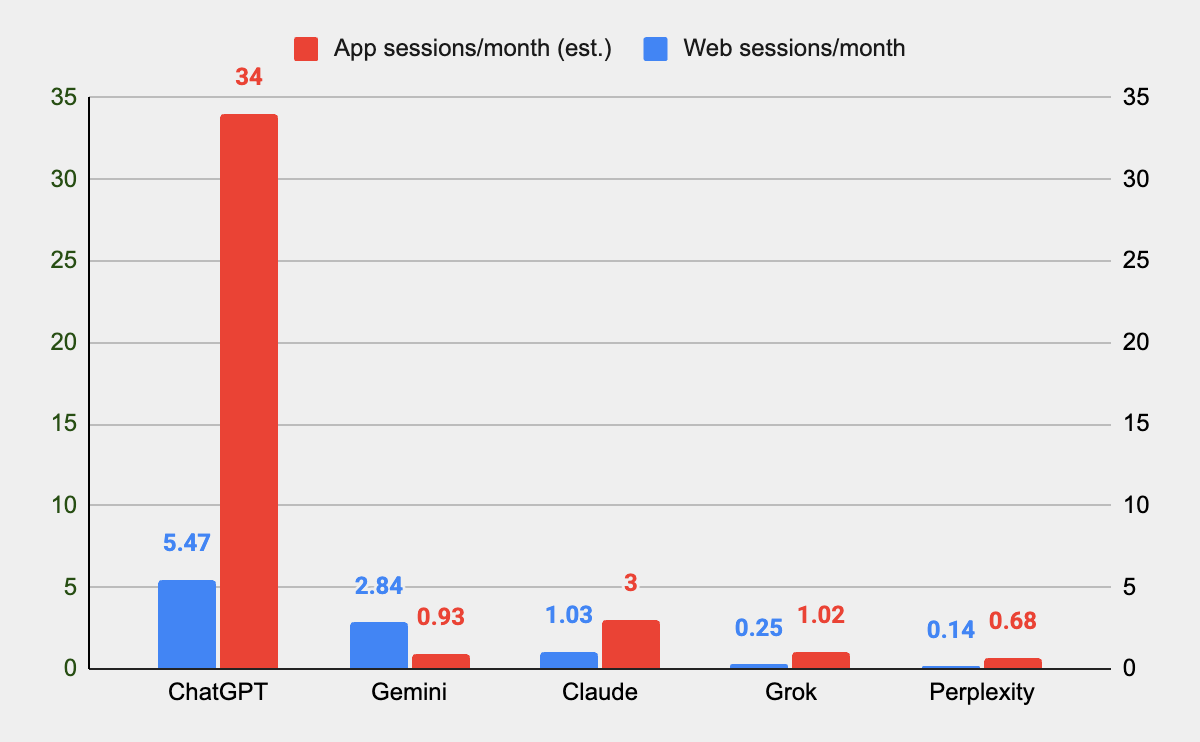
The majority of LLM usage happens through mobile apps rather than the web.
ChatGPT is the best example of this trend. Out of its 39.5 billion total monthly sessions, only 5.47 billion come from the web, while approximately 34 billion come from its mobile apps. We see a similar pattern across most leading LLMs, with Gemini being one of the few exceptions.
While search engine usage is still largely web-first, LLM adoption is increasingly app-first, with the majority of user sessions happening through mobile applications.
Step 2: Calculating the total number of searches and prompts
After benchmarking the total number of sessions and understanding the adoption of AI tools, we moved on to estimating the total number of searches and prompts happening across these platforms.
For Google, we used the widely cited estimate of 5.9 trillion searches per year as our benchmark. We calculated the average number of searches per session and applied it to total monthly sessions. For Bing, Yahoo, DuckDuckGo, and other search engines, we applied the same average searches-per-session as Google.
For AI tools, we used a blended (web + app combined) queries-per-session rate. ChatGPT has a publicly known blended rate of 1.75 queries per session. For the remaining LLMs, we applied a uniform estimate of 2.0 queries per session, reflecting a blended rate across both web and app sessions.
This results in an estimated 624.1 billion monthly interactions across search engines and LLMs, with approximately 14.2% of all interactions taking place in LLMs.
We also applied the same methodology to estimate search interactions across the United States and India.
The regional analysis shows a similar trend to session adoption. India generates a higher proportion of AI interactions than the United States, suggesting that AI tools are becoming a relatively larger part of the information discovery journey for Indian users.
Insight 2: Not all AI prompts are search-equivalent
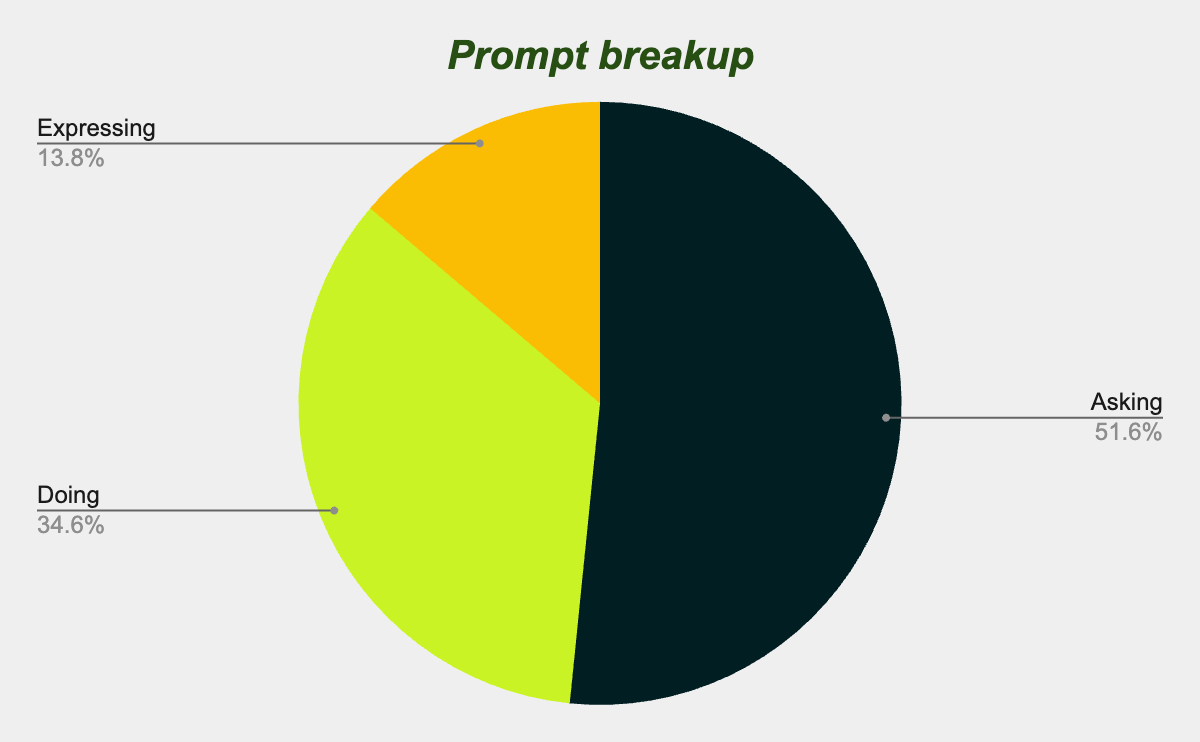
To better understand how many LLM prompts can actually be considered searches, we looked at a recent research study published by OpenAI in collaboration with researchers from Harvard. The study analyzed more than one million de-identified ChatGPT conversations and found that not every prompt is a search query.
Instead, they grouped prompts into three broad categories.
- The first is Asking, where users are looking for information, answers, or solutions. This accounts for 51.6% of all prompts.
- The second is Doing, where users ask the LLM to perform a specific task, such as writing, summarizing, coding, or generating content. This represents 34.6% of all prompts.
- The third is Expressing, where users are neither searching for information nor asking the model to complete a task, but are instead sharing thoughts or engaging in conversation. This accounts for the remaining 13.8% of prompts.
Based on this research, we consider only the 51.6% of prompts that fall under the Asking category as search-equivalent queries for the purpose of this analysis.
Step 3: Calculating AI search demand
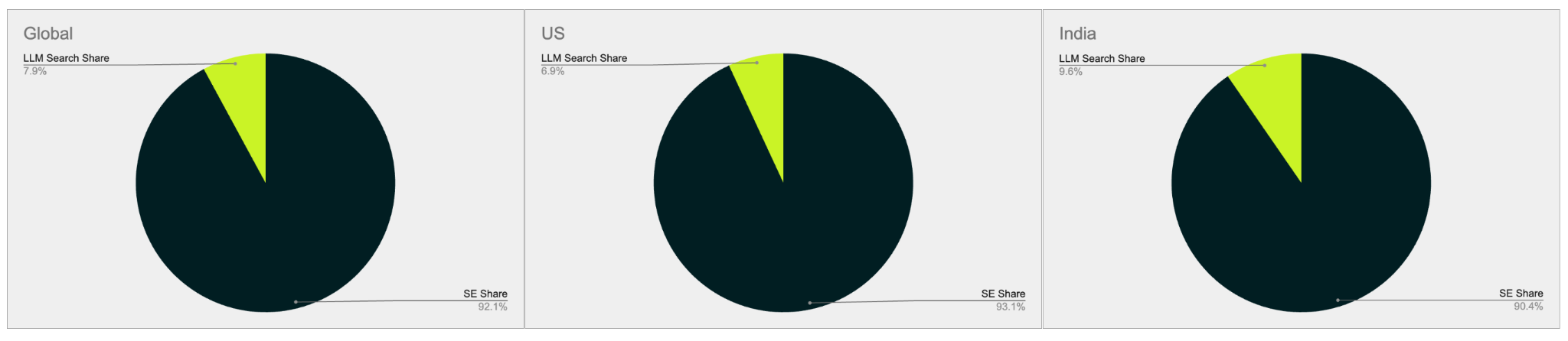
By excluding the remaining 48.4% of prompts that do not fall under the Asking category, we arrive at an estimate of the actual search queries happening across LLMs.
We then compared this with the total number of searches happening across search engines globally. Based on this comparison, we estimate that LLMs account for approximately 7.9% of all search queries globally, while traditional search engines account for the remaining 92.1%.
We also applied the same methodology to the United States and India. AI accounts for ~7% of search-equivalent queries in the United States, and ~10% in India. While traditional search engines continue to dominate information discovery, AI search is becoming a more meaningful channel in certain markets.
Final observations
Two important insights for us from the analysis
The first is that AI adoption has reached a meaningful scale much faster than many people realize. AI tools now generate 49.3 billion monthly sessions, equivalent to roughly one AI session for every two search engine sessions. In markets such as India, AI already represents more than one-third of all discovery sessions.
The second is that AI usage and AI search are not the same thing. While users generate more than 88 billion prompts every month across leading LLMs, almost half of those interactions are focused on content creation, coding, summarization, brainstorming, or conversation rather than information retrieval. Once these interactions are excluded, we estimate that LLMs generate approximately 46 billion search-equivalent queries every month.
Looking only at sessions or prompts can overstate AI's role in information discovery. Looking only at traditional search queries understates the broader shift in how users are interacting with AI.
AI is not replacing search engines today — it is expanding the overall information discovery market. Traditional search engines continue to generate more than 535 billion searches every month, while AI has created a new category of search-like interactions that now accounts for approximately 8% of global search demand.
Search engines remain the primary channel for information discovery and continue to account for more than nine out of every ten search queries globally. At the same time, AI assistants have become a significant secondary discovery channel, particularly for research, comparison, decision-making, and complex questions where conversational interfaces provide a better user experience.

I help B2B SaaS companies grow pipeline and visibility through strategy-led SEO, AI-powered execution, and content aligned to buyer journeys across key touchpoints and platforms.. With over 5 years of experience, I’ve led execution across the entire organic funnel, delivering measurable results aligned with business goals.