
.png)
.png)
Key Takeaways
- Most B2B teams avoid mentioning competitors, but this silence reduces visibility during high-intent searches where buyers shortlist and compare tools.
- In the market, buyers actively search listicles, alternatives, and comparison pages, making competitor mentions essential for appearing during critical decision making moments.
- Common fears like promoting competitors or losing deals are outdated, as honest positioning attracts better-fit leads and filters out low-quality prospects.
- Four key page types, including listicles, alternatives, vs pages, and competitor info pages, help capture different buyer intents across the research and decision journey.
- Effective competitor positioning relies on factual comparisons, clear ICP differentiation, and a professional tone that builds trust instead of biased or negative framing.
Most B2B marketing teams stay silent on competitors, fearing that the mention gives them airtime. That silence is a visibility loss, it’s like not being in the room when decisions are made.
This article is a practical playbook for using competitor mentions to win attention from buyers in-market today.
Here's what's covered:
- Why competitor mentions matter for active buyers who are in-market right now and using shortlisting tools
- The three objections that keep most marketing teams from naming competitors, and what's wrong with each
- The four-page types where competitor mentions actually rank, convert, and bring in real pipeline
- A three-filter framework that keeps competitor pages factual without sliding into bashing
The final goal is attracting the right-fit buyers and politely redirecting the rest.
Why should you talk about your competitors on your website?
Your buyers already know your competitors exist. Pretending they do not on your own site does not protect your brand or make them invisible.
"The best marketing doesn't avoid comparisons. It helps buyers make better decisions."
— Andy Crestodina, Co-Founder & CMO, Orbit Media LinkedIn Profile
Roughly 95% of your category is not buying today. Only 5% is in-market with budget and a clear problem statement to solve, and that 5% drives almost all short-term revenue.
Here's what those active buyers actually do during their research:
- They search "best [category] software" listicles early on, looking to build a shortlist of three to five vendors before booking demos
- They search "[Competitor] alternatives" once they have already used one tool and want comparable options that solve the same job
- They search "[Competitor A] vs [Competitor B]" to validate a final-round call between two finalists they have already shortlisted
If your brand does not show up in those three searches, you are invisible at the exact moment buyers pick finalists for demos. Talking about competitors helps in positioning your brand narrative against a reference point buyers already trust.
Why do most companies avoid talking about competitors (and why that's a mistake)?
Three objections come up almost every time someone considers competitor mentions on their site. Each sounds reasonable. Each rests on an outdated assumption.
Objection #1: "We'll be doing free marketing for them."
The fear is that naming competitors hands them traffic and authority. Anyone with a budget already knows four to five providers from AI, G2, Reddit, and peer networks.
The current buyer path is non-linear. Buyers bounce between LinkedIn, podcasts, AI search, and analyst sites. Refusing to name competitors does not erase them from any shortlist.
Objection #2: "We don't want to lose business by sending traffic elsewhere."
Losing business is not what comparison pages cause. If your positioning is sharp, the leads who show up after reading one are ICP-fit by definition, not generic interest.
Sending a poor-fit lead to a better alternative is not a loss. It protects your CAC, your sales team's time, and your churn rate.
Objection #3: "We don't want to take the low road."
There is a real difference between bashing and positioning. A factual comparison that names where you win and where they win is professional.
Honest, specific competitor comparisons build buyer trust faster than vague differentiation claims ever can. Buyers can spot spin in the first paragraph.
What are the four types of pages where you should mention competitors?
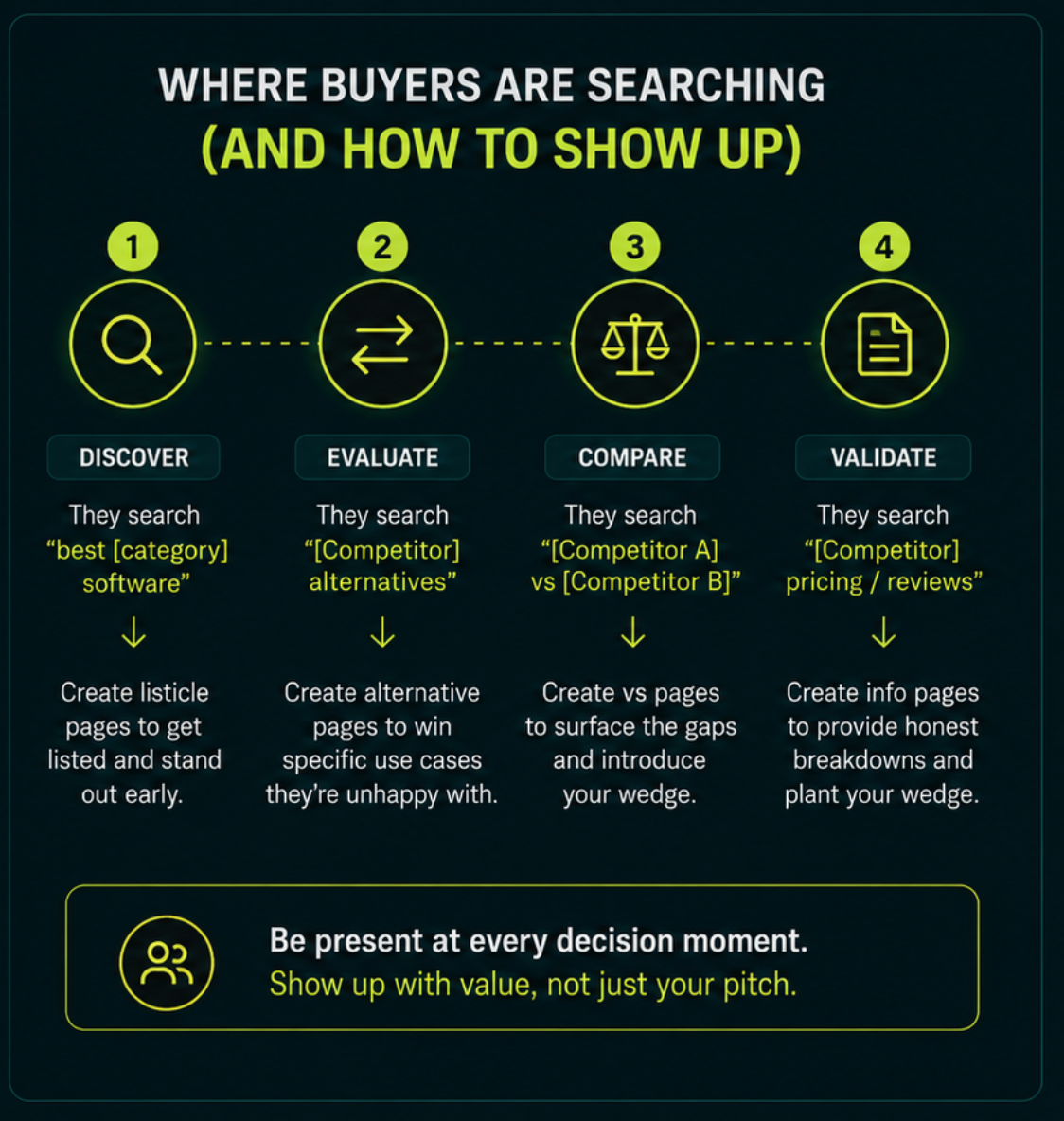
The four page types form a progression from broad discovery at the top to bottom-of-funnel decision moments at the very end.
Each page type serves a different buyer intent, so the way you mention competitors has to change accordingly across each page.
A Quick Comparison: 4 Types of Pages
Page 1: Listicle pages (e.g., "best CRM software," "best project management tools")
Buyers land on listicles early in their research. They want a shortlist. Visibility and sharp positioning are everything, because the page gets screenshot and used for demo bookings.
Every tool you list must own a distinct positioning, ICP, and market segment. No two entries should overlap or sound interchangeable.
Here's how to write each competitor entry:
- Map each competitor's stated positioning, ICP, and target market in detail before you write a single word about them
- Identify the unique market segment each competitor wins in, so no two tools sound interchangeable on the page
- Write your own entry to clearly own one specific ICP, feature angle, or use case the others do not cover
- Avoid listing any tool that is a direct ICP and has a positioning overlap with you. That only weakens your case
If two competitors feel similar in your draft, you have not researched their positioning deeply enough. Either drop one or rewrite your differentiation.
Page 2: Alternative pages (e.g., Best "[Competitor] alternatives")
Buyers searching for "[Competitor] alternatives" are actively trying to replace a tool. They have a real, specific frustration: pricing, missing features, scaling pain, support, and integration limits.
The goal is to identify the actual reasons users are leaving the competitor, then pitch your product against the specific use case where you win, never a generic "we are better" claim.
Here's what to research before you write:
- G2, Capterra, and TrustRadius reviews filtered to one to three stars to find recurring complaint patterns
- Reddit threads and community posts where users explain in plain words why they are leaving the competitor
- Feature gaps, pricing breakpoints, and scaling limits where the competitor consistently underdelivers for specific buyer profiles
- Adjacent tools that solve the same job differently, so your shortlist feels balanced and credible to readers
Your entry should be the alternative for one specific use case, specific wins beat broad claims.
Page 3: Vs pages (e.g., "[Competitor A] vs [Competitor B]")
Vs pages catch buyers in the final-round decision, often comparing two tools that might not be yours. They want validation for a call they have nearly made.
The goal is to give a fair, factual positioning summary of both competitors first, then introduce yourself through their shared blind spot.
Here's how to structure the page:
- Open with accurate positioning summaries of both tools so the reader trusts your objectivity from the very first paragraph
- Build a side-by-side feature, pricing, and ICP table that buyers can scan and absorb in under a minute
- Identify the shared positioning gap, whether an ICP, feature, or use case that neither competitor serves particularly well
- Introduce your product as the answer to that specific gap, with proof points and named outcomes, not adjectives
Never claim you beat both tools on every dimension. That breaks trust instantly and turns the comparison into a sales page.
"Trust is earned when brands acknowledge trade-offs instead of pretending they're the answer for everyone."
— Peep Laja, Founder, Wynter LinkedIn Profile
Page 4: Competitor info pages (e.g., "[Competitor] pricing," "[Competitor] reviews")
Buyers searching "[Competitor] pricing" or "[Competitor] reviews" want validation. They want an honest breakdown of cost, ratings, or limitations before they commit to a tool.
The goal is to be useful first, not promotional. The page should rank because it answers the query better than the competitor's own site does.
Here's what each variant needs:
- Pricing pages: full tier breakdown, hidden costs, scaling math, and where pricing breaks for which ICP profiles
- Review pages: an honest summary of G2, Capterra, Reddit and other community review patterns, both strengths and recurring user complaints
- Limitation callouts: specific use cases, ICPs, or scale points where the competitor underdelivers for certain buyer profiles
- A clear, non-aggressive bridge to your product, positioned for the ICP that the competitor does not serve, but you do
Honest beats promotional every time on these pages. Buyers can detect spin in the first paragraph and bounce.
A Simple Framework to Position Your Brand Without Bashing Competitors
Every competitor mentioned on your site should pass three filters before it goes live.
- Is the comparison factual and verifiable? Anything subjective should be backed by a specific feature, pricing tier, or public review pattern. Opinion is fine; unsupported opinion is not.
- Does your entry own a distinct ICP, use case, or positioning angle? If your description could be swapped with a competitor's and still read fine, you have not differentiated.
- Would you be comfortable if the competitor's CEO read this page? If yes, your tone is professional. If no, rewrite it before publishing anything live.
The strongest competitor pages help buyers self-select toward the right fit and away from the wrong one.
Frequently asked questions
1. Should I mention every competitor on my website?
No. The right list depends on the page type and where the buyer sits in their evaluation timeline.
On a listicle, include only tools whose positioning is meaningfully different from yours. On alternative or vs pages, focus on the named competitor and the closest adjacent tools.
2. Will writing about competitors hurt my brand image?
Not if it is done well. Buyers respect brands that engage with the competitive set honestly and openly.
The brand risk lives in tone, not topic. A factual comparison reads as professional. Pages that build straw men or insult competitors erode trust faster than silence.
3. How do I avoid sounding promotional on competitor pages?
Lead with utility. The first 60% of the page should answer the buyer's actual query without selling at all.
Read the page with your product name removed. If it still helps the buyer decide, the tone is right. If it falls apart, it was a pitch.
4. What if my product is genuinely worse than a competitor on some dimensions?
Say so directly. Specific concessions build buyer trust faster than blanket claims that try to gloss over real trade-offs.
Acknowledge where the competitor wins, then explain why your wedge matters more for a specific ICP or use case. No tool wins on everything; buyers already know that. Build your next growth channel before your competitors do. Book a demo.

I help B2B SaaS companies grow pipeline and visibility through strategy-led SEO, AI-powered execution, and content aligned to buyer journeys across key touchpoints and platforms.. With over 5 years of experience, I’ve led execution across the entire organic funnel, delivering measurable results aligned with business goals.
.png)
