


Key Takeaways
The 12 AI visibility monitoring tools we narrowed from our research are Profound, Peec AI, Scrunch, Cite AI, OtterlyAI, Rankability, Semrush, Ahrefs, Writesonic, Conductor, ZipTie, and SE Ranking. We have ensured that each of the 12 tools fit a particular use case, industry, scale or other factors that will align to your purchase needs.
- Profound and Writesonic connect AI answer tracking with content workflows
- Peec AI prioritizes citation gaps and actions teams can measure afterward.
- Semrush and Ahrefs combine AI visibility tracking with established SEO research, best for companies who are already investing in any of these platforms already.
- Scrunch specializes in AI crawler activity and agent-ready pages
- Conductor connects AI visibility with site health, analytics, and content operations.
- Cite AI, OtterlyAI, and ZipTie offer smaller-budget tracking options, with different strengths in simple monitoring, GEO audits, and flexible client pricing.
When someone asks ChatGPT for the best customer support software or compares data integration platforms in Perplexity, the answer will recommend several products based on the intent, use case and relevance of the prompt. .
Close to 94% of B2B buyers use AI at some point in their purchase journey. If your brand is missing from AI answers when your ideal customers look for a solution like yours, you risk being left off their shortlist. And even when your brand appears, a negative description or one that misrepresents who your product is best for can steer buyers toward a competitor.
AI visibility monitoring tools show you where your brand appears in AI answers and how it’s described. They also reveal which competitors AI platforms recommend, what use cases they recommend them for, and which sources they draw on when discussing each product.
But tracking mentions alone does not tell a marketing team what to do next.
A useful AI visibility audit checklist needs to answer three questions:
- Tracking: Which buyer prompts mention or cite your brand, and where are competitors appearing instead?
- Acting: Which content pages, technical issues, or third-party sources should your team work on to improve its visibility?
- Monitoring impact: Did your visibility change after those activities, and are AI search visits contributing to leads, demos, or other conversions?
Different GEO tools handle these activities differently. Some specialize in AI answer tracking and citation analysis. Others provide content optimization, automated workflows, outreach research, AI crawler analytics, or integrations with website performance data.
The choice also depends on how much attention AI search deserves alongside traditional SEO. In our How Big Is AI Search? research, we compared search demand across LLMs and traditional search engines. We estimated that standalone LLMs account for approximately 7.9% of global search-equivalent queries, compared with 92.1% for traditional search engines.
That represents around 45.9 billion monthly search-like queries across LLMs versus 535.2 billion searches across traditional search engines.
Google's AI Overviews also create AI exposure within traditional Google searches, so they should be tracked separately from standalone LLM usage.
For this guide, we reviewed 12 AI visibility monitoring tools using their product documentation, available pricing, tracking capabilities, optimization features, integrations, and customer feedback.
We have compared what each tool can track, how it helps teams act on the findings, and what it provides for monitoring results afterward.
The goal is to help you choose the right AI visibility monitoring tool that fits your B2B SaaS business, whether you need a focused brand tracker, competitor citation research, automated GEO execution, or a platform that connects AI search performance with your wider SEO program.
Quick comparison of the 12 best AI visibility monitoring tools in 2026

In-depth analysis of the 12 best AI visibility monitoring tools in 2026
1. Profound - Best for enterprise AI visibility and automated content workflows
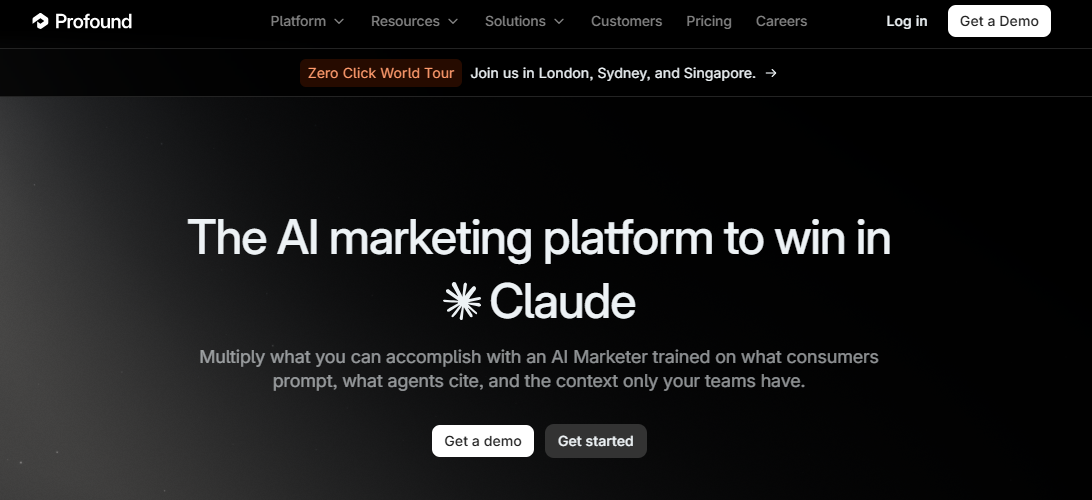
Profound is an AI marketing platform that combines AI search monitoring, audience research, and content automation. It is designed for marketing teams that need to understand how their brands appear in AI answers and use those findings to improve their content strategy.
Its Answer Engine Insights monitors brand mentions, citations, sentiment, competitive visibility, and the sources used in AI-generated responses.
Profound also provides Prompt Volumes, which uses anonymized data from opted-in consumer panels to identify questions people ask AI platforms. This helps marketers research potential buyer demand before deciding which prompts deserve ongoing tracking.
The platform connects this research with execution through Profound Agents. When a competitor receives recommendations for a relevant prompt, or a third-party publication is cited without mentioning the brand, an agent can investigate the opportunity and prepare a content brief, FAQ, new article, or existing-page update.
Teams can configure these workflows using brand knowledge, writing guidelines, and approval steps. The platform helps prepare and organize content activities, although publishing decisions and earned outreach placements still require appropriate review.
For monitoring, Profound continues tracking brand visibility and citations after content changes. Agent Analytics also examines AI crawler activity and identifiable AI referral traffic, helping teams understand whether increased AI exposure is accompanied by website visits or conversions.
This makes Profound more suitable for companies running an ongoing AI search optimization program than businesses that only need a small set of prompt-monitoring reports.
Key features
- Answer Engine Insights: Tracks brand mentions, sentiment, citations, competitor visibility, and inaccurate claims across supported AI platforms.
- Prompt Volumes: Uses anonymized consumer-conversation data to investigate buyer questions, topic demand, and search intent.
- Profound Agents: Creates content briefs, FAQs, articles, and page updates through configurable workflows with approval controls.
- Citation analysis: Identifies publishers, URLs, and other sources influencing AI answers, including opportunities for third-party mentions.
- Agent Analytics: Measures identifiable AI crawler activity, referral sessions, and website engagement through connected analytics.
Top 3 services
1. Answer Engine Insights
Profound monitors selected prompts across AI search platforms and records brand mentions, citations, sentiment, and competitor appearances. Teams use these reports to understand category visibility, investigate missing recommendations, and measure changes over time.
2. Prompt Volumes and audience research
Profound analyzes anonymized consumer-conversation samples to identify relevant questions, topic relationships, and intent patterns. This helps marketers prioritize prompts based on observed audience demand rather than relying entirely on manually generated keyword lists.
3. Agents and content automation
Profound uses brand context, citation research, and configurable agents to prepare content briefs, FAQs, articles, and page updates. Marketing teams can review suggested changes before they are published or distributed.
Pricing
Profound currently offers a free Trial and custom-priced Enterprise plan for brands. Agencies can choose Agency Growth, starting at $99/month, or request custom Agency Enterprise pricing.
Agency Growth's $99 monthly fee does not include a full ongoing client monitoring workspace. Each full client workspace costs an additional $399/month and supports 100 tracked prompts. An agency with one active client workspace would therefore pay approximately $498/month before other add-ons.
For brands that need ongoing monitoring of 50, 100, or 200 prompts, Profound does not currently publish a comparable subscription price. Businesses must request an Enterprise quote based on the number of prompts, AI engines, and automation requirements.
View Profound's current pricing
Best for
- Mid-market and enterprise marketing teams: Companies that need consumer prompt research, AI visibility monitoring, and repeatable content workflows.
- GEO agencies managing larger programs: Agencies that want to connect citation analysis with content production and client reporting.
What makes Profound different from other AI visibility tools?
Profound's main advantage is the connection between AI conversation research, answer monitoring, and content execution.
Its Prompt Volumes product helps teams understand which questions deserve attention. Answer Engine Insights then shows how brands appear in responses to those questions.
When the platform identifies a gap, Profound Agents can use the associated prompt, cited sources, competitor information, and brand knowledge to prepare content addressing it. This reduces the manual work between discovering an opportunity and producing a content update.
Profound also includes AI crawler and referral analytics, which gives marketers a broader view of how AI platforms interact with their websites.
However, Agent Analytics and prompt visibility measure different activities. A crawler visiting a page does not guarantee the page will appear in an AI answer.
Limitations
- Complex setup: Some G2 reviewers report difficulty configuring advanced workflows and onboarding larger teams.
- Content requires review: Generated articles, recommendations, and citations may need editing and fact-checking before publication.
- Higher costs at scale: Larger prompt allowances, additional workspaces, and advanced agent usage can increase the total subscription cost.
2. Peec AI - Best for actionable GEO recommendations and competitor citation gaps
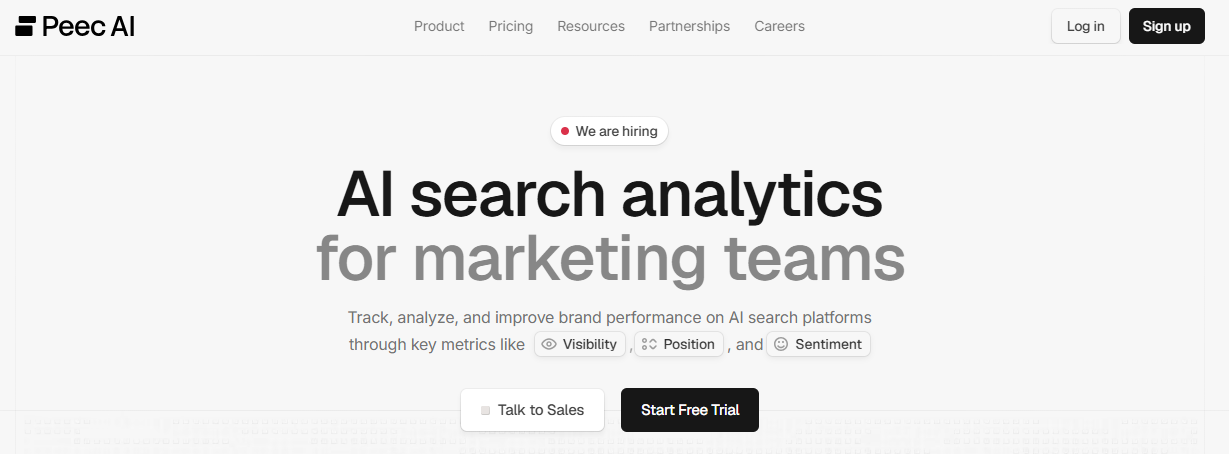
Peec AI is an AI search analytics platform for marketing teams that helps businesses track, analyze, and improve their brand performance across AI search platforms such as ChatGPT, Perplexity, and Gemini.
Its core analytics focus on three metrics: Visibility, Position, and Sentiment. Visibility measures how often a brand appears in AI answers, Position shows where it appears relative to competitors, and Sentiment analyzes how AI platforms describe the brand.
Teams can track relevant buyer prompts, compare competitors, and analyze the websites cited in AI-generated answers. Peec also suggests prompts and provides relative demand signals to help marketers identify which customer questions deserve attention.
Peec's main strength is connecting these insights with its Actions feature. It identifies missing brand mentions, competitor citation gaps, and content opportunities, then recommends activities such as updating existing pages, creating new content, correcting inaccurate information, or pursuing third-party mentions.
Its content editor and agent can help prepare some of these improvements, while marketing teams handle final reviews and external outreach.
After implementing changes, Peec's Impact view displays completed activities with subsequent changes in visibility, position, sentiment, and share of voice. This helps teams monitor whether their GEO activities are followed by improvements in AI search performance.
Key features
- AI visibility monitoring: Tracks brand mentions, position, sentiment, share of voice, and competitor appearances.
- Smart prompt suggestions: Recommends buyer questions and provides relative demand signals to support prompt selection.
- Citation analysis: Identifies the URLs and external sources appearing in AI answers, including competitor citation gaps.
- Actions and content editor: Suggests content updates, technical fixes, fact corrections, and editorial outreach opportunities.
- Impact reporting: Connects completed activities with subsequent visibility trends, supported by reporting and data integrations.
Top 3 services
1. AI visibility and competitor benchmarking
Peec monitors selected prompts across supported AI engines, recording mentions, sentiment, average position, and competitive share of voice. Teams can identify the questions where their brand receives recommendations and where competing products dominate.
2. GEO recommendations and citation opportunities
Peec analyzes tracked answers and cited sources to recommend content improvements, technical fixes, and third-party mentions. Its Actions feature helps teams prioritize these opportunities and prepare some of the required updates.
3. Impact monitoring and reporting
Peec places completed GEO activities alongside subsequent changes in brand visibility, sentiment, and share of voice. Marketing teams can export the data or connect it to client dashboards through supported integrations.
Pricing
Peec AI offers separate subscription plans for brands and agencies. Pricing depends on the number of tracked prompts, active AI models, projects, and reporting requirements.
Pricing for brands
All standard brand plans include daily tracking, unlimited users, competitor analysis, citation tracking, sentiment analysis, and recommended GEO actions.
Pro adds API access and expanded brand analysis. Advanced includes multi-country tracking and Looker Studio integration, while Enterprise supports custom prompt allowances and broader AI model coverage.
For businesses comparing plans by prompt volume:
- 50 prompts: Starter at €85/month. (upto 50 prompts)
- 100 prompts: Pro at €205/month. (from 51 to 150 prompts)
- 200 prompts: Advanced at €425/month. (from 151 to 350 prompts)
Pricing for agencies
Peec AI also offers credit-based plans for agencies managing multiple client brands.
Agency prompt allowances vary depending on the selected AI models and tracking frequency. These prompt counts reflect Peec's example configuration, not fixed allowances across every model combination.
Agency plans include centralized billing, client management, prospect-audit projects, and reporting capabilities.
Additional AI models: Brand subscribers can purchase extra model coverage without changing plans. Add-on prices start at €25/month for Starter, €55/month for Pro, and €115/month for Advanced, with annual billing.
Peec AI also offers an annual billing discount.
View Peec AI brand pricing | View agency pricing
Best for
- B2B SaaS marketing teams: Companies that need recommendations for improving content and citations, rather than only tracking mentions.
- SEO and GEO agencies: Teams managing ongoing client optimization work and reporting on activities completed.
What makes Peec AI different from other AI visibility tools?
Peec AI's main differentiator is connecting AI search analytics with actionable GEO recommendations and impact monitoring.
While its Visibility, Position, and Sentiment metrics show how a brand performs across AI search platforms, the Actions feature uses prompt-level data, competitor comparisons, and cited sources to identify what needs improvement.
For example, if a competitor appears more frequently in AI recommendations because a relevant comparison article mentions them, Peec can identify that citation gap and recommend it as an outreach opportunity.
Its Impact feature then places completed activities alongside changes in AI visibility and brand performance, helping marketers evaluate progress over time.
This makes Peec particularly useful for B2B SaaS marketing teams that need more than visibility reports and want clear recommendations their content and SEO teams can act on.
Limitations
- Prompt suggestions may overlap: Some G2 reviewers report needing to remove repetitive or less relevant prompts.
- Standard model coverage is limited: Paid brand plans allow three active AI models, which may be restrictive for companies tracking more platforms.
- Impact is not attribution: Completed-action markers help explain timing but cannot prove that a specific update caused a change in AI answers.
3. Scrunch - Best for AI agent traffic and AI-ready website experiences
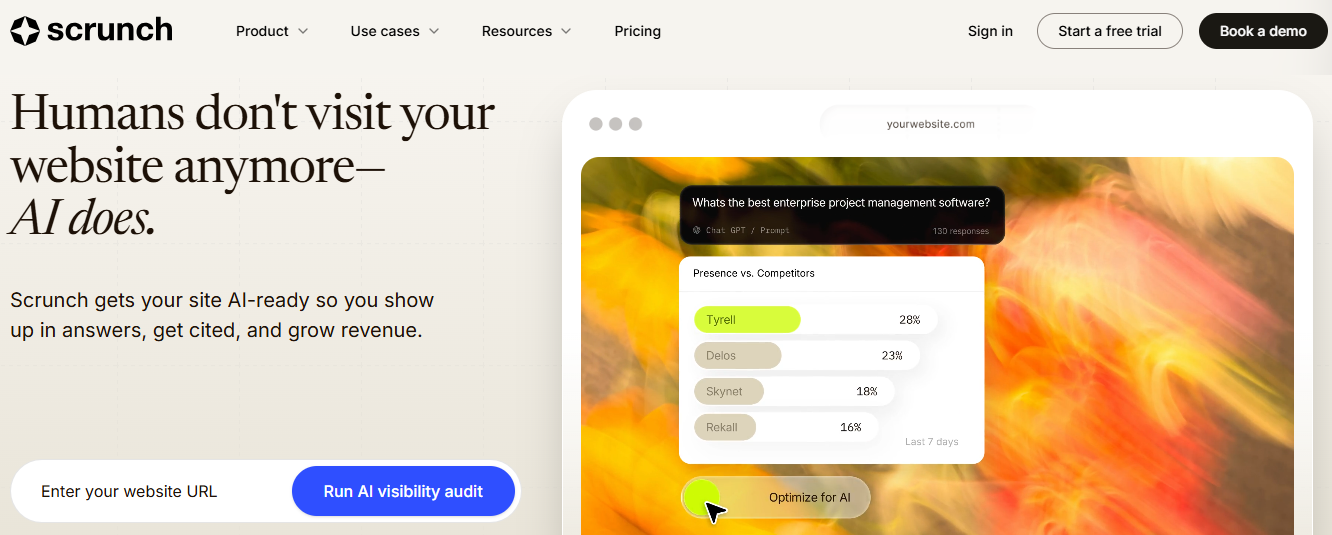
Scrunch is an AI visibility platform that monitors how brands appear in AI answers and how AI agents interact with their websites.
Its Monitoring & Citations features track brand presence, sentiment, competing products, and cited sources across selected buyer prompts.
Scrunch also examines what happens before an AI platform recommends or cites content.
Its Agent Traffic product records visits from identifiable AI bots and shows which pages they request. Where the available evidence supports it, Scrunch distinguishes activity associated with retrieval, indexing, and model training.
This helps marketing and technical teams investigate whether important product pages, documentation, and other resources are accessible to AI agents.
For execution, Scrunch's Site Optimization features identify accessibility problems, missing information, and content changes worth investigating.
Its most distinctive feature is the Agent Experience Platform (AXP).
AXP can provide simplified, structured versions of selected website content to supported AI retrieval agents while leaving the human-facing website experience unchanged.
For example, a B2B SaaS company with extensive JavaScript-based product documentation may use Scrunch to investigate whether AI retrieval agents can access the information customers need.
The company can then address technical problems or use AXP where appropriate to make supported content easier for those agents to retrieve.
Scrunch monitors changes in AI answers, citations, crawler activity, and available AI referral data after implementation.
Key features
- Monitoring & Citations: Tracks brand mentions, source citations, sentiment, and competing products across supported AI platforms.
- Agent Traffic: Identifies AI crawler visits and the website pages requested by recognized agents.
- AI Search Trends: Estimates changes in topic demand to support prompt selection and content research.
- Site Optimization: Identifies content structure and website accessibility problems affecting AI retrieval.
- Agent Experience Platform: Provides an AI-readable content delivery layer for supported retrieval agents.
Top 3 services
1. AI visibility and citation intelligence
Scrunch runs selected prompts across supported AI platforms to measure brand mentions, citations, sentiment, and competitor presence. Teams can establish a visibility baseline and investigate the external sources influencing AI answers.
2. AI agent traffic and site diagnostics
Scrunch records identifiable AI bot requests and reviews website accessibility. This helps technical and marketing teams locate pages that agents struggle to retrieve and prioritize changes to their content or delivery.
3. Agent Experience Platform
Scrunch's enterprise AXP provides structured website content to supported AI retrieval agents without replacing the pages seen by human visitors. It is intended for businesses managing technically complex websites or large content libraries.
Pricing
Brand Core includes 5,000 AI responses and five site audits per month.
A brand tracking 50 or 100 prompts can use Core. Tracking 200 prompts requires a custom brand plan or an agency configuration where appropriate.
AXP is available through Enterprise, not the standard Core plan.
Best for
- Mid-market and enterprise companies with complex websites: Particularly relevant for large documentation sites, JavaScript-heavy applications, and teams investigating AI crawler access.
- Technical SEO and GEO agencies: Useful when client work requires both AI answer monitoring and site-level diagnostics.
What makes Scrunch different from other AI visibility tools?
Scrunch's main advantage is its ability to investigate and change how supported AI agents access website content.
Most monitoring platforms focus on the answers generated after a prompt is submitted.
Scrunch adds evidence from crawler behavior and provides an infrastructure layer designed to improve content accessibility.
This distinction matters for websites where important information is difficult for automated agents to retrieve.
However, making content accessible does not guarantee a citation or recommendation. Companies still need to measure whether subsequent AI answers include the relevant pages.
Limitations
- Analytics integrations can be difficult: Some G2 reviewers report issues reconnecting GA4 or switching analytics properties.
- Reporting flexibility: Reviewers have requested longer histories, clearer benchmarks, and easier client reporting.
- AXP requires Enterprise: The standard $250 plan does not include the platform's main content delivery feature.
4. Cite AI - Best for affordable AI visibility tracking for startups
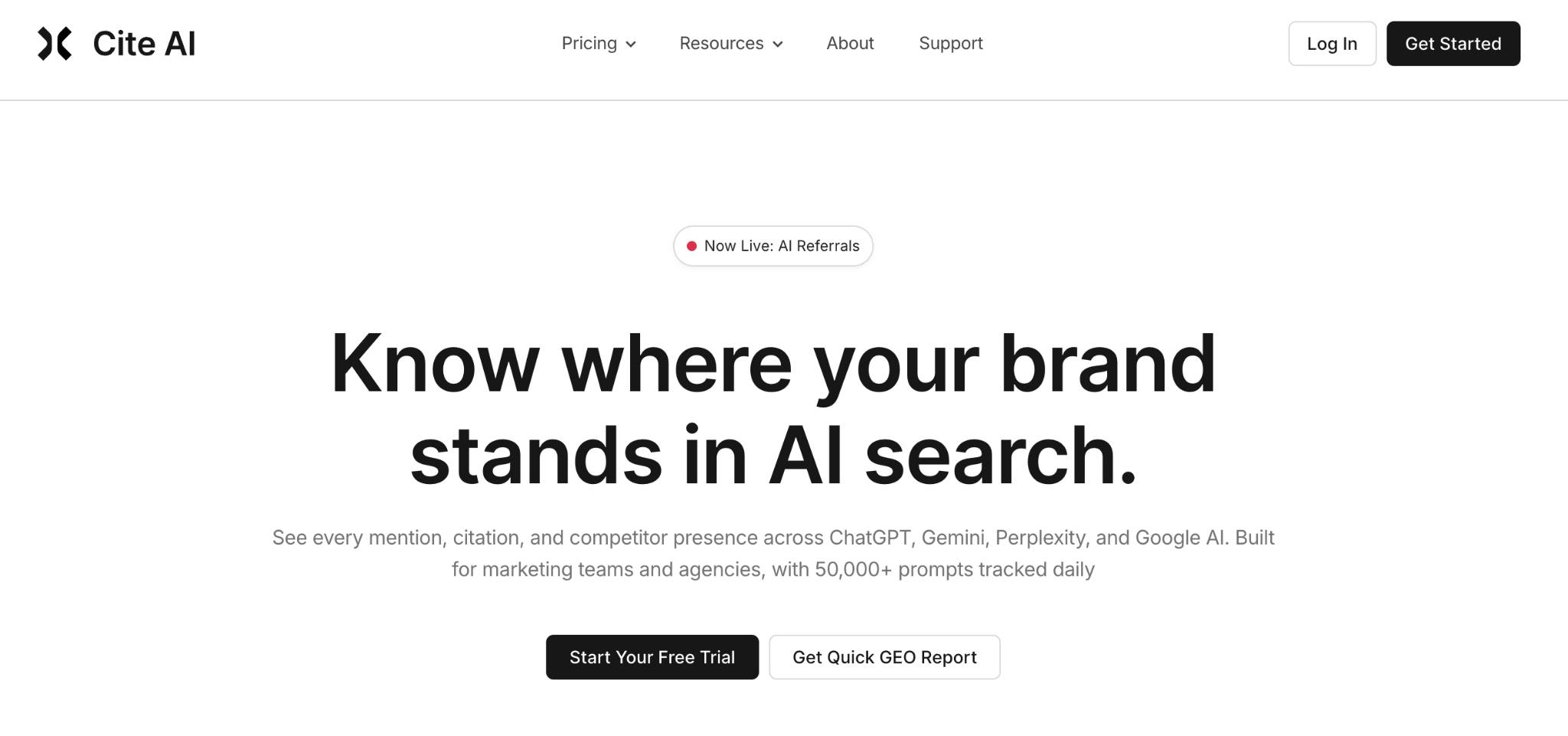
Cite AI is an AI visibility monitoring platform that helps businesses track how often their brands appear in AI-generated answers and how they compare with competitors.
Its main advantage is its low starting price and focus on core AI search measurements.
Users add a brand, select commercial prompts, and identify competing products. Cite AI then monitors brand mentions, average position, sentiment, share of voice, and website citations.
For a B2B SaaS startup, this could mean tracking questions such as "best customer onboarding software for small businesses" or "alternatives to [competitor]."
The platform shows whether the business appears in those answers, which competitors are recommended, and the websites cited as sources.
Cite AI's citation analysis can help teams investigate missing comparison articles, directories, and relevant third-party publications. It also documents an Actions area for organizing opportunities identified from source data.
However, the product is primarily a tracking and analysis platform. Marketing teams must create or update content and manage outreach themselves.
For performance monitoring, Cite AI provides historical visibility reports and a GA4-connected AI Referrals feature. This allows teams to compare changes in AI mentions and citations with identifiable visits arriving from AI platforms.
The results are useful for reporting, but a brand appearing in an AI answer does not necessarily mean a user clicked through to its website.
Key features
- Daily AI visibility tracking: Monitors brand appearances and average position for selected prompts.
- Competitor benchmarking: Compares mentions and share of voice against competing products.
- Citation analysis: Identifies referenced websites and URLs to support content and outreach research.
- Sentiment reporting: Tracks how AI-generated answers describe the brand over time.
- AI Referrals: Connects Google Analytics 4 to examine identifiable AI-origin traffic and conversions.
Top 3 services
1. AI visibility and position tracking
Cite AI monitors selected prompts daily, records AI responses, and measures mentions, sentiment, position, and share of voice. This helps smaller teams establish their baseline without extensive platform configuration.
2. Competitor and citation analysis
Cite AI compares brands appearing in tracked AI answers and identifies cited domains and URLs. Marketers can investigate missing product mentions, content gaps, and relevant third-party publications.
3. Historical monitoring and AI referrals
Cite AI stores visibility trends and connects with GA4 to report identifiable AI-referred sessions, engagement, and configured conversions. Teams can review traffic and answer visibility as separate performance measures.
Pricing
Cite AI offers separate pricing plans for brands and agencies, based on the number of tracked prompts, AI models, and projects.
Pricing for brands
Pricing for agencies
All standard plans include daily tracking, unlimited users, and a choice of three AI models from ChatGPT, Google AI Overviews, Google AI Mode, and Gemini.
Enterprise plans expand coverage to include Perplexity and Claude, with custom tracking and unlimited projects.
- For brands tracking 50 or 100 prompts, Growth at $90/month is the lowest qualifying plan.
- Tracking 200 prompts requires Scale at $275/month.
For agencies, Basic starts at $175/month and includes 200 tracked prompts across up to 10 projects, making it suitable for teams managing multiple clients.
View Cite AI brand pricing | View agency pricing
Best for
- Early-stage B2B SaaS startups: Teams that want to monitor a focused set of commercial prompts without committing to expensive SEO software.
- Budget-conscious agencies: Agencies delivering basic brand visibility and competitor reports for multiple clients.
What makes Cite AI different from other AI visibility tools?
Cite AI focuses on providing the measurements smaller teams need first.
It does not require businesses to purchase an extensive research database or an automated content platform.
Companies can select relevant buyer questions, inspect competitor recommendations, review citations, and monitor historical changes.
At $25 per month for 25 prompts, it offers one of the lowest published starting prices among the tools reviewed.
The trade-off is that content execution, outreach, and more advanced analysis remain largely outside the platform.
Limitations
- Prompt selection requires work: Teams may need to refine the initial suggestions to focus on commercially relevant questions.
- Limited model access: Standard plans allow three active AI models, with broader coverage restricted to higher-tier arrangements.
- No full GEO execution workflow: Cite AI identifies opportunities but does not manage content publishing or external outreach.
5. OtterlyAI - Best for AI prompt research and on-page GEO audits
OtterlyAI positions itself as a Content Intelligence Platform for AI Search, combining AI prompt research, brand visibility monitoring, content audits, and GEO optimization to help marketing teams improve their presence in AI-generated answers.
Its AI Prompt Research feature identifies relevant buyer questions, topics, and intent patterns from a website, product, or keyword. Teams can use these findings to determine which prompts matter to their business.
Through AI Search Analytics, OtterlyAI tracks brand coverage, share of voice, average position, citations, sentiment, and competitor visibility across supported AI platforms.
For execution, Content Audit and GEO Optimization examine AI crawler access, website structure, and content relevance. The platform identifies missing topics, technical accessibility issues, and page improvements that could help brands become more visible in AI search results.
Its Brand Profiling feature also analyzes how AI platforms describe a product, including attributes such as affordability, features, or implementation complexity. This helps B2B SaaS companies understand their brand perception alongside competitor positioning.
After implementing content improvements, teams can compare changes in visibility and citations through historical reports and activity annotations. Agent Analytics provides additional crawler insights on eligible plans.
OtterlyAI is particularly useful for SEO and content teams that want to connect AI prompt discovery, content intelligence, and GEO optimization within one platform, while managing content publishing and outreach themselves.
Key features
- AI Prompt Research: Generates buyer questions from products, URLs, or topics and organizes them by intent.
- AI Search Analytics: Tracks brand coverage, citations, sentiment, share of voice, and competitor mentions.
- Brand Profiling: Identifies attributes, objections, and product associations appearing in AI-generated answers.
- GEO Audits: Reviews crawler access, content structure, and missing information affecting AI search visibility.
- Agent Analytics: Examines recognized AI crawler activity and supports performance monitoring on eligible plans.
Top 3 services
1. AI search analytics and citation tracking
OtterlyAI runs selected prompts daily and measures brand coverage, citation performance, sentiment, and competitive share of voice. Teams can identify missing recommendations and compare results across supported AI engines.
2. AI prompt research and brand profiling
OtterlyAI generates buyer questions from relevant topics or URLs and groups them by intent. Brand Profiling examines the product attributes and objections AI platforms associate with the business.
3. GEO audits and content optimization
OtterlyAI examines AI crawler accessibility and page structure, then recommends improvements to existing content. Marketing teams can investigate cited sources and monitor subsequent visibility changes after making updates.
Pricing
OtterlyAI offers four pricing plans based on the number of tracked prompts and access to advanced AI search analytics features.
All standard plans include daily tracking across ChatGPT, Google AI Overviews, Perplexity, and Microsoft Copilot, along with unlimited users, brand visibility monitoring, sentiment analysis, citation tracking, and GEO recommendations.
Standard and Premium also include API access, MCP integration, and Agent Analytics. Businesses can add 100 extra tracked prompts for $99/month.
Claude, Google AI Mode, and Gemini are available as paid add-ons, rather than being included in the standard subscription.
For businesses comparing plans by prompt volume, Standard covers 50 or 100 prompts at 189/month(160/month with annual billing). Tracking 200 prompts requires Standard plus the 100-prompt add-on, costing $288/month before additional model charges.
Best for
- Startups and small SEO teams: Businesses starting with focused AI visibility tracking and prompt research.
- Mid-market SaaS content teams: Companies that want content audits and brand profiling alongside regular monitoring.
What makes OtterlyAI different from other AI visibility tools?
OtterlyAI connects prompt research with page-level GEO auditing.
A marketing team can discover relevant customer questions, identify which competitors appear in the answers, inspect the URLs being cited, and evaluate whether its own pages address those questions.
Its Brand Profiling feature adds another layer by examining how AI platforms describe the product.
This can be useful when a SaaS company appears frequently in recommendations but is associated with outdated information or inaccurate product positioning.
OtterlyAI provides the research and recommendations, while the company remains responsible for making the required changes.
Limitations
- Recommendations may need interpretation: Some G2 reviewers want more specific optimization instructions.
- Reporting limitations: Users have requested deeper historical analysis and more customizable reports.
- Additional model costs: Gemini, Google AI Mode, and Claude are not included in the standard four-engine subscription.
6. Rankability - Best for managing SEO and AI search optimization in one platform
Rankability is an SEO and AI search platform that combines visibility monitoring, content research, website audits, and content optimization.
It is particularly suited to marketing agencies that manage both traditional SEO and AI search activities for clients.
Its Tracker monitors brand mentions, citations, competitor presence, and sentiment across 11 AI platforms.
Rankability also tracks Google rankings and local search performance, giving teams a broader view of where their clients appear.
For execution, its Research product identifies relevant keywords, buyer questions, and competitor content gaps.
Teams can then use Create and Optimize to produce briefs, draft articles, and improve existing pages using client information and brand guidelines.
Its Auditor checks technical SEO issues, including crawler access, indexability, canonical tags, internal links, and page structure.
Rankability also provides Serena, an AI SEO assistant that uses connected client information and search data to suggest priorities and prepare supported tasks.
After making changes, marketers can monitor daily AI visibility, weekly Google ranking updates, citation trends, and audit findings.
Its Search Performance Index combines eligible AI and traditional search signals into a 0–100 score, although this score should not be interpreted as a direct measure of leads or revenue.
Key features
- AI and Google tracking: Monitors mentions, citations, sentiment, Google rankings, and local search performance.
- Keyword and topic research: Identifies buyer questions, competitor gaps, and relevant keyword opportunities.
- Content creation and optimization: Creates briefs and drafts and recommends improvements using brand-specific knowledge.
- Technical and page audits: Identifies website structure, indexability, and crawler accessibility issues.
- Serena AI assistant: Uses connected research and client data to recommend and support recurring SEO activities.
Top 3 services
1. AI search visibility and Google rank tracking
Rankability monitors mentions, citations, and sentiment across 11 AI platforms, alongside Google rankings and local search results. Agencies can compare performance across search channels and identify changes affecting their clients.
2. AI content research, creation, and optimization
Rankability researches buyer questions and competing content, then generates briefs and drafts using brand-specific information. Its optimization tools help improve existing pages for traditional search and relevant AI-generated answers.
3. Technical audits and AI strategy automation
Rankability audits website accessibility and SEO issues, identifies citation opportunities, and uses Serena to turn connected client data into prioritized recommendations and repeatable content or monitoring activities.
Pricing
Rankability offers monthly and annual subscriptions based on the number of tracked AI queries, content projects, and SEO audit allowances.
All paid plans include daily tracking across 11 AI platforms, unlimited workspaces and team members, keyword research, branded reporting, and API/MCP access.
Annual billing saves two months compared with monthly payments. Annual subscribers also receive their full yearly content-project and audit allowances upfront.
- For businesses tracking 50 or 100 AI queries, Starter costs 97/month (80.83/month with annual billing).
- Tracking 200 queries requires Growth at 297/month (247.50/month with annual billing).
Google keyword tracking has separate allowances of 50, 150, and 250 keywords for Starter, Growth, and Pro, respectively, with weekly ranking updates.
Best for
- SEO agencies and consultants: Teams managing several client websites, content programs, and search reporting requirements.
- Small to mid-market marketing teams: Companies that want AI monitoring alongside regular SEO research and execution.
What makes Rankability different from other AI visibility tools?
Rankability connects AI monitoring with the daily work involved in running SEO campaigns.
Its users can research a topic, track relevant prompts, produce content, audit the website, and monitor performance through one product.
Serena adds support for interpreting connected client information and converting findings into recommended tasks.
For B2B SEO agencies already managing Google rankings, content production, and technical SEO, this can reduce the need for separate software products.
Rankability is therefore more relevant to teams that actively produce and optimize content than companies looking only for AI visibility reporting.
Limitations
- Learning curve: Some G2 reviewers report needing time to understand the platform's expanding feature set.
- Automation usage: Teams may need to monitor content and automation allowances carefully during high-volume campaigns.
- Local tracking accuracy: Individual reviewers have reported occasional geographic mismatches in local ranking results.
7. Semrush - Best for combining SEO and AI visibility with large-scale prompt intelligence
Semrush is a search marketing platform that combines traditional SEO research with AI visibility monitoring.
Its AI Visibility Toolkit helps businesses investigate how their brands appear in ChatGPT, Gemini, Perplexity, Google AI Overviews, and other supported AI search experiences.
Semrush's main strength is its large prompt research database and existing SEO intelligence.
It reports a dataset of more than 317 million AI prompts and responses, which marketers can use to identify buyer questions, estimate AI topic demand, compare brands, and investigate cited sources.
Its Prompt Research supports the discovery stage, while Prompt Tracking monitors custom questions daily.
For tracking, Semrush measures brand mentions, citations, average position, share of voice, and sentiment.
Its Brand Performance features help marketers understand the attributes AI platforms associate with a brand, including recurring strengths, weaknesses, and product positioning.
For execution, marketers can use Semrush's keyword research, Site Audit, and content tools to address missing topics or improve existing pages.
Its separate AI PR offering supports research into influential publishers and journalist outreach, making it possible to connect citation findings with external brand mention activities.
After implementing changes, teams can review AI visibility trends alongside Google rankings, web traffic, and other reporting data.
This makes Semrush particularly useful for companies already managing an established SEO program that want to incorporate AI search measurement into the same research and optimization process.
Key features
- AI Visibility Overview: Measures brand mentions, citations, competitor visibility, and share of voice.
- Prompt Research: Analyzes large-scale AI prompt data, intent, topic demand, and competing brands.
- Brand Performance: Examines sentiment, brand attributes, and the questions influencing AI perception.
- Daily prompt tracking: Monitors selected buyer questions and cited sources over time.
- SEO and AI PR tools: Supports content audits, technical improvements, publisher research, and outreach.
Top 3 services
1. AI visibility tracking and competitor benchmarking
Semrush monitors selected prompts, brand mentions, citations, and competing products across supported AI search platforms. Teams can identify commercial questions where competitors appear more frequently and follow those results over time.
2. AI prompt research and brand sentiment
Semrush researches audience questions using its large AI prompt dataset, estimates topic demand, and examines how AI platforms describe brands. This helps teams identify missing subjects and product positioning problems.
3. SEO content optimization and digital PR
Semrush connects AI citation gaps with website audits, content research, and optional AI PR activities. Teams can improve relevant pages, investigate influential publishers, and assess subsequent search and AI visibility changes.
Pricing
Semrush offers two ways to track AI visibility: a standalone AI Visibility Toolkit and Semrush One, which combines traditional SEO with AI search monitoring.
AI Visibility Base provides brand mentions, competitor analysis, prompt research, sentiment tracking, and AI readiness audits. However, it does not include Semrush's broader SEO research and optimization capabilities, making it less suitable for teams that also want to act on AI visibility findings through traditional SEO workflows.
Semrush One Starter combines AI visibility monitoring with keyword research, competitor analysis, technical site audits, and Google rank tracking. Pro+ adds content optimization, historical SEO data, and more tracking capacity.
For businesses tracking 50, 100, or 200 prompts, Semrush One Starter, Pro+, and Advanced provide the corresponding allowances.
Additional users, AI PR tools, and advanced reporting may require separate subscriptions.
View Semrush One pricing | View AI Visibility Toolkit pricing
Best for
- Mid-market SEO teams and agencies: Companies already using keyword research, content optimization, and technical SEO.
- Large marketing organizations: Teams requiring broad competitive research, multiple markets, and coordinated reporting.
What makes Semrush different from other AI visibility tools?
Semrush combines a large AI prompt research dataset with established keyword, backlink, and competitor data.
This allows marketers to investigate AI search demand before deciding which prompts to monitor.
For example, a B2B SaaS company can research prompts related to customer onboarding software, compare which brands receive recommendations, identify cited publishers, and examine the related Google search opportunities.
The company can then plan content improvements or use Semrush's optional PR tools to pursue relevant third-party coverage.
Semrush has also published an eAccountable customer case study reporting a 100% increase in combined AI share of voice, 282 additional citations, and 17% higher branded organic traffic.
These are vendor-reported campaign results, not guaranteed outcomes from the standard AI Visibility subscription.
Limitations
- High subscription costs: G2 reviewers frequently mention pricing as a challenge for smaller teams.
- Additional modules: AI PR, advanced reporting, and extra users can increase overall costs.
- Complex interface: Teams may need time to understand the different AI research, tracking, and SEO reports.
8. Ahrefs - Best for AI visibility research backed by SEO and backlink data
Ahrefs is an SEO and AI search analytics platform that helps marketing teams investigate brand visibility, competing products, and the websites influencing search results.
Its main AI product, Brand Radar, includes a large index of AI responses and separate custom prompt monitoring.
Ahrefs reports a database of more than 500 million search-backed AI prompts. It builds this research dataset using search demand, related questions, and other query-expansion methods.
This distinction matters. The dataset is not a complete record of real conversations happening inside AI applications.
For tracking, Brand Radar measures mentions, citations, estimated impressions, and share of voice. Its Custom Prompt Tracking monitors selected buyer questions, brand sentiment, competitors, and cited sources.
For execution, Ahrefs connects this information with its existing SEO products.
Site Explorer and Content Explorer help marketers investigate websites that receive citations, evaluate their backlink profiles, and identify possible outreach opportunities.
The optional AI Content Helper analyzes search intent and competing content to suggest improvements to existing pages.
For impact monitoring, Ahrefs provides Web Analytics, which separates identifiable AI referral visits from other traffic sources.
Its Bot Analytics product also examines activity from recognized AI crawlers, helping teams understand which pages agents request.
This makes Ahrefs relevant to marketing teams that need broad AI visibility research alongside detailed SEO and backlink analysis.
Key features
- Brand Radar AI Visibility Index: Investigates brand appearances across a large collection of search-backed AI prompts.
- Custom Prompt Tracking: Monitors selected questions, citations, competitors, and sentiment.
- Citation and backlink research: Connects frequently cited sources with website authority and backlink data.
- AI Content Helper: Reviews search intent and topical coverage to recommend content improvements.
- Web and Bot Analytics: Measures identifiable AI referral visits and recognized AI crawler activity.
Top 3 services
1. AI visibility and competitor monitoring
Ahrefs uses Brand Radar to compare mentions, share of voice, citations, and estimated impressions across AI search platforms. Teams can also monitor their own high-priority prompts on a recurring schedule.
2. Citation research and content optimization
Ahrefs identifies influential cited domains, competing pages, and backlink opportunities using Brand Radar and its SEO databases. AI Content Helper recommends improvements based on search intent and topical coverage.
3. AI referral and crawler analytics
Ahrefs combines prompt tracking with Web Analytics and Bot Analytics to examine changes in mentions, cited pages, identifiable AI referral visits, and crawler behavior after content or outreach activities.
Pricing
Ahrefs includes AI prompt tracking in its main SEO subscriptions, alongside keyword research, backlink analysis, site audits, and Brand Radar access.
All three plans include API and MCP access, Google keyword tracking, and AI prompt monitoring.
AI prompt checks are different from tracked prompts. Each check represents a prompt execution, so the number of prompts a business can monitor depends on the AI platforms, locations, and tracking frequency selected.
Ahrefs also offers separate custom prompt tracking packages and Brand Radar AI visibility indexes for businesses requiring broader coverage.
Best for
- Mid-market and enterprise SEO teams: Businesses that need AI citation research connected with keyword and backlink intelligence.
- SEO agencies and content marketers: Teams already using Ahrefs for competitor research and link-building campaigns.
What makes Ahrefs different from other AI visibility tools?
Ahrefs allows companies to research broad AI visibility without first creating their own prompt library.
Through Brand Radar, marketers can investigate brands, topics, cited websites, and competing products within an existing AI response index.
This is useful when a business is entering a new software category or wants to identify questions it has not considered tracking.
The findings can then be connected with keyword demand, organic search performance, and backlink research.
For example, if a third-party software comparison article receives frequent AI citations, Ahrefs can help a marketing team examine its search performance and backlink profile before deciding whether to produce similar content or investigate an editorial opportunity.
The main advantage is the connection between AI citation research and a large established SEO dataset.
Limitations
- Additional costs: G2 reviewers frequently mention expensive subscriptions and usage charges.
- Check-based pricing: Tracking more platforms, locations, or frequent prompts consumes more checks.
- Estimated data requires validation: AI impressions and traffic estimates are modeled; important findings should be checked against original responses and analytics.
9. Writesonic - Best for automated GEO content and citation outreach
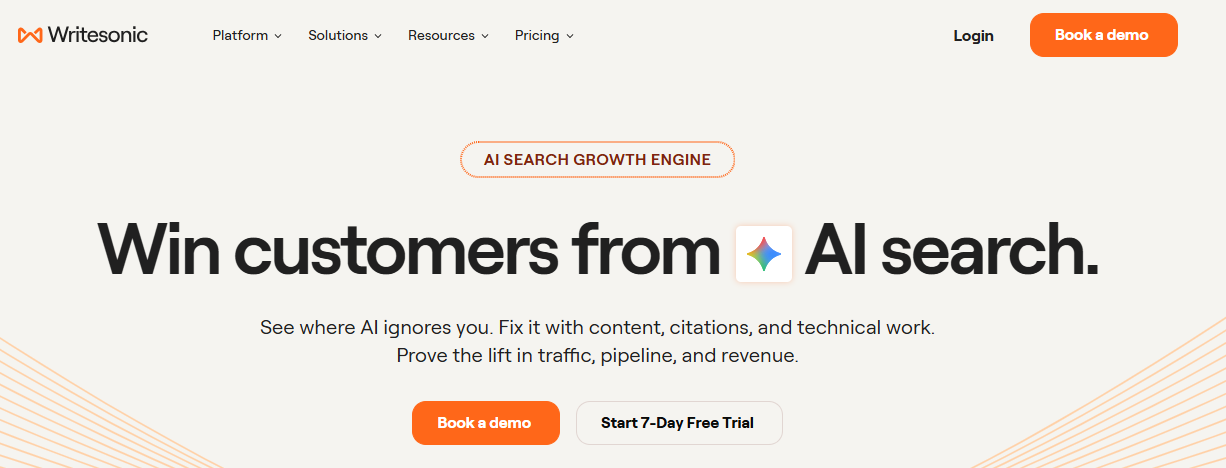
Writesonic is an AI visibility and content optimization platform that helps businesses monitor AI recommendations and take action on the problems identified.
Its approach follows an AI Search Loop: Track → Prioritize → Act → Measure.
For tracking, its AI Visibility Monitoring records brand mentions, citation share, competitor recommendations, and sentiment across supported AI platforms.
Its AI Brand Explorer also allows marketers to research competing brands without first configuring a tracking project.
Writesonic says its AI research dataset includes more than two billion conversations. Its AI Search Volume product uses this data to estimate prompt demand and identify relevant topics.
For execution, the Action Center identifies missing prompts, competitor citations, content gaps, and technical issues.
It organizes those findings into prioritized activities that marketing teams can address through content creation, existing-page updates, technical fixes, or outreach.
Writesonic's AI agents can help generate content, update pages, and prepare changes. Its Enterprise Outreach Agent supports efforts to contact third-party publications and sources already appearing in AI citations.
After changes are implemented, Writesonic tracks AI visibility and citation performance, with its documented workflow reviewing changes at 14 and 28 days.
Its higher-tier integrations can also connect identifiable AI referral visits with website conversions and pipeline reporting.
This makes Writesonic suitable for companies that want to execute GEO activities from the same platform used to identify opportunities.
Key features
- AI visibility monitoring: Tracks mentions, citations, competitor appearances, and sentiment on supported plans.
- Prompt Volume and Brand Explorer: Researches category demand and competing brands using its proprietary dataset.
- Action Center: Prioritizes missing content, citation opportunities, and technical issues.
- Content agents: Help create articles, refresh pages, and prepare SEO improvements.
- Outreach Agent: Supports third-party mention opportunities and outreach workflows on Enterprise.
Top 3 services
1. AI visibility and competitor monitoring
Writesonic monitors selected buyer prompts across supported AI interfaces and records mentions, citations, sentiment, and competing brands. Teams can identify commercially relevant questions where their brand is missing.
2. AI content optimization and citation outreach
Writesonic's Action Center organizes content, citation, and technical opportunities. Its agents help prepare articles, page improvements, and external outreach, with full execution capabilities depending on the selected subscription.
3. AI visibility impact monitoring
Writesonic compares mentions and citation share after completed activities. Enterprise reporting can connect AI referral traffic with conversions and pipeline, helping teams review outcomes while recognizing the limits of attribution.
Pricing
Starter and Basic include monitoring across ChatGPT, Gemini, and Google AI Overviews, along with AI article creation and website audits.
Growth adds sentiment analysis and limited Action Center access.
Full Action Center access, automated outreach, and expanded platform coverage require Enterprise.
Best for
- Mid-market B2B SaaS companies: Marketing teams wanting to connect visibility tracking with content production and ongoing GEO improvements.
- Enterprise brands and GEO agencies: Organizations needing larger campaigns, outreach automation, and more extensive reporting.
What makes Writesonic different from other AI visibility tools?
Writesonic focuses on converting visibility findings into work the marketing team can execute.
If a competing product appears frequently in a third-party article cited by ChatGPT, Writesonic can identify that article as an opportunity and help prepare outreach through its Enterprise workflows.
If an existing page lacks information relevant to commercial prompts, its content agents can help create additional sections or refresh the page.
The platform also monitors subsequent visibility changes, allowing teams to review which activities were followed by improvements.
Its largest advantage is the connection between monitoring and execution. However, businesses should evaluate the actual plan inclusions carefully, because the complete workflow is not available at the entry price.
Limitations
- Advanced GEO features are expensive: G2 reviewers mention pricing and usage restrictions.
- Generated content requires editing: Technical articles and product claims still need fact-checking and brand review.
- Standard plans have limited execution features: Full outreach and advanced Action Center capabilities require Enterprise.
10. Conductor - Best for enterprise AI visibility and content performance measurement
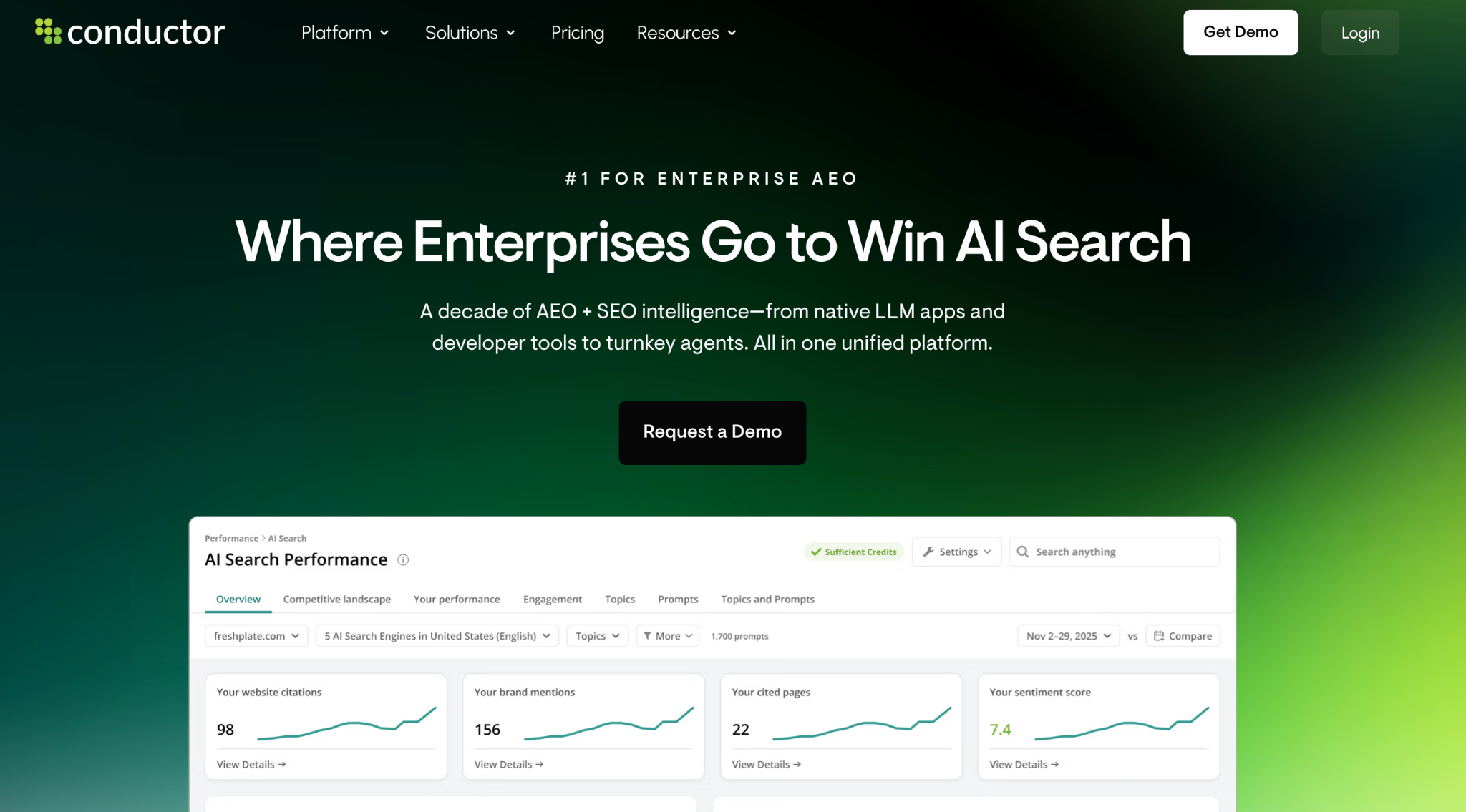
Conductor is an enterprise SEO and AI search optimization platform that connects AI visibility reporting with content creation, technical site monitoring, and website analytics.
It is designed for organizations managing large websites, multiple brands, and established SEO and content teams.
Conductor provides three connected products: Conductor Intelligence, Conductor Creator, and Conductor Monitoring.
For tracking, Conductor Intelligence measures brand mentions, citations, sentiment, and competitor share of voice across supported AI platforms. It allows teams to organize prompts by topic, location, customer persona, and intent.
Conductor uses official AI platform APIs where supported and combines response data with Google Search Console, traditional rankings, and website analytics.
For execution, Conductor Creator uses its research findings to recommend content opportunities and help produce briefs and drafts.
Its Writing Assistant works with company knowledge and brand guidelines, while Content Score evaluates how well content addresses relevant topics.
Conductor Monitoring adds continuous technical website checks. It can detect changes that affect crawling, indexability, page accessibility, or other technical conditions influencing search performance.
For monitoring results, Conductor connects AI visibility with website engagement, traffic, and conversion reporting.
This makes it useful for organizations trying to understand whether increased AI citations and recommendations are accompanied by changes in measurable business performance.
Key features
- AI Search Performance: Tracks mentions, citations, sentiment, and competitive visibility for selected prompts.
- Unified reporting: Connects AI search data with traditional rankings, Search Console, and website analytics.
- AI Topic Map: Identifies missing topics and content opportunities based on audience and competitor research.
- Writing Assistant and Content Score: Supports content production and evaluates topical coverage.
- 24/7 website monitoring: Detects technical problems and website changes affecting search performance.
Top 3 services
1. Enterprise AI visibility and competitor intelligence
Conductor Intelligence monitors brand mentions, citations, sentiment, and competitive visibility for selected AI prompts. It connects these findings with SEO and website analytics to identify opportunities across topics and markets.
2. AI content creation and optimization
Conductor Creator converts research findings into briefs and content drafts using approved company knowledge. Its Content Score evaluates topical coverage and search intent, helping editorial teams improve pages before publication.
3. Technical monitoring and performance analytics
Conductor Monitoring detects website changes and technical issues that may affect search performance. Teams can investigate those events alongside AI visibility, referral traffic, engagement, and conversions to explain performance movements.
Pricing
Conductor provides custom pricing for Essentials, Growth, and Enterprise.
Conductor uses AI Search Credits, not a fixed prompt allowance.
Each AI response consumes a different number of credits depending on the platform. For example, the reviewed documentation lists one credit for a ChatGPT Auto response and two for Gemini.
For 50 ChatGPT Auto prompts monitored weekly over 52 weeks, a team would need approximately 2,600 credits annually.
This is slightly above the listed 2,500-credit allowance, so teams should use Conductor's credit estimator before selecting their monitoring configuration.
Best for
- Enterprise and multi-brand businesses: Companies with large websites, multiple teams, and complex reporting requirements.
- Established mid-market marketing teams: Organizations wanting AI visibility connected with content production, technical monitoring, and business analytics.
What makes Conductor different from other AI visibility tools?
Conductor's advantage is its connection between AI visibility, content operations, technical monitoring, and website performance.
For example, a company may publish new product comparison pages and later observe an increase in AI citations. Conductor can help the team review those citations, examine the related prompts, and compare website traffic or conversion trends.
If visibility declines following a website deployment, its technical monitoring tools can help investigate whether changes to the site affected accessibility.
This creates a more connected reporting process for businesses managing substantial SEO programs.
Its API-first approach also supports enterprise data governance, although API-based responses may differ from personalized answers in consumer AI interfaces.
Limitations
- Steep learning curve: G2 reviewers report that implementation and advanced reporting can require onboarding.
- Reporting and data concerns: Some users have questioned AI visibility accuracy or requested easier dashboard customization.
- Custom pricing: Teams must request a quote and estimate their engine-specific credit requirements.
11. ZipTie.ai - Best for flexible AI visibility monitoring across multiple clients
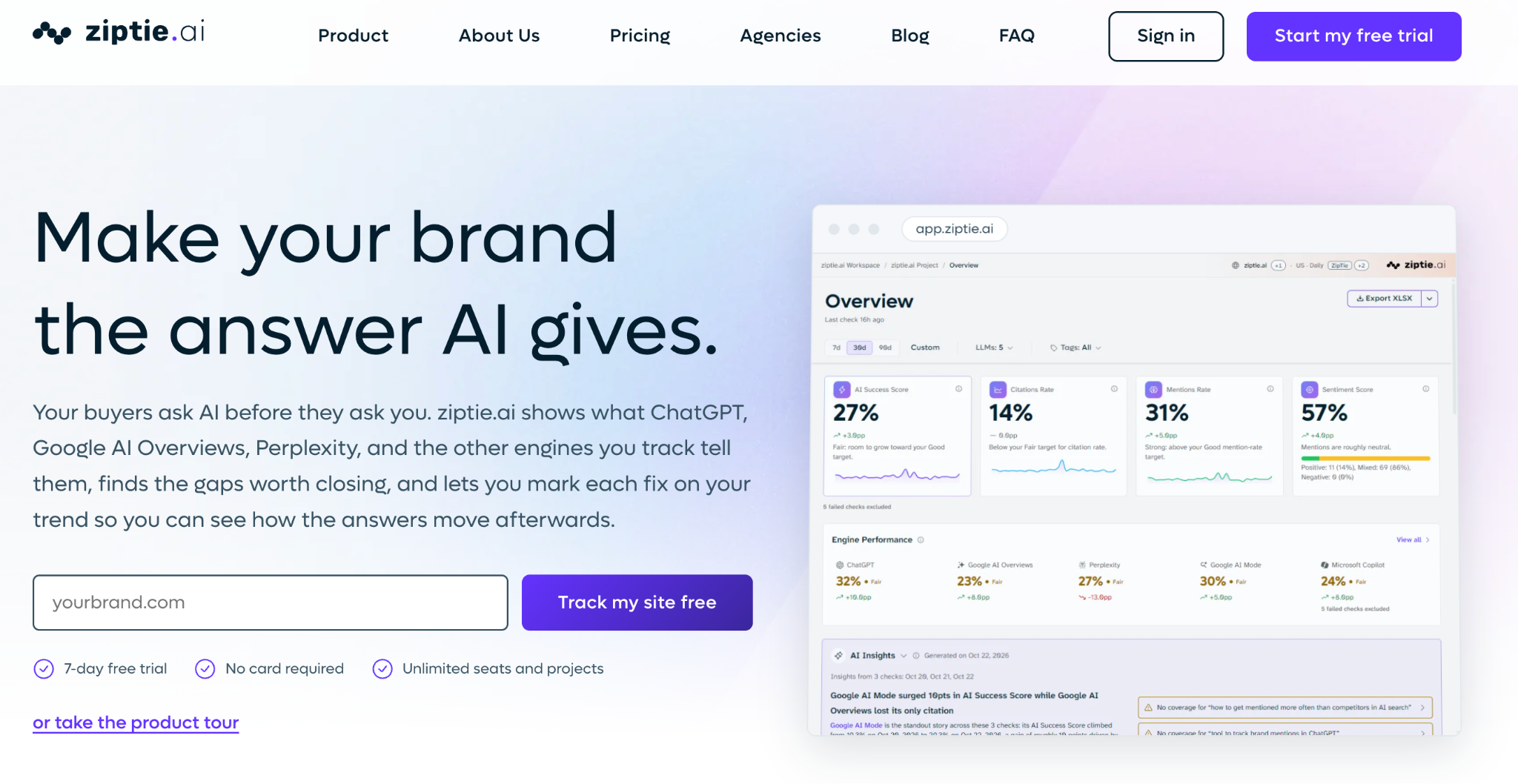
ZipTie.ai is an AI search monitoring platform focused on helping businesses understand what AI search engines say about their brands and how those results change over time.
Its main strength is flexible pricing and transparent visibility measurement.
Instead of charging separately for users, clients, and projects, ZipTie prices monitoring according to the number of prompts, selected AI engines, and tracking frequency.
The platform supports seven AI search engines, including ChatGPT, Perplexity, Gemini, Google AI Overviews, Google AI Mode, Microsoft Copilot, and Bing AI Overview.
Teams can choose how often to track AI prompts, daily, weekly, or monthly, depending on their importance.
For tracking, ZipTie's Project Wizard helps users identify relevant buyer questions. The platform then captures full AI answers and measures brand mentions, citations, sentiment, and competing products.
Its AI Success Score combines these measurements into a 0–100 trend, while allowing users to inspect the responses behind individual scores.
For execution, the Action Center identifies prompts where a brand is missing, citations that have declined, and competitors gaining visibility.
An optional Content Generation module turns relevant prompts into briefs and drafts using the company's information and writing style.
Its UGC Impact Analysis examines cited Reddit threads, YouTube videos, and other third-party sources to help marketers understand which discussions influence AI answers.
After publishing changes, teams can record the implementation date and compare subsequent visibility results. ZipTie also connects Google Search Console, allowing marketers to review organic search performance alongside AI visibility.
Key features
- AI Success Score: Combines mentions, citations, and sentiment into a historical performance metric.
- Flexible prompt monitoring: Supports daily, weekly, or monthly tracking across seven AI engines.
- Competitor and citation analysis: Identifies competing brands and cited websites within monitored AI answers.
- Action Center and Content Generation: Recommends areas to investigate and optionally creates content drafts.
- UGC Impact Analysis: Examines cited Reddit discussions, YouTube videos, and other external sources.
Top 3 services
1. AI visibility and citation monitoring
ZipTie records full AI responses for selected prompts and measures mentions, cited URLs, sentiment, and competitor presence. Its AI Success Score summarizes results while preserving the evidence behind each metric.
2. AI content research and optimization
ZipTie's Action Center identifies missing mentions and declining citations. Its optional Content Generation feature creates briefs and drafts using company-provided information, with verification and human review before publication.
3. AI visibility performance reporting
ZipTie compares visibility trends before and after recorded changes and places Search Console data alongside AI results. Teams can investigate differences while recognizing that historical comparisons do not establish causation.
Pricing
ZipTie offers flexible pricing based on tracked prompts, AI engines, and monitoring frequency. Businesses can start with a preset configuration or customize their plan.
These are example configurations, not fixed plan limits. Teams can adjust their prompt volume, tracking frequency, and AI engine selection, which changes the subscription price.
ZipTie supports seven AI engines, including ChatGPT, Google AI Overviews, Perplexity, Google AI Mode, Microsoft Copilot, Bing AI Overview, and Gemini. All plans include unlimited users, projects, competitors, client reports, and Google Search Console and GA4 connections.
Optional add-ons include:
- UGC Impact Analysis: Adds 80% to the base monitoring cost for deeper analysis of Reddit, YouTube, and other cited third-party sources.
- Content Generation: $20/month per brand or product context.
- API and MCP access: $10/month.
ZipTie offers 5% off quarterly billing, 10% off semi-annual billing, and 20% off annual billing on the prompt-tracking subtotal. Flat-priced add-ons are not discounted.
A seven-day free trial includes 25 daily prompts across three AI engines, without requiring a credit card.
Best for
- Startups and small businesses: Teams needing affordable monitoring without purchasing a larger SEO platform.
- Agencies with multiple clients: Companies that want shared prompt allowances, unlimited project access, and client reporting.
What makes ZipTie different from other AI visibility tools?
ZipTie stands out for its flexible pricing and transparent reporting methodology.
SaaS SEO agencies can monitor high-priority buyer prompts daily for one client and less urgent informational prompts weekly for another without buying separate subscriptions for each project.
ZipTie also avoids treating the order of brands within a single ChatGPT answer as a stable search ranking.
Instead, it measures how frequently brands are mentioned and cited across repeated checks.
The platform excludes failed checks from its rates and allows users to inspect the underlying AI responses.
This makes it useful for teams that need practical monitoring and client reporting without more expensive content automation features.
Limitations
- Manual execution: ZipTie does not automatically publish content or conduct third-party outreach.
- No direct revenue attribution: It tracks changes in AI visibility but cannot prove which activities generated conversions or revenue.
- Cross-client reporting restrictions: Reports are project-specific, and shared links retain elements of ZipTie branding.
ZipTie does not yet have enough published G2 reviews to support a meaningful customer-feedback assessment. These limitations come from its documented product functionality.
12. SE Ranking - Best for affordable SEO and AI visibility monitoring with agency reporting
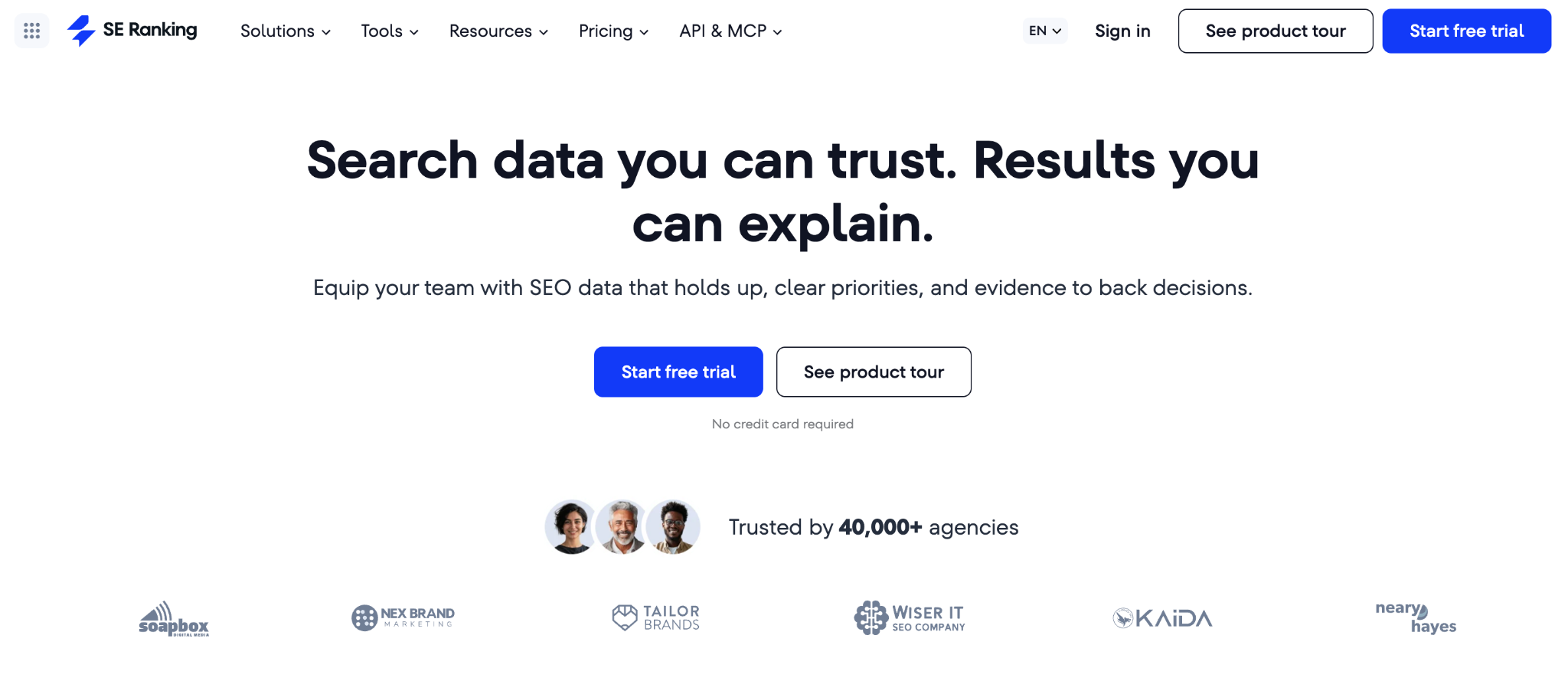
SE Ranking is an SEO platform that combines keyword research, rank tracking, website audits, and competitor analysis with AI search visibility monitoring.
Its dedicated AI visibility product, SE Visible, helps businesses understand how their brands appear across major AI search engines.
The platform is particularly relevant to companies that want AI monitoring connected with their existing SEO work.
For tracking, SE Visible monitors brand mentions, citations, sentiment, share of voice, and competitor appearances across supported AI engines.
It tracks selected buyer prompts daily and stores the generated answers for historical comparisons.
SE Visible also provides prompt research and citation analysis. Teams can investigate which questions recommend competing products, which pages appear as sources, and where their brand is missing.
For execution, SE Ranking connects these findings with keyword research, website audits, and content optimization tools. Its Content Editor helps marketers improve existing pages, while website audits identify technical problems affecting search accessibility.
The platform does not independently execute editorial outreach or publish all recommended content changes.
For monitoring, SE Visible shows changes in AI mentions, citations, sentiment, and competitive visibility. SE Ranking also connects with Google Analytics and Search Console and supports external reporting through APIs, MCP, and integrations.
This makes SE Ranking useful for agencies and smaller marketing teams that want AI visibility monitoring alongside traditional SEO analysis without buying an enterprise-focused platform.
Key features
- AI visibility tracking: Monitors brand mentions, citations, sentiment, and share of voice.
- Prompt and competitor research: Identifies relevant buyer questions and competitors receiving recommendations.
- Citation source analysis: Shows referenced URLs and domains, including gaps in third-party coverage.
- SEO and content optimization: Connects AI insights with keyword research, content editing, and technical audits.
- Agency reporting and integrations: Supports client projects, reporting, API access, and MCP workflows.
Top 3 services
1. AI search visibility and competitor tracking
SE Visible runs selected prompts daily across supported AI engines and measures brand mentions, citations, sentiment, and competing products. Teams can compare performance across relevant topics, markets, and time periods.
2. Citation research and content optimization
SE Visible identifies domains and pages cited in AI answers, including sources mentioning competitors. SE Ranking's content and audit products help marketers investigate improvements to their own website.
3. SEO and AI visibility reporting
SE Visible tracks changes in AI recommendations and citation performance. SE Ranking adds keyword tracking, website analytics integrations, and client reporting so teams can review search performance across channels.
Pricing
SE Ranking offers SE Visible, a standalone AI visibility monitoring platform, alongside its broader SEO subscriptions.
All standard SE Visible plans include daily tracking across ChatGPT, Google AI Overviews, Google AI Mode, Gemini, and Microsoft Copilot, along with competitor analysis, citation tracking, sentiment monitoring, unlimited users, API access, and MCP integration.
Basic supports one tracking location per project, while Core and Agency offer unlimited locations. Agency also supports weekly tracking and provides a dedicated customer success manager.
For businesses tracking 50 prompts, Basic is sufficient at $89/month. Tracking 100 or 200 prompts requires Core at $189/month.
SE Ranking's broader SEO platform starts at approximately $103/month with annual billing and includes SE Visible functionality alongside keyword tracking, competitor research, site audits, and other SEO tools. Teams needing higher AI prompt allowances can consider the standalone SE Visible plans.
A 10-day free trial is available.
View SE Visible pricing | View SE Ranking pricing
Best for
- Startups and small to mid-market teams: Businesses needing AI monitoring, competitor analysis, and citation research at a moderate cost.
- SEO agencies: Teams managing traditional SEO and AI visibility reporting for multiple clients.
What makes SE Ranking different from other AI visibility tools?
SE Ranking gives businesses two ways to approach AI monitoring.
Companies can use SE Visible as a dedicated visibility product or combine its data with SE Ranking's wider SEO tools.
For example, a SaaS company can track how ChatGPT and Google AI Overviews describe its product, investigate competitor citation gaps, and then use SEO research to identify relevant pages that need improvement.
For AI SEO agencies, the connection with client management, website analytics, and reporting tools makes it easier to include AI visibility in an existing SEO service.
SE Visible also provides daily tracking across its included engines without requiring a separate subscription for each platform.
However, content implementation and third-party outreach remain the responsibility of the marketing team.
Limitations
- Additional costs and plan restrictions: G2 reviewers mention paid add-ons and usage limits as concerns.
- Limited automated GEO execution: Some reviewers want more actionable recommendations beyond visibility and citation reports.
- Reporting and usability: Users report occasional difficulty navigating certain tools, while full white-label customization does not currently extend to SE Visible.
How to choose the right AI visibility monitoring tool for your business
The right AI visibility monitoring tool depends on what your marketing team needs to measure and how it plans to use the findings. A B2B SaaS startup tracking ChatGPT recommendations has different requirements from an agency managing AI visibility for 20 clients.
Here are four factors to consider before choosing a platform.
1. Check which AI platforms and buyer prompts you need to monitor
To choose prompts to track AI visibility, start with the questions your potential customers ask when evaluating a software. These typically include product recommendations, competitor alternatives, integrations, pricing, and specific use cases.
For example, a customer support platform may need to track "best help desk software for D2C brands" rather than broad questions about customer service.
Choose a tool that supports the AI platforms relevant to these queries, including ChatGPT, Gemini, Perplexity, Google AI Overviews, and AI Mode.
Before purchasing, check:
- Which AI engines are included, and which cost extra?
- Can you track prompts by country, language, product, or customer segment?
- Does the tool suggest relevant prompts, or must you create them manually?
- How frequently are prompts checked, and can you review the original AI answers?
Also, check how the platform calculates prompt usage. Some tools count one saved question across multiple engines, while others charge based on prompts, engines, locations, and tracking frequency.
As a result, the AI SEO cost of tracking the same 100 prompts can be significantly higher on one platform than another.
2. Make sure it measures competitors, citations, and brand perception
Knowing your brand appears in 40% of tracked AI answers is useful, but it doesn't explain where improvements are needed.
A B2B SaaS company should understand which competitors appear for the same buyer questions, which websites AI platforms cite, and how its product is described.
Look for tools that measure brand mentions, citations, competitive share of voice, and sentiment.
Citation analysis is especially useful for identifying opportunities outside your website.
For example, if AI engines repeatedly cite a software comparison article featuring three competitors but not your product, that article may be worth targeting through editorial outreach.
The tool should provide the original AI answers and cited URLs so your team can investigate these opportunities instead of relying only on visibility scores.
3. Find out whether the tool helps you execute GEO activities
Some platforms only report missing brand mentions and citations. Others recommend content improvements, generate briefs, identify technical issues, or suggest external websites for outreach.
Consider what your marketing team can already handle.
If you have writers, SEO specialists, and developers, tools such as Peec AI or OtterlyAI can provide the research and recommendations they need.
Smaller teams looking for additional content execution support may prefer Writesonic, Profound, or Rankability.
However, check what each platform actually automates. Generating content is different from publishing it, and identifying outreach opportunities doesn't mean securing editorial placements.
Make sure you understand which activities the tool handles and which still require your team's involvement.
4. Check how it measures improvement and connects AI visibility with conversions
AI visibility monitoring should continue after implementing content changes, technical fixes, or outreach activities.
Look for platforms that track changes in brand mentions, citations, sentiment, and competitive visibility over time. Activity annotations and impact reports can help connect completed work with subsequent performance changes.
However, an increase in visibility after publishing content doesn't necessarily mean that content caused the improvement.
For B2B SaaS companies, connecting AI search data with website analytics is equally important.
Integrations with Google Analytics, Google Search Console, and existing reporting tools can help identify:
- Whether AI platforms generate referral traffic.
- Which landing pages receive those visits.
- Whether visitors request demos, start trials, or become leads.
- Whether AI visibility improvements coincide with changes in branded search and organic conversions.
Not every AI recommendation results in a direct visit. Someone may discover your product through ChatGPT and return later through Google.
Therefore, AI visibility, referral traffic, and pipeline should be measured separately, even when they contribute to the same customer journey.
Finally, compare pricing against the prompts, AI models, locations, projects, and reporting features your team actually needs. The lowest subscription price may not cover your monitoring requirements.
Frequently asked questions about AI visibility monitoring tools
1. What is an AI visibility monitoring tool?
An AI visibility monitoring tool measures how a brand or product appears in AI-generated answers across platforms such as ChatGPT, Gemini, Perplexity, and Google AI Overviews.
It typically tracks brand mentions, website citations, competitor appearances, and visibility changes over time. Some tools also provide prompt research, content recommendations, and website analytics integrations.
2. What metrics should B2B SaaS companies track in AI search?
B2B SaaS companies should track brand mention frequency, citation share, competitor visibility, and sentiment for relevant buyer prompts.
They should also monitor which URLs AI platforms cite and whether AI-referred visitors generate trials, demos, or qualified leads.
A broad visibility score is less useful without knowing which customer questions the brand appears in.
3. Which AI visibility monitoring tools are best for startups?
Cite AI, OtterlyAI, ZipTie, and SE Visible are reasonable starting points for smaller teams.
Cite AI offers a low entry price, OtterlyAI combines prompt research with GEO audits, ZipTie provides flexible monitoring costs, and SE Visible supports competitor and citation analysis.
The right choice depends on the number of prompts, AI engines, and optimization features required.
4. How many prompts should a company track for AI visibility?
There is no fixed number that works for every company.
A smaller B2B SaaS team can begin with approximately 30–50 carefully selected prompts covering product categories, alternatives, comparisons, integrations, and important use cases.
As the program develops, the team can add prompts for different customer segments, products, and regions.
Relevance matters more than tracking hundreds of broad informational questions.
5. Can AI visibility monitoring tools measure leads and revenue?
Some tools connect with website analytics and CRM reporting to measure identifiable AI referral traffic, conversions, and pipeline.
However, AI visibility monitoring alone cannot prove that a particular recommendation generated a customer.
A brand may be mentioned without receiving a click, and a buyer may discover it through AI before returning through another channel.
Use visibility metrics to understand how often your product is recommended, and use analytics and CRM data to assess measurable business outcomes.

I help B2B SaaS companies grow pipeline and visibility through strategy-led SEO, AI-powered execution, and content aligned to buyer journeys across key touchpoints and platforms.. With over 5 years of experience, I’ve led execution across the entire organic funnel, delivering measurable results aligned with business goals.

