


Key Takeaways
- AI Overviews currently appear for 70–80% of Google searches.
- AI Overviews might not be the only reason your organic traffic dropped. Check and confirm whether your website was also hit by a recent Google core update.
- Thinking only about recovering traffic lost to AI Overviews is not the right approach. AI Overviews have shifted the experience from clicking blue links to interacting with answers.
- Focus on improving your AI Overview visibility for the core keywords that matter to your business. Track brand presence, citations, and sentiment. Identify content and brand mention opportunities that can help you get listed, improve your position, or improve sentiment.
In our research on AI exposure in Google, we used an estimated AI Overview appearance rate of 70–80%.
That estimate draws on Ahrefs’ analysis of 232.8 million US desktop search-result crawls, where September 2026 averages reached 73.3% for branded queries and 78.3% for non-branded queries. It is not a measurement of every Google search globally, but it shows how frequently an AI-generated answer can appear within a large search dataset.
The effect of AI overview on clicks is hard. Pew Research Center found that users clicked a traditional search result in 8% of visits where an AI summary appeared, compared with 15% where one did not. Users were almost half as likely to click through to a traditional result.
For businesses that depend on Google organic traffic, this changes the opportunity. Your page can still rank well while fewer people reach it. The information they previously needed to visit your website to find may now be available directly in the search results.
But before attributing your traffic decline to AI Overviews, you need to check whether your rankings have held up.
Across the B2B SaaS websites we have reviewed, most companies blaming AI search for their traffic losses had also experienced substantial ranking declines around Google core updates. Their content needed attention regardless of how often AI Overviews appeared.
Your response to the traffic drop should depend on which of these problems you have.
Improving content to recover lost rankings and building visibility within AI-generated answers require different priorities. This guide explains how to identify the difference and approach each.
Before blaming AI Overviews, understand what caused the decline
There are two factors we would investigate first: whether fewer people are clicking despite your rankings remaining stable, and whether your pages have lost those rankings.
You may find evidence of both.
1. AI Overviews can reduce clicks without a ranking decline
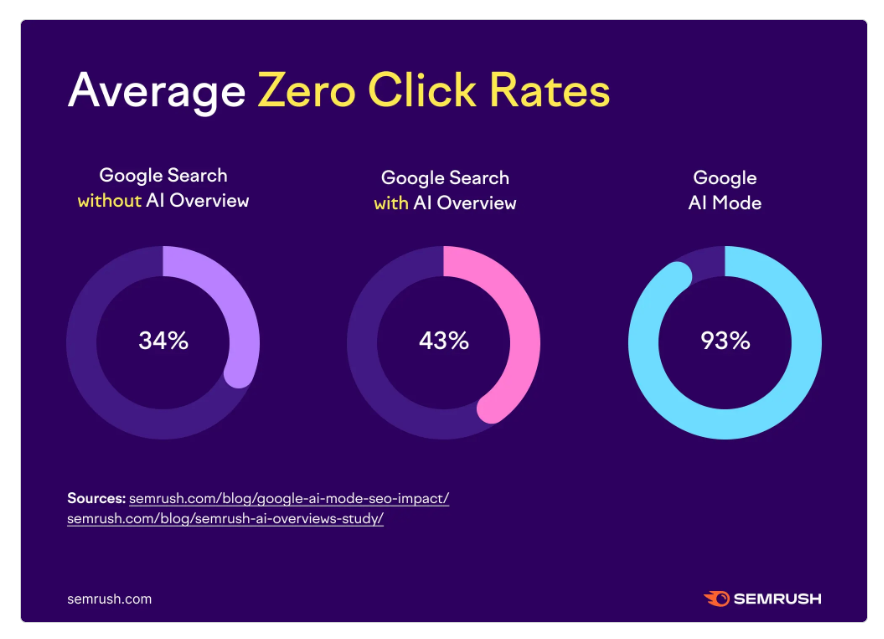
Source: Semrush, Google AI Mode SEO impact
Previously, someone searching for an answer would often visit a few pages, compare their explanations, and decide which information was useful.
An AI Overview can complete part of that work within Google. It presents a synthesized answer alongside supporting sources. If that answer satisfies the user, they may have little reason to visit another page.
For your website, the result can be declining clicks even when your organic position has changed very little.
This is why rankings alone no longer tell you how much traffic a query can deliver. You also need to understand what appears around your result and whether users still need to click.
2. Core updates can add a second source of traffic loss
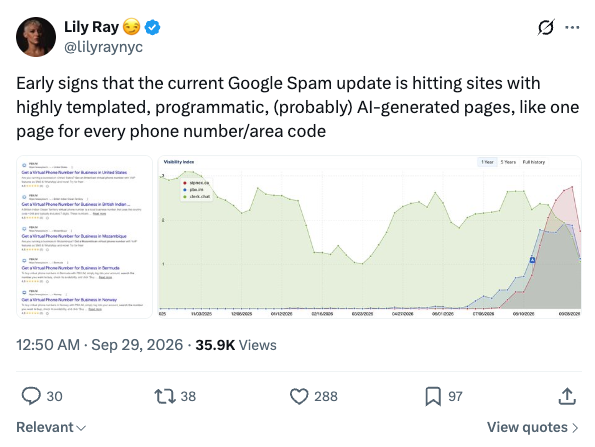
Source: Lily Ray
In our core update recovery guide, we discussed five websites we analyzed that experienced ranking and traffic declines around Google updates.
The recurring content problems included outdated information, low-quality AI-generated material that added little value, and topics where the company contributed little relevant expertise.
If important pages have fallen from the first few positions to the second page, reduced click-through from AI Overviews is unlikely to explain the whole decline.
You need to investigate the ranking loss as well.

How to identify what happened to your website
Start with the pages that generated most of your Google organic traffic before the decline. This keeps the investigation focused on the losses that explain most of the change.
1. Identify your highest-contributing pages and their queries
Export page-level performance from Google Search Console for a period before the decline. Sort the pages by clicks and calculate their cumulative contribution.
The top 10–20% of pages will account for most of your traffic, but check the distribution on your own website rather than assuming an 80–90% contribution.
For each selected page, map its core keyword and other queries that historically brought meaningful clicks. A single target keyword is useful for tracking, but it may not explain everything that happened to a page receiving traffic from hundreds of searches.
Keep the country and device consistent throughout the comparison.
2. Map historical rankings and traffic
Collect one to two years of historical data where available. Use monthly comparisons to understand the overall pattern, then examine weekly or daily changes around suspected declines.
Your working sheet should include:
Mark update periods using Google’s confirmed rollout dates. Then look for changes across the group of pages, rather than drawing a conclusion from one keyword.
If rankings deteriorated across multiple important queries during an update and traffic declined alongside them, that supports investigating an update-related impact. Timing is evidence to examine, rather than proof on its own.
3. Check AI Overview presence for the affected queries
For the same queries, record whether an AI Overview appears in your target market.
Where historical SERP records are available, check whether its appearance or frequency changed around the period when clicks declined. If you only have current results, record that limitation. An AI Overview appearing today does not establish that it caused a decline six months ago.
Now compare the patterns.
If rankings and impressions remain relatively stable while clicks and CTR fall on queries showing AI Overviews, reduced click-through becomes a stronger explanation.
If rankings and traffic both decline, investigate the ranking loss. If the ranking loss is across queries and is aligned with any of Google update timelines, it’s a core update hit.

If AI Overviews are reducing clicks, prioritize visibility for your money topics
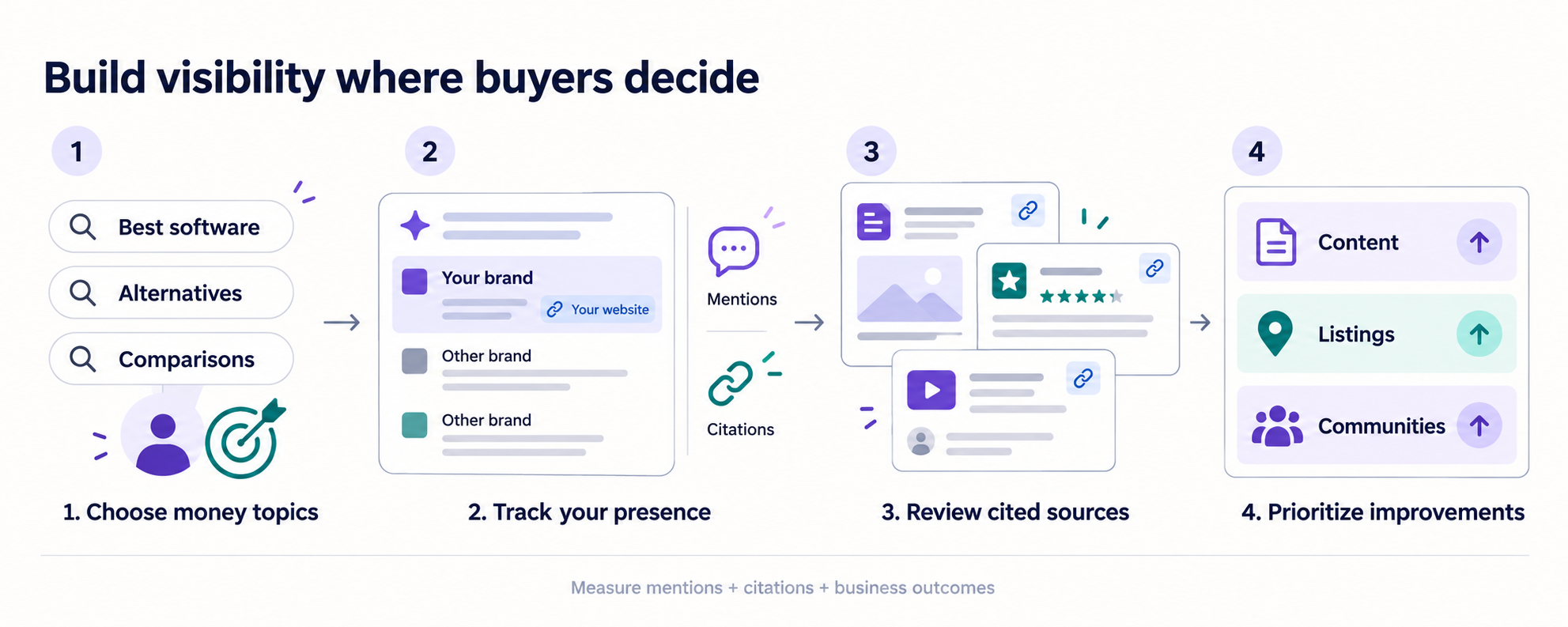
When your rankings remain strong but fewer people click, another content refresh may not restore the traffic you previously received.
The user is receiving information within Google. You can improve your page, but you cannot require them to visit it.
That changes what we prioritize. Alongside the visits and conversions still available, we want to understand whether the business appears in the answers buyers are reading.
Our research on the size of AI search estimated that traditional search engines still account for approximately 92% of search-equivalent queries across the platforms we analyzed. The shift toward AI-generated answers is happening within that established search activity as well as across standalone LLMs.
For a business, the practical question is whether its brand appears when a potential buyer researches the category, compares products, or looks for a solution.
Start with the commercial topics that matter to your business
Identify the topics where being considered could influence a purchase decision.
For a customer support platform, these might include software for a particular company size, alternatives to an established competitor, or solutions for a specific support workflow.
Choose these topics based on your product and ICP. High search volume alone is not a sufficient reason to prioritize them.
For each topic, identify relevant buyer queries, check whether AI Overviews appear, and add those searches to your visibility tracking.
Benchmark mentions, citations, and how your brand is described
A brand mention and a website citation tell you different things.
Your brand may be recommended because a third-party comparison includes it, even when Google does not cite your website. Your website may also be cited for an explanation without your product being recommended.
Record both.
Review whether your brand appears, which competitors appear alongside it, and whether the answer describes your product accurately. Where the answer makes recommendations, assess whether your product’s strengths and intended audience are represented correctly.
This gives you a baseline for identifying gaps.
Use the cited sources to decide what to work on
Collect the pages cited for your priority queries and group those covering the same topic.
If several frequently cited pages cover a relevant topic your website does not address, assess whether you should create a page. If you already have one, compare its usefulness, evidence, and coverage with the sources receiving citations.
Next, review third-party pages. A frequently cited listicle that fits your product category but excludes your brand may be an outreach priority.
Apply the same approach to cited discussions, reviews, and videos. Let the sources appearing in your tracked results guide the work.
We cover the broader reasoning in our research on Google’s AI exposure. The objective is to improve your presence in the answers relevant buyers encounter, while continuing to measure the traffic those answers generate.
If you also lost rankings, address the recovery work separately
A website with substantial ranking losses has another problem to solve. Increasing AI visibility does not replace the work needed to improve its organic performance.
The process we use starts with a content and performance audit.
- Map affected pages by rankings, traffic, ICP relevance, funnel stage, and contribution to leads or MQLs. Then review what each page needs.
- Some pages need updated information and better explanations. Others overlap with existing content and may benefit from consolidation. Pages with little relevance or useful contribution need a closer assessment of whether they belong on the website.
- Prioritize the work by business impact. We start with ICP-relevant pages that have generated MQLs and deals, followed by high-intent pages with clear conversion potential. Relevant middle-of-funnel and top-of-funnel content follows.
- When optimizing, examine the substance of the page. Does it answer the buyer’s questions? Are its claims accurate? Does it include useful expertise, examples, or evidence? Has the product information changed?
- Changing the year in a title will not resolve outdated information throughout the article.
Track implementation alongside results: pages updated, changes published, and whether Google has recrawled the content. Then monitor rankings, clicks, and lead contributions over time.
The full process is explained in our guide to recovering from Google core updates.
Measure visibility alongside clicks and business outcomes
Clicks remain useful. They tell you how many people reached your website from search. They cannot tell you whether a buyer encountered your brand in an answer and continued their research without visiting.
For your priority commercial queries, track brand presence, website citations, competitor presence, and the accuracy of the descriptions. Use a consistent query set, market, and tracking schedule so changes are comparable.
Where an answer presents an ordered list of recommendations, record placement. Avoid treating every mention in a paragraph as a meaningful ranking.
Continue measuring organic visits, qualified leads, and pipeline contribution. For pages affected by ranking declines, maintain a separate view of ranking recovery.
Branded search and direct traffic can provide supporting context, but increases are not proof that AI visibility caused them. Campaigns, referrals, sales activity, and existing customers can affect both. Treat them as indicators to investigate alongside customer feedback and attribution data.
The first decision is where to direct the work. Pages that lost rankings need a recovery plan. Commercial queries where your brand is absent from AI answers need a visibility plan. When both problems exist, work on both and measure their progress separately.

I help B2B SaaS companies grow pipeline and visibility through strategy-led SEO, AI-powered execution, and content aligned to buyer journeys across key touchpoints and platforms.. With over 5 years of experience, I’ve led execution across the entire organic funnel, delivering measurable results aligned with business goals.

