Key Takeaways
- Google AI Overviews offer substantial visibility opportunities. ScaleTheory's research estimates that 330–378 billion Google searches monthly could trigger an AI Overview, based on a 70–80% appearance rate.
- Traditional SEO matters, but top-10 rankings don't guarantee citations. Ahrefs' March 2026 study found that 37.1% of AI Overview citations overlapped with Google's top 10 organic results.
- Prioritize commercially relevant SaaS buyer queries. Identify your core keywords, check which trigger AI Overviews, and analyze the pages and competitors receiving citations.
- Create content that answers buyer questions clearly. Cover related subtopics, use direct answers, and include original research, product information, customer examples, and useful formats.
- Build third-party visibility and measure results. Earn relevant mentions in cited publications and communities while tracking AI Overview citations, competitor visibility, and business outcomes.
AI overviews are most probably appearing when someone searches in Google for the best software in your category or alternatives to your competitors.
Does your brand appear in the AI Overview? And how important is it to be mentioned in the AI overviews
They are so damn important as these searches are coming from buyers comparing solutions or evaluating products. Being mentioned in AI overviews means that your brand is registered into your ideal customer's mind before they even visit your website.
In our research, Google Has 7–8X More AI Exposure Than LLMs, approximately 330–378 billion searches trigger an AI Overview monthly, representing 7–8X more potential AI exposure than LLMs.
So, AI search visibility is no longer limited to platforms like ChatGPT, Claude, Perplexity, etc. Google is the largest potential source of AI-generated answers. For B2B SaaS companies, tracking and improving website citations in AI Overviews should become part of the existing SEO strategy.
In this article, we'll explain the workings behind AI Overviews and cover eight practical steps to improve your chances of getting mentioned or cited.
What does it mean to get mentioned in Google AI Overviews?
Getting mentioned in Google AI Overviews means your brand or product appears within the AI-generated answer Google displays for a search query.
Google AI Overviews summarize information from relevant sources to help users understand a topic, answer a question, or compare available options. These answers can also include links to websites that support the information presented.
If you are a B2B marketer, your main objective is to appear for the high intent searches that are relevant to your product and the problems your potential customers are trying to solve.
For example, consider a company offering customer relationship management (CRM) software for small and growing businesses.
A potential customer might search Google for:
- "What is the best CRM software for small B2B sales teams?"
- "Which CRM platforms integrate with Slack and Gmail?"
- "Best HubSpot alternatives for startup companies"
- "Which CRM software is suitable for a 10-person sales team?"
These searches represent different buyer requirements. Some users are exploring a software category, while others are comparing products or checking specific capabilities. If Google generates an AI Overview that names your CRM product or cites your website, your business gains visibility for that search.
Brand mentions vs website citations in AI Overviews
There are three different outcomes worth understanding.
For commercial queries, brand mentions are especially relevant because they can place your product in front of someone evaluating potential vendors. Website citations are also useful because they allow users to visit your website from the AI Overview box for more information.
Neither outcome guarantees a click. In Pew's study, users clicked a link within an AI summary in only 1% of visits where an AI summary appeared.
This is why you should track both mentions and citations rather than relying entirely on organic traffic to understand their visibility.

How does Google decide which websites to cite in AI Overviews?
Google AI Overviews use Google's existing Search systems to retrieve relevant webpages and generate answers with supporting citations. According to Google Search Central, this process relies on Google's ranking and quality systems, including retrieval-augmented generation (RAG).
However, the cited pages don't always match the top-ranking organic results. Three factors help explain how Google selects its sources.
How much do traditional Google rankings matter?
Strong organic rankings can improve your chances of being cited, but appearing in Google's top 10 isn't required.
However, Ahrefs' March 2026 study, covering approximately four million AI Overview URLs, reported different results.
Ahrefs also improved its citation parsing methodology between the studies, so these figures aren't directly comparable.
For SaaS businesses, traditional SEO remains important, but ranking for your main keyword isn't the only opportunity. Google can also cite pages that answer related questions.
How does query fan-out influence AI Overview citations?
Google uses query fan-out to run multiple related searches before generating certain AI answers. According to Google's documentation, these searches can cover different subtopics and information sources.
For example, when someone searches "CRM software for a small B2B team", Google might retrieve information about:
- CRM platforms suitable for small businesses.
- Pricing and user limits across different plans.
- Email and communication integrations such as Slack and Gmail.
- Sales automation features available to smaller teams.
- Customer reviews and product comparisons across CRM providers.
Google may cite a CRM integration guide for feature information or a comparison article for product differences, even if those pages don't rank for the original query.
This creates opportunities for websites that answer specific buyer questions clearly. Since Google doesn't disclose its exact fan-out queries, use related searches, existing citations, and buyer research to identify relevant subtopics.
Does website authority determine AI Overview citations?
Website authority can influence citation visibility, but smaller websites can also earn citations.
In August 2026, Wellows analyzed 20.5 million AI citations across five AI platforms. Its March–June 2026 Google AI Overview data found:
- The median Domain Authority of cited websites was 47.
- 40.8% of AI Overview citations came from domains below DA 40.
- 23.8% of AI Overview citations came from domains with DA 90 or higher.
Domain Authority is a third-party metric, not a Google ranking factor. The findings also reflect Wellows' tracked dataset, which was heavily concentrated in the U.S.
For B2B SaaS companies, this means you don't need to be the largest website in your category to earn citations. Providing useful information about specific integrations, product capabilities, or technical problems can create opportunities to appear in relevant AI Overviews.
How to get mentioned in Google AI Overviews: 8 practical steps
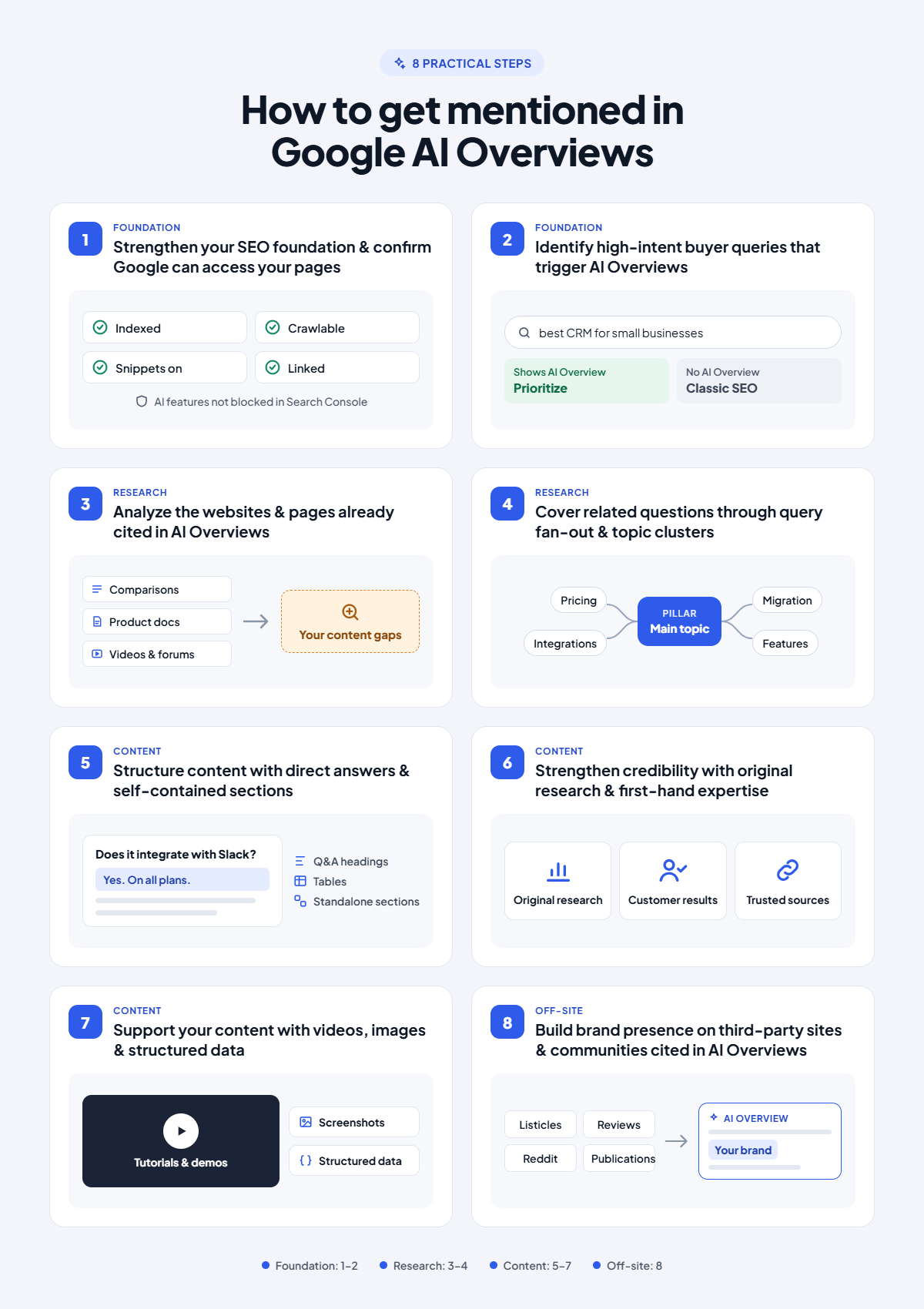
Improving visibility in Google AI Overviews starts with traditional SEO, but you also need to understand which queries trigger AI answers and which sources Google cites.
Start with your most important commercial keywords, analyze the existing AI Overviews, and use those findings to improve your content and brand visibility.
Step 1. Strengthen your traditional SEO foundation and confirm Google can access your pages
Before optimizing for AI Overviews, make sure Google can access and index your important pages. According to Google's documentation, a page must be indexed and eligible to appear with a snippet to be considered as a supporting source in AI Overviews.
Start with your product pages, feature pages, comparison articles, and other commercially important content.
1. Indexing and crawl accessibility
Use Google Search Console's URL Inspection tool to check whether your priority pages are indexed.
Also verify that:
- Googlebot isn't blocked by robots.txt, your CDN, or firewall.
- Important pages don't have unintended noindex directives.
- Canonical tags point to the correct page versions.
If Google cannot access or index your content, it won't be eligible for an AI Overview citation.
2. Snippet availability and page content
Check that important content isn't restricted by nosnippet, data-nosnippet, or restrictive snippet settings.
Make product information available as readable text, rather than hiding it inside interfaces Google may struggle to access.
3. Internal linking and website usability
Connect important pages through relevant internal links. For example, a CRM comparison article should link to related feature pages and integration guides.
Also check mobile usability, navigation, and technical issues that could affect accessibility.
4. AI feature controls in Search Console
Google introduced generative AI visibility controls in Search Console in June 2026, with global rollout completed by August 31, 2026.
Check that your website hasn't been excluded from Google's generative AI Search features.
These checks establish your pages' eligibility, but they don't guarantee citations.
Step 2. Identify high-intent buyer queries that trigger Google AI Overviews
Focus on commercial queries your potential customers search when evaluating software, rather than targeting keywords based only on search volume.
1. Identify your top 10 commercial keywords
Start by identifying ten core keywords related to your product category, competitors, features, and use cases.
For example, a CRM company might prioritize:
Your actual keywords should reflect your product and ideal customer profile.
2. Check which keywords AI Overview is appearing for
Search each keyword in Google and record whether an AI Overview appears.
Not every commercial keyword triggers an AI Overview. Check the actual search results, especially for queries where buyers compare products, pricing, and features.
For each keyword, record:
- AI Overview presence: Whether Google generates an AI answer.
- Brand mentions: Whether your product appears.
- Website citations: Whether Google links to your website.
- Competitor visibility: Which competing brands appear.
- Cited sources: Which websites support the answer.
Also record the search date, country, and device because AI Overviews can vary.
3. Prioritize keywords based on AI Overview presence
Divide your keywords into two groups:
Group 1: Commercial keywords triggering AI Overviews
Prioritize these for AI Overview optimization because Google already displays an AI-generated answer.
Group 2: Commercial keywords without AI Overviews
Continue targeting these through traditional SEO, but don't prioritize them specifically for AI Overview citations yet.
The goal is to focus your optimization efforts on commercially relevant keywords where AI Overviews already appear.
Step 3. Analyze the websites and pages already cited in AI Overviews
For every priority keyword, collect the URLs cited in Google's AI Overview and examine why those pages might be relevant to the answer.
1. Identify frequently cited websites and page types
Group the cited sources into categories such as:
- Product and feature pages explaining software capabilities.
- Comparison articles and reviews evaluating different tools.
- Technical guides and documentation answering product questions.
- Industry publications and research providing supporting information.
- YouTube videos and communities discussing products or experiences.
For example, a CRM comparison query might cite software listicles, while a query about a specific integration might cite technical documentation.
Identify which types of pages Google references for each search.
2. Compare cited pages with your existing content
Review the cited pages and compare them with your own.
Look at:
- Organic rankings and topic coverage for the target keyword.
- Product details and comparisons included in the content.
- Research, statistics, and examples supporting important claims.
- Content structure and formats, including tables and videos.
- Missing information that your website could explain better.
For example, suppose a cited CRM comparison covers pricing, integrations, and automation features, while your article only provides basic product descriptions.
That gives you a clear content gap to address. Improve your page with useful details rather than copying the cited article.
3. Identify competitor citation opportunities
Pay attention to queries where competitors appear, but your brand doesn't.
Check:
- Which competitors are mentioned and which pages support their inclusion.
- Whether Google cites their websites or third-party articles.
- What product features or information make them relevant.
- Whether your product meets the same buyer requirements.
For example, if Google recommends CRMs with Slack integrations and your product offers that feature, make sure your website explains it clearly.
Prioritize opportunities where your product genuinely meets the buyer's needs.
The outcome should be a list of cited sources, competing brands, and content gaps worth addressing.
Step 4. Cover related questions through query fan-out and topic clusters
Google's query fan-out process can retrieve information from several related searches before generating an AI Overview.
This means your content should address relevant subtopics, not just the main keyword.
1. Identify related questions and subtopics
Suppose your target keyword is "best CRM software for small businesses."
Related questions might include:
- Pricing: How much does CRM software cost?
- Integrations: Which CRMs support Gmail and Slack?
- Features: What capabilities do small sales teams need?
- Automation: Which platforms provide sales automation?
- Migration: How difficult is switching CRM platforms?
- Comparisons: How do startup and enterprise CRMs differ?
Use Google's People Also Ask results, related searches, competitor articles, customer questions, and existing citations to find these subtopics.
These are possible related searches, not Google's confirmed internal fan-out queries.
2. Review whether your existing pages answer them
For each question, check whether your content:
- Answers it clearly.
- Covers it partially.
- Doesn't address it.
For example, your CRM comparison might cover pricing but not migration requirements.
You could add a relevant section or create a separate guide if the topic needs a detailed explanation.
Not every question needs its own article. Include related answers where they fit naturally.
3. Connect related pages through topic clusters
Organize related articles around a broader topic.
For example:
Pillar article: Best CRM software for small businesses.
Supporting content:
- CRM pricing comparisons across software plans.
- CRM integration guides for common business tools.
- CRM migration tutorials for switching platforms.
- Sales automation guides for small teams.
- CRM alternatives and comparisons for buyers.
Connect these pages with relevant internal links.
This helps readers explore related questions while keeping each article focused.
Avoid publishing repetitive pages for minor keyword variations. Google's AI optimization guidance warns against producing large amounts of repetitive content primarily to influence search visibility.
The objective is to cover related buyer questions with useful, distinct content.
Step 5. Structure content with clear, direct answers and self-contained sections
Make important answers easy to find and understand. Use clear headings, concise explanations, and relevant formats rather than forcing readers to search through lengthy paragraphs.
1. Provide direct answers early
Start relevant sections by answering the main question.
For example, if a CRM article discusses Slack integration, first explain whether the integration is supported, what it does, and whether any plan restrictions apply.
Then cover setup instructions and practical examples.
Aim to answer the question within the first two or three sentences where appropriate.
This improves clarity, although Google doesn't require a specific answer length for AI Overview citations.
2. Use headings and formats that reflect buyer questions
Organize content using descriptive headings such as:
- Does the CRM integrate with Slack?
- What automation features are included?
- How much does the CRM cost?
- Which plans support advanced reporting?
Use comparison tables for pricing and features, numbered lists for instructions, and short paragraphs for explanations.
Choose formats based on what makes the information easiest to understand.
3. Make important sections understandable independently
Each section should provide enough context to make sense on its own.
For example, a CRM migration section should identify the software involved and explain the requirements instead of referring vaguely to information mentioned earlier.
This helps both readers and retrieval systems understand specific passages. However, Google doesn't require artificial content chunking or a special AI writing style.
Focus on clear, useful explanations rather than formatting content solely for AI extraction.
Step 6. Strengthen content credibility with original research and first-hand expertise
Clear formatting helps readers understand your content, but original information gives them a reason to trust and reference it.
For SaaS companies, this can come from product expertise, customer experiences, and research.
1. Include original research and product insights
Use insights from customer interactions, product usage, or internal research to answer relevant questions.
For example, a CRM company could discuss:
- Common integration challenges customers experience.
- Frequently requested automation workflows used by sales teams.
- CRM migration problems encountered during implementation.
- How different teams use specific product features.
These details can make your content more useful than generic software articles.
At ScaleTheory, our research, How Big Is AI Search?, estimates AI adoption and search demand using a documented methodology.
It distinguishes sessions, LLM prompts, and search-equivalent queries, giving readers specific findings and assumptions they can reference.
2. Use customer examples and case studies
Include real customer experiences that explain:
- The original problem the customer faced.
- The product features used to address it.
- How the solution was implemented.
- The measurable business results achieved.
- Any important limitations affecting those results.
For example, if your CRM reduces manual work, explain which tasks it automates and support the claim with real evidence.
Specific customer results are more useful than generic claims about efficiency or productivity.
3. Support claims with reliable sources
Link to credible sources when discussing statistics, technical information, or industry claims.
Include relevant author credentials, expert contributions, and research methodology where appropriate.
Google's E-E-A-T principles emphasize Experience, Expertise, Authoritativeness, and Trustworthiness, but there is no published citation score based on these individual elements.
4. Keep important information accurate
Update content when your pricing, product features, integrations, or availability changes.
Accurate product information helps buyers evaluate your software and avoids confusion caused by outdated details.
Step 7. Support your content with relevant videos, images, and structured data
Videos, screenshots, and diagrams can help explain complex SaaS products, especially integrations and technical workflows.
Google also cites YouTube content in AI Overviews.
According to Ahrefs' March 2026 study, 5.6% of AI Overview-cited URLs were YouTube pages. Among cited URLs outside the top 100 organic results, 18.2% were YouTube pages.
This makes video worth considering when it already appears in your target AI Overviews.
1. Identify video opportunities from existing citations
Check whether Google cites YouTube videos for your priority keywords.
Review those videos to identify missing explanations, outdated information, or unclear instructions.
For example, if Google cites a basic project management automation tutorial that skips important configuration steps, you could create a more detailed walkthrough.
Focus on answering the question better rather than producing another video covering the same information.
2. Create useful videos and supporting resources
Relevant SaaS content formats include:
- Product tutorials and demonstrations showing real workflows.
- Integration walkthroughs explaining tool connections.
- Setup and migration guides covering implementation.
- Product comparison videos explaining feature differences.
- Screenshots and diagrams supporting technical explanations.
Use descriptive titles, accurate captions, transcripts, and timestamps.
You can also embed videos within relevant articles. For example, a written integration guide could include a video showing the setup process.
Useful videos can improve your content, but citations aren't guaranteed.
3. Use structured data where appropriate
Use structured data such as Article, Organization, or VideoObject when relevant, making sure it matches the visible content.
According to Google's guidance, a special AI-specific schema isn't required for AI Overviews.
FAQPage or VideoObject markup alone won't guarantee citations.
Treat structured data as part of technical SEO, not as a replacement for useful content.
Step 8. Build brand presence on relevant third-party websites and communities cited in AI Overviews
Google AI Overviews can also cite information from websites outside your own, including software comparisons, publications, review platforms, and communities.
These sources can create opportunities for your brand to appear in answers to relevant buyer queries.
1. Identify frequently cited third-party websites
Review the citations collected in Step 3 and identify:
- Software comparisons and listicles covering your category.
- Review platforms and directories listing relevant products.
- Industry publications discussing your software market.
- YouTube videos and podcasts reviewing or explaining products.
- Reddit and industry forums discussing user experiences.
For example, suppose Google cites an article about the best CRM software for small businesses, but your product isn't included.
That could be a relevant outreach opportunity, provided your software fits the article's criteria.
2. Evaluate whether your product belongs in the cited content
Check whether your product matches the article's audience and requirements.
For example, a CRM built for small SaaS companies might suit a startup-focused comparison but not an enterprise CRM roundup.
Prioritize relevant inclusion rather than trying to appear in every comparison article.
3. Reach out with relevant product information
When contacting publishers, explain why your product deserves consideration.
Provide:
- Product features and integrations relevant to their readers.
- Customer case studies supporting your claims.
- Pricing and documentation explaining your offering.
- Independent reviews or evidence demonstrating product capabilities.
Avoid requesting inclusion solely for AI visibility.
Disclose sponsored placements appropriately and follow Google's policies for paid links.
Getting mentioned in a cited article doesn't guarantee that Google will recommend your brand, but it can improve the information available about your product.
4. Participate in relevant communities
Join discussions where your team can provide useful product knowledge or first-hand experience.
For example, if buyers discuss project management software limitations on Reddit, you can contribute relevant explanations rather than promotional responses.
Disclose your connection to your company when discussing its products. Also review how third-party websites describe your software. If they contain incorrect pricing, outdated features, or misleading information, request corrections.
The goal is to build an accurate brand presence across the sources your potential customers and Google already reference.
Which AI Overview optimization practices should you avoid?
As more businesses invest in AI search optimization, several tactics have emerged that claim to improve Google AI Overview visibility.
Some are useful extensions of traditional SEO. Others are unnecessary or unsupported by Google's guidance.
In its official guide to generative AI optimization, Google identifies several practices that websites do not need to follow specifically for AI-generated search features.
For B2B SaaS businesses, this distinction matters because these tactics can divert resources away from activities that are more closely connected to buyer demand.
You do not need to create an entirely separate website optimization system for Google AI Overviews. Start with traditional SEO foundations, identify the commercially relevant queries where AI Overviews appear, and improve the information available about your product.
Then measure whether those changes are associated with better visibility.
How to measure your brand's visibility in Google AI Overviews
Traditional SEO metrics such as rankings, impressions, and clicks don't fully capture AI Overview visibility. To measure progress, track brand mentions, website citations, and business outcomes across a consistent set of commercial queries.
1. Track brand mentions and website citations for important buyer queries
For each priority keyword triggering an AI Overview, check whether Google mentions your brand, cites your website, or recommends competitors.
Track mentions and citations separately:
Brand mention rate = Responses mentioning your brand ÷ Total responses tested × 100
Website citation rate = Responses citing your website ÷ Total responses tested × 100
For example, across 40 AI Overview responses, suppose your brand appears in 12 and your website receives eight citations. Your mention rate is 30%, while your citation rate is 20%.
These percentages reflect your tested responses, not all Google searches. Compare results using the same keywords, locations, and devices, and review third-party pages cited alongside competitors to identify new opportunities.
2. Monitor Google AI visibility in Search Console
Google introduced Generative AI performance reports in Search Console in June 2026, allowing website owners to monitor visibility across AI Overviews and AI Mode.
The reports include:
- Impressions: How often your pages appear in AI search features.
- Pages: Which URLs receive visibility.
- Countries and devices: Where and how users encounter your content.
- Dates: How visibility changes over time.
However, Search Console doesn't replace query-level AI Overview tracking. Use separate monitoring to identify which commercial queries trigger AI Overviews, which competitors appear, and which external pages Google cites.
3. Measure website traffic, qualified leads, and conversions
AI Overview mentions don't always result in website visits, so traffic alone cannot measure their full business impact.
Monitor the organic performance of pages receiving AI visibility, including:
- Organic clicks and sessions from Google.
- Demo requests and form submissions from relevant visitors.
- Free-trial and product signups generated through organic search.
- Qualified leads and pipeline associated with organic acquisition.
- Conversion rates of important landing pages.
Compare performance before and after content improvements, but consider attribution limitations.
For example, someone might discover your brand through an AI Overview and later visit through a branded Google search. That visit may not be attributed to the AI Overview.
Use these metrics to understand overall organic performance without assuming AI visibility directly caused every conversion.
4. Review citation changes and update underperforming pages
AI Overview citations can change over time, so monitor your priority keywords regularly using a consistent tracking process.
Review changes in:
- Brand mentions and website citations across relevant queries.
- Competitor visibility in AI-generated answers.
- Frequently cited third-party websites supporting the answers.
- Lost citations from pages previously appearing in AI Overviews.
For example, if your CRM comparison article stops receiving citations, compare it with the pages Google currently references. Look for outdated product details, missing information, or stronger evidence you could add.
Avoid making changes based on a single missing citation, since AI Overview results can vary between searches.
The goal is to identify consistent patterns and use those findings to improve the pages that matter most to your business.
How ScaleTheory helps B2B SaaS brands improve visibility in Google AI Overviews
For B2B SaaS businesses, Google AI Overviews create another opportunity to appear when potential customers research software, compare alternatives, or evaluate product capabilities.
However, improving visibility requires understanding which commercial searches matter to your business and where your brand currently stands.
At ScaleTheory, we approach Google SEO and AI search visibility as connected parts of the organic growth program.
Our process starts by identifying the topics and buyer queries most relevant to a company's product and commercial goals. We then analyze Google search results, AI-generated answers, competitor visibility, and the pages receiving citations to understand where opportunities exist.
Our work focuses on:
- Commercial keyword and buyer-intent research: Identifying the topics where a SaaS brand needs visibility.
- Content creation and optimization: Developing useful content around buyer questions, product capabilities, comparisons, and relevant search opportunities.
- Technical SEO and content architecture: Improving website accessibility, page structure, internal linking, and topic coverage.
- AI search visibility monitoring: Using VisibilityX to track brand mentions, citations, competitor appearances, and visibility changes across relevant AI platforms.
Our VisibilityX tool helps us identify where clients appear within AI-generated answers and where competing brands receive visibility. These findings inform which content to create, which existing pages to improve, and where relevant third-party coverage may be worth pursuing.
Our focus is on improving visibility for commercially relevant topics while continuing to measure organic traffic, qualified leads, and pipeline outcomes.
If you want to understand whether your SaaS brand appears in Google AI Overviews for your most important buyer queries, book a demo with ScaleTheory.
Frequently asked questions about Google AI Overview citations
1. How do I get my brand mentioned and cited in Google AI Overviews?
Identify relevant keywords that trigger AI Overviews, analyze the cited websites, and improve your content with direct answers, useful product information, and credible sources. You can also build brand visibility through relevant third-party websites. However, no optimization guarantees citations.
2. Can older content still appear in Google AI Overviews?
Yes. Older content can still receive AI Overview citations if it remains relevant, accurate, and useful. Keep product details, statistics, and examples updated rather than changing publication dates unnecessarily.
3. How long does it take to get cited in Google AI Overviews?
There is no fixed timeline. Google must first discover and index your content, but indexing doesn't guarantee citations. Monitor your target keywords regularly to track changes after making improvements.
4. Do I need to rank in Google's top 10 to appear in AI Overviews?
No. Pages outside Google's top 10 can also receive AI Overview citations. Ahrefs' March 2026 study found that only 37.1% of cited URLs ranked in the top 10 for the original query. Strong SEO performance helps, but top rankings aren't required.
5. How can I check if my website is cited in Google AI Overviews?
Search your priority commercial keywords and review the websites linked in each AI Overview. Record your citations, brand mentions, and competitor appearances. Use AI visibility tracking tools to monitor these results consistently over time.

I help B2B SaaS companies grow pipeline and visibility through strategy-led SEO, AI-powered execution, and content aligned to buyer journeys across key touchpoints and platforms.. With over 5 years of experience, I’ve led execution across the entire organic funnel, delivering measurable results aligned with business goals.