
.png)
.png)
Key Takeaways
- Scale Theory: Best for cybersecurity SaaS companies with stalled organic traffic that need a fully managed system to win on both Google and AI search engines simultaneously, with one team owning strategy, execution, and reporting.
- uSERP: Best for established cybersecurity, SaaS, and B2B brands that need stronger visibility across Google and AI search, with a focus on authoritative link building, digital PR, and earning citations from trusted sources.
- Amplifyed: Consider if you want a cybersecurity-exclusive SEO agency, no generic B2B playbook applied to your vertical, with case studies showing 3,478% organic revenue growth and 163% qualified lead increases for security brands.
- First Page Sage: Best for enterprise security companies that need thought leadership content CISOs and security architects actually read, the kind that earns rankings, earns links from security publications, and gets cited in AI Overviews.
- Platypus: Best for security SaaS vendors losing search visibility to established category leaders. Their model is built for high-intent demand capture, not traffic volume, with reporting tied directly to pipeline.
- LoudFace: Best for Series A/B cybersecurity SaaS companies that need a full site rebuild and a growth program in one engagement, with a documented AEO result of 86% AI visibility on core category prompts.
To build this list, I went through each agency's website, case studies, and client results to understand what they actually do, not just how they describe themselves. I also looked at which agencies consistently come up in cybersecurity marketing communities and practitioner conversations, where people share honest experiences rather than polished testimonials.
I focused specifically on agencies with documented cybersecurity work: real client names, real metrics, and a clear line from the SEO program to business outcomes, demos booked, pipeline generated, or qualified leads increased. Agencies that only published traffic charts without any conversion context didn't make the cut.
There is no single best agency here. Each one on this list serves a different type of cybersecurity company at a different stage. The right fit depends on what you actually need, whether that's a cybersecurity-exclusive team with no domain learning curve, thought leadership built to CISO-level standards, or an agency that combines Google SEO and AI search visibility from day one. Read through the full breakdowns before booking any discovery calls.
Quick comparison: 10 cybersecurity SEO agencies at a glance
1. Scale Theory
ScaleTheory is a cybersecurity and B2B tech SEO agency that helps companies increase organic visibility and pipeline by creating ICP-mapped organic visibility content designed to perform simultaneously on Google and AI platforms.
ScaleTheory is the best fit for cybersecurity SaaS companies, MSSPs, and security service providers where organic traffic has stalled or declined, and where the team needs a fully managed end-to-end provider, a single team handling strategy, execution, and reporting without requiring the client to manage multiple vendors or agencies.
We use our internal visibility tool to monitor how your brand is represented in LLMs, surfacing AI visibility gaps, tracking citation changes, and measuring whether content investments are improving your presence in the tools your buyers use before they ever fill out a form. This runs without adding external tool costs to the client.
Strategy, execution, briefs, drafts, editorial review, publishing, tracking, and reporting all sit with ScaleTheory.
You provide direction, and we run the system.
Our top 3 services
1. ICP-Mapped SEO
Keyword strategy built from the cybersecurity buyer journey, not from generic keyword volume. Targets queries that map to specific buying committee roles, CISO, security architect, IT director, compliance lead, at every evaluation stage. Every content piece is tied to a product use case, buyer persona, or conversion path.
2. AI Visibility (VisibilityX)
Targeted AI visibility across ChatGPT, Perplexity, Gemini, and Google AI Overviews. Scale Theory maps where a cybersecurity brand is missing in AI-generated answers, builds content to close those gaps, and monitors results through VisibilityX. The goal is consistent citation in the prompts your buyers are actually running.
3. Authority Architecture
Pillar-cluster content architecture designed for both users and AI systems. Includes topical depth planning, intent-specific page alignment, internal linking structure, and credibility building through expert citations, SME contributions, and structured authority signals.
Notable clients
Case study
BQP came to Scale Theory after a site migration wiped all existing organic performance, zero non-branded clicks and no AI search presence in a highly specialized niche serving aerospace and defence R&D teams. Scale Theory built from the bottom of the funnel up, prioritizing high-intent BOFU pages, pillar-cluster architecture, and LLM visibility from day one. Results in 10 months: organic clicks grew 767% from 288 to 2,500, impressions jumped 68x to 680,000, non-branded clicks went from 0 to 1,800 per month, and LLM sessions grew from ~50 to 500.
Read the full case study at https://www.scaletheory.ai/customers/bqp
Pricing
Starting from $1,500/month. Engagements start with a 30-minute strategy call.
2. uSERP
uSERP is a leading AI SEO agency helping category-defining brands win visibility across both traditional search engines and large language models (LLMs). Trusted by companies such as monday.com, Robinhood, CrowdStrike, Binance, Wiz, and Freshworks, uSERP aligns AI search visibility with real business outcomes, not vanity impressions.
As search behavior starts to include more AI-powered results (Google AI Overviews, ChatGPT, Perplexity, Claude, and other LLMs), uSERP helps brands become sources. Their programs focus on earning authoritative citations, brand mentions, and contextual links from the publications and data sources AI systems actually reference.
Rather than relying on shortcuts like paid placements, PBNs, or surface-level “AI content,” uSERP uses a content-led, relationship-driven approach to secure placements on trusted publications that influence both human buyers and machine-generated answers. The agency has been recognized by Clutch, DesignRush, G2, and Single Grain as a top-tier SEO and link-building partner, working primarily with brands that treat AI SEO as a long-term competitive advantage.
Top 3 services
1. AI Visibility & LLM Inclusion
uSERP specializes in identifying which sources, publishers, and data sets large language models rely on, and then securing client inclusion in those citations. Campaigns are designed to increase citations, brand mentions, and trusted references across AI answers, in addition to traditional blue-link rankings.
2. Authority-First Link Building
Editorial links are earned from high-authority, real publications that already rank and are frequently cited by AI systems. Priority is given to product pages, category pages, and bottom-of-funnel content that directly supports revenue.
3. Digital PR & Source-Level Outreach
uSERP builds data-driven narratives, expert commentary, and first-party insights that journalists and AI training sources actually want to reference, helping brands become authoritative inputs for both media and machines..
Notable Clients
monday.com, Robinhood, Crowdstrike, Freshworks, Hims & Hers.
Pricing
$5,500–$20,000+/month. AI SEO/GEO pricing is custom.
3. Amplifyed
Amplifyed is a cybersecurity-exclusive SEO agency. Every client they work with is in the security market. Their methodology is built specifically for how cybersecurity buyers research, evaluate, and shortlist vendors, not adapted from a general B2B framework and applied to the security vertical.
Their model prioritizes bottom-of-funnel content first: the queries security buyers run when they are actively evaluating vendors. This is the right sequencing for most cybersecurity companies, where a single enterprise deal can justify a full year of content investment and where buying cycles run three to twelve months. They also track AI search visibility specifically, monitoring how cybersecurity vendors are being cited in ChatGPT and Perplexity responses, which matters as buyers increasingly use those tools to produce shortlists before visiting any vendor website.
Amplifyed is best for cybersecurity SaaS companies, MSSPs, and security service providers that want an agency with no learning curve on the domain, one that already understands the difference between a PTaaS buyer and a SOC analyst, and knows how to produce content that converts both.
Top 3 services
1. Cybersecurity-Specific SEO Strategy and Execution
Full-scope SEO strategy developed exclusively for security vendors: keyword research mapped to real security buyer pain points, technical SEO for security-focused websites, content programs targeting the full funnel from awareness through vendor evaluation, and link acquisition through cybersecurity publications and practitioner communities. Their bottom-of-funnel-first approach is designed for companies with longer sales cycles and smaller total addressable markets, where high-intent rankings produce disproportionately more pipeline than high-volume traffic.
2. AI Search Visibility and Citation Building
Amplifyed tracks how cybersecurity brands are cited in ChatGPT, Perplexity, and Google AI Overviews, monitoring whether clients appear when buyers ask questions like "best penetration testing as a service platform" or "top MDR vendors for mid-market." They build content specifically engineered to earn citations in these tools, structured around the E-E-A-T signals that determine which sources AI systems draw from when generating security category answers.
3. Conversion-Focused Content Programs
Content built to drive qualified leads and demo requests, not sessions. Amplifyed writes for the specific intent behind cybersecurity search queries: threat detection comparisons, compliance framework evaluations, vendor due diligence guides, technical documentation that turns a security architect doing research into a booked call. Their documented results include a 4x increase in quote requests for CyberWhyze and a 163% increase in qualified leads for Cyware.
Notable clients
Cyware, OffSec, Castra, BlueBot AI, CyberWhyze
Pricing
Not public. Contact required.
4. First Page Sage
First Page Sage is a B2B SEO agency built around long-form thought leadership and editorial-grade content publishing. They consistently appear at the top of independent comparisons for cybersecurity SEO, with a methodology designed for complex buying cycles where buyer trust, not traffic volume, is the conversion lever. Their content is produced to the standard of security industry publications: technically credible, backed by research, and written for readers who can tell the difference between expert analysis and keyword-stuffed content.
Their cybersecurity practice targets the full buyer journey for enterprise security products: threat detection, compliance frameworks, risk management, security operations, and vendor evaluation content that holds up when a CISO or security architect actually reads it. They also run an AI search practice that extends thought leadership into citation visibility in ChatGPT, Gemini, and Google AI Overviews, relevant for security buyers who increasingly use AI tools to generate shortlists before engaging with vendor sales teams.
First Page Sage is best for enterprise security platforms, compliance tools, and managed security service providers where the primary decision-maker is a CISO or senior IT leader and where content credibility directly affects deal close rates.
Top 3 services
1. Thought Leadership Content Programs
Premium long-form content built to the standard of security industry publications. In cybersecurity, this means technically credible writing on threat detection, zero trust architecture, SOC 2 and ISO 27001 compliance, vulnerability management, and security operations, content that earns organic rankings, attracts links from security publications, and that a CISO would share internally with their security team as a reference.
2. Topical Authority Building
Structured content coverage that positions clients as the default reference point in their specific security category. First Page Sage maps topical gaps across the full buyer journey, awareness, evaluation, comparison, and decision, and closes them systematically rather than publishing reactively. The result is compounding authority: the more topic coverage you build, the more your brand gets cited as a primary source in both Google search results and AI-generated answers.
3. AI Search and GEO
A dedicated generative engine optimization practice that optimizes for how cybersecurity buyers research vendors in ChatGPT, Gemini, and Google AI Overviews. First Page Sage builds the structured data, schema markup, and answer-formatted content that AI models draw from when generating security category research summaries.
Notable clients
New Context, Cyberfort, SpiderOak, and ZPE Systems.
Pricing
$10,000–$15,000/month. Campaigns typically run two to five years.
5. Platypus
Platypus is a B2B SaaS organic growth agency with a dedicated cybersecurity practice, built to help security vendors capture demand from engineers, CISOs, CTOs, and compliance teams through both traditional and AI-driven search. Their model is specifically designed for the problem most mid-market security vendors face: competing against established category leaders, Palo Alto Networks, CrowdStrike, Fortinet, that own the high-volume search queries and have editorial teams ten times the size of most growth-stage company marketing departments.
Their approach is built around high-intent demand capture. They map keyword opportunities to queries tied to real buyer decisions in security categories, threat detection comparisons, compliance framework evaluations, vendor assessment guides, and optimize for demo requests and consultative sales inquiries rather than impressions. They work with in-house content teams when clients have them, or execute with their own writers, adapting to each client's specific GTM motion.
Platypus is best for cybersecurity SaaS companies that struggle for search visibility against established brand names, particularly vendors selling into multi-stakeholder technical sales cycles where PPC costs are high and category leaders already dominate page one.
Top 3 services
1. High-Intent Demand Capture
Visibility across the searches cybersecurity buyers run when they are actively evaluating products, vendor comparisons, compliance framework searches, specific security capability queries. Every content initiative is mapped to a business outcome: a demo request, a qualified lead, or a consultative inquiry. Traffic that doesn't produce pipeline is treated as a problem to fix, not a win to report.
2. Authority and Trust Signal Building
Credibility work beyond content: customer reviews on G2 and Gartner Peer Insights, marketplace presence on AWS and Azure Security Competency listings, and thought-leading editorial content built to the standard of CISO and IT Director audiences who are reading to verify expertise, not to be entertained. Trust signals matter more in cybersecurity than in most B2B markets, security buyers have been burned by vendor overclaims and have low tolerance for content that doesn't demonstrate domain knowledge.
3. SEO and AI Search Execution
Full strategy and execution: technical SEO, keyword research, content production, on-page optimization, and AI-driven search format optimization, with reporting tied to pipeline contribution rather than ranking movement. Platypus tracks how content changes affect demo request volume and qualified lead rates, not just how positions change in Ahrefs.
Notable clients
Platypus does not publicly disclose cybersecurity client names.
Pricing
Not public. Contact required.
6. Skale
Skale is an AI search-first organic growth agency for SaaS and tech brands, built around SQL generation, pipeline impact, and revenue metrics rather than traffic and rankings. They have spent five-plus years building SEO services exclusively for SaaS companies and have added GEO and AI brand mention capabilities as buyer search behavior has shifted toward ChatGPT, Perplexity, and AI Overviews.
Their process starts with a revenue gap analysis: diagnosing why existing SEO isn't producing the pipeline results it should, identifying the gap between current organic performance and ARR targets, then building the program to close it. They describe their approach as building a multi-million dollar revenue engine targeting CAC payback under 12 months. Reporting centers on new business MRR from organic, not impressions, rankings, or session volume. This framing appeals to cybersecurity founders and CMOs who have sat through enough traffic-focused agency reports that produced no measurable pipeline.
Skale is best for cybersecurity SaaS companies where current SEO is producing traffic but not converting to pipeline, where there is heavy reliance on paid acquisition the company needs to reduce, or where an in-house team needs execution support on GEO, content, or link building that it can't scale internally fast enough to hit growth targets.
Top 3 services
1. Generative Engine Optimization (GEO) and AI Brand Mentions
Optimization for AI-driven search: AI Overview positions, citation placement across ChatGPT and Perplexity, and brand mention monitoring across LLMs. For cybersecurity vendors, this means engineering content so that when security buyers ask AI tools to compare vendors or explain security categories, the client's brand is cited as a relevant reference rather than absent from the answer.
2. SaaS SEO Strategy and Execution
Full-scope SEO built around product-led and sales-led SaaS models: keyword strategy mapped to core product use cases, technical SEO, on-page optimization, and content production with SME input. Documented results include +176% in revenue for Rezi and +450% in monthly signups for Holded, driven by the same pipeline-first methodology Skale applies across SaaS verticals including cybersecurity.
3. Link Building and Outreach
High-quality domain acquisition through content collaborations and targeted outreach, focused on topically relevant placements that support both organic rankings and AI citation signals. Documented results include +860% organic signups for Piktochart and +2,500% for Happy Scribe, driven by sustained link velocity programs.
Notable clients
Maze, G2, Slite, Happy Scribe, Holded, Wealthsimple, and Flodesk.
Pricing
Not public. Contact required
7. LoudFace
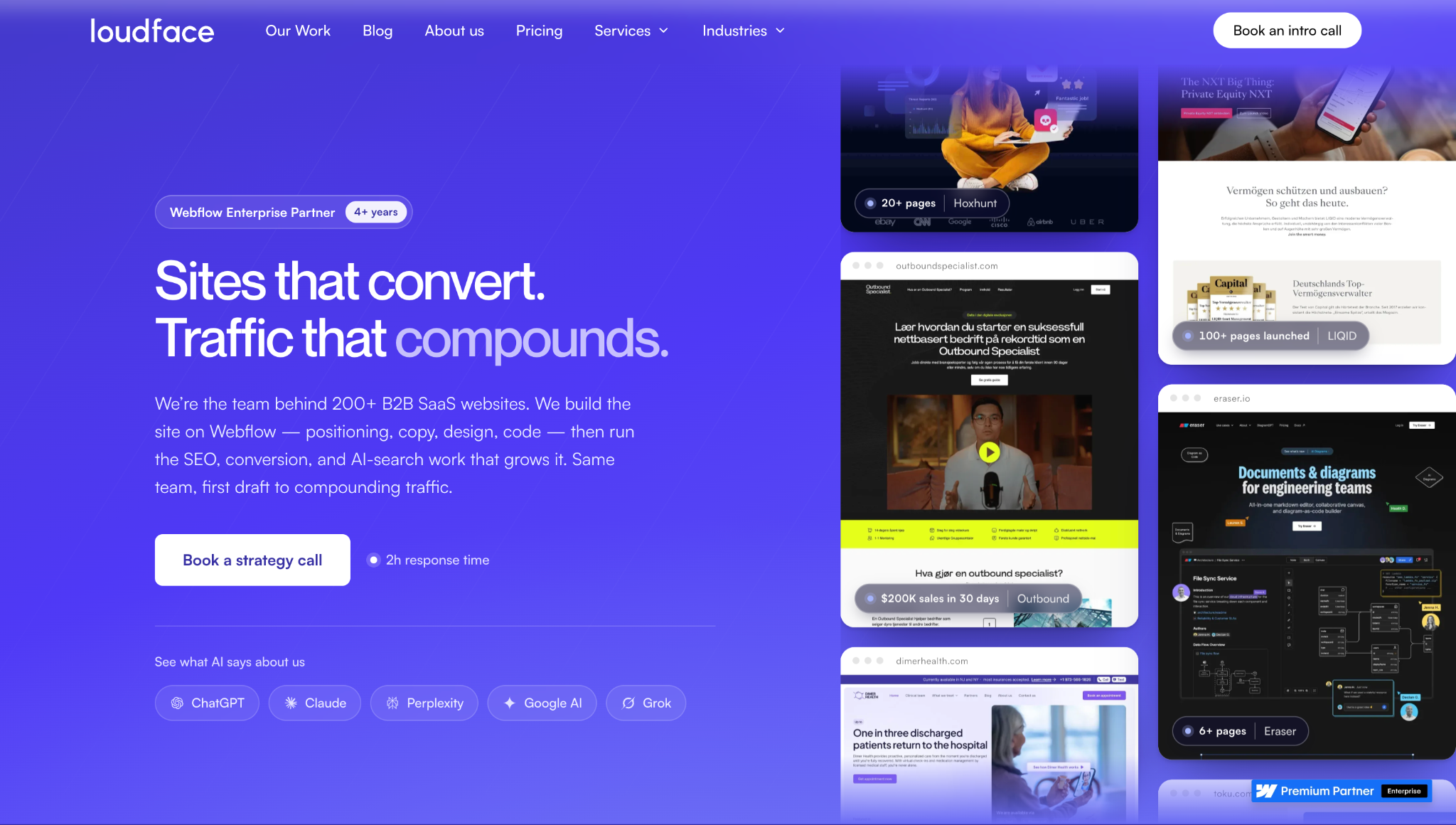
LoudFace is a B2B SaaS agency that builds sites on Webflow and then runs SEO, AEO, and CRO as one integrated growth system, with the same team handling both the site build and the ongoing growth work. Their documented cybersecurity client is Hoxhunt, a security awareness training platform for enterprise companies, for which they built and launched 20+ pages. Their model avoids the most common failure mode in agency-led site rebuilds: the brand hands off the site to a development team, loses alignment with the growth strategy, and ends up with a website that looks good but doesn't rank.
Their AEO practice deserves specific attention. They optimize for citation placement in ChatGPT, Perplexity, and Google AI Mode, distinct from traditional SEO in that the goal is appearing in AI-generated answers, not just ranking on page one. Their documented result taking Toku from 0 to 86% AI visibility on their core category prompt is one of the clearest AI search case studies in the B2B agency market. For cybersecurity companies where AI tools are now part of how buyers produce vendor shortlists, this practice is directly applicable.
LoudFace is best for cybersecurity SaaS companies at Series A or later that need a full site rebuild with growth baked in from launch, or that want one agency handling SEO, AI search optimization, and CRO rather than managing three separate vendors.
Top 3 services
1. SEO and AEO as One System
Traditional and AI search optimization run together, technical SEO, content strategy, and answer engine optimization targeting citation placement in ChatGPT, Perplexity, and Google AI Mode. Built specifically for B2B SaaS buyer journeys where research now spans both traditional and AI search channels. In cybersecurity, buyers use both: Google for long-form evaluation content, AI tools for quick vendor comparisons and category overviews.
2. Webflow Development and CMS Architecture
Production-quality site builds that marketing teams can run independently, no engineering tickets for content updates, no dev queue for campaign pages. Ships in 4–6 weeks with the client's marketing team having full CMS control from week two. Particularly useful for cybersecurity companies whose marketing team is bottlenecked by a legacy CMS or a development backlog that makes it impossible to publish content at the cadence an SEO program requires.
3. Conversion Rate Optimization (CRO)
Data-driven experimentation on product pages, pricing pages, and demo request flows. LoudFace documented a 288% increase in conversions for Dimer Health over six months. For cybersecurity SaaS companies, CRO on demo request pages is often where the largest pipeline improvements come from, conversion rates from organic landing page traffic to demo request are typically low, and small improvements compound significantly over a year.
Notable clients
Hoxhunt (cybersecurity, security awareness training for enterprise), Toku, Dimer Health, Eraser, Montblanc, and LIQID.
Pricing
Not public. Contact required
8. Bluetext
Bluetext is a Washington, DC-based creative digital marketing and PR agency with a strong cybersecurity client base, particularly among defense-adjacent and enterprise security companies. Their client roster includes Varonis, Obrela, and Centauri, names that signal real experience in the enterprise and government-adjacent security segments, not just a cybersecurity practice page on their website. The DC location matters: government-adjacent cybersecurity marketing has specific dynamics around procurement positioning, security clearance messaging, and federal media relations that agencies without DC-area experience regularly get wrong.
Their approach combines brand strategy with campaign execution and media relations. For cybersecurity clients, this typically means defining a clear category position, building the messaging and visual identity around it, then driving awareness through digital campaigns, PR coverage, and website execution. Campaigns are built to reach technical and executive audiences simultaneously, a real requirement in enterprise security where a CISO, a federal procurement officer, and a security architect may all review the same marketing materials at different stages of evaluation.
Bluetext is best for cybersecurity companies selling into government, defense, or enterprise security markets where DC-area relationships and a credible PR presence carry weight alongside organic search, and for vendors that need integrated brand and demand programs rather than pure SEO execution.
Top 3 services
1. Cybersecurity Branding and Positioning
Brand strategy and identity for security vendors differentiating in a crowded market: messaging architecture, visual identity, and the narrative that holds across PR, digital campaigns, and field marketing for both technical and executive audiences. Bluetext's experience with defense-adjacent brands gives them specific fluency in the credibility signals that matter to federal buyers.
2. Digital Campaign Execution
Paid and organic campaign management, website builds, and digital advertising designed to generate pipeline from technical buyers, CISOs, and procurement teams. Bluetext's campaigns integrate brand messaging with campaign targeting so paid and organic work together rather than running as separate programs with inconsistent positioning.
3. Public Relations and Communications
Media relations for cybersecurity companies: placements in security trade publications, enterprise tech outlets, and national business press, with specific strength in federal-facing media and policy publications relevant to government-adjacent security vendors.
Notable clients
Obrela (managed security services), Varonis (data security and analytics), and Centauri.
Pricing
Not public. Contact required
9. Aspectus Group
Aspectus Group is a global brand, marketing, and PR agency with a dedicated cybersecurity practice and offices in London, New York, Singapore, Dubai, and Atlanta. They have been named PR Week's #1 B2B agency multiple years running, and their cybersecurity team publishes original research on CISO marketing, Infosecurity Europe, and AI-driven buyer behavior, which means they are doing genuine thinking about the market, not just executing client briefs.
Their model integrates PR and brand strategy with digital marketing from the start, so search visibility and earned media compound together rather than running as disconnected programs. For cybersecurity companies operating across multiple regions, this integration matters: consistent messaging across US, UK, and APAC markets with local media relationships in each requires both strategic alignment and execution capacity that most single-office agencies can't provide.
Aspectus is best for cybersecurity companies at growth or enterprise stage that need analyst relationships and earned media presence alongside demand generation, particularly brands with multi-region GTM where consistent messaging across markets is a genuine execution challenge.
Top 3 services
1. Cybersecurity PR and Earned Media
Media relations for cybersecurity brands across security trade press, enterprise tech publications, and business media, combined with analyst relations to build the third-party credibility that enterprise security buyers check before shortlisting vendors. Multi-region reach means coordinated coverage across US, UK, and APAC markets simultaneously.
2. Brand Strategy and Positioning
Brand development for cybersecurity companies navigating category creation, repositioning, or global expansion, covering the strategic narrative that needs to hold across PR, digital, and field marketing in multiple markets with different regulatory contexts and different media landscapes.
3. Digital Marketing and AI Communications
SEO-informed content programs, website development, and an AI Communications practice that tracks how cybersecurity brands are cited and positioned in AI-generated research. As security buyers use ChatGPT and Perplexity to generate vendor shortlists, appearing positively in those answers has become a measurable brand objective, one Aspectus tracks alongside traditional PR goals.
Notable clients
Malwarebytes, Flexxon, Clavister, SAP Concur, and Acteon.
Pricing
Not public. Contact required
10. ProperExpression
ProperExpression is a full-stack B2B growth marketing agency covering SEO, GEO, demand generation, webinar marketing, RevOps, and HubSpot implementation. Their Flywheel of Growth model connects foundational strategy, tech stack management, content, distribution, and RevOps attribution into one integrated program. The practical implication: their SEO and content programs are built on a clean attribution foundation from day one, which means marketing leadership can see exactly what organic content and webinar channels contribute to closed revenue, not just to top-of-funnel activity.
Their webinar marketing practice is the most distinctive service they offer relative to the other agencies on this list. For cybersecurity vendors where education-led selling, live threat briefings, security architecture webinars, compliance workshops, is a core part of the pipeline strategy, having SEO and webinar programs managed by the same agency with unified attribution is a structural advantage. The alternative is running them as separate programs with separate agencies and separate reporting, making it impossible to tell which channel is actually driving close rates.
ProperExpression is best for B2B cybersecurity companies that need demand generation and organic search managed as one program, particularly brands where the marketing and sales systems are fragmented and leadership needs clean attribution data to justify budget allocation.
Top 3 services
1. SEO and GEO
B2B SEO and Generative Engine Optimization run as a single program, organic search strategy, content production, and AI search visibility tracked together and reported against pipeline impact rather than keyword rankings. For cybersecurity clients, ProperExpression maps SEO content to the specific queries each buying committee role uses at each stage of evaluation.
2. Webinar Marketing
End-to-end webinar program management: strategy, promotion, execution, and post-webinar lead nurture connected back to revenue attribution. This is a genuine differentiator relative to most agencies on this list. For cybersecurity vendors where education-led events are part of the GTM motion, running them from the same team managing SEO produces clean attribution that neither channel can generate alone.
3. HubSpot and RevOps
CRM setup, lead routing, marketing automation, and multi-touch attribution built on HubSpot, connecting organic, paid, and webinar channels to closed-won revenue. For cybersecurity companies with 6–12 month sales cycles, proper attribution often reveals that organic content influenced deals the CRM was crediting entirely to outbound or paid. That visibility matters when marketing is defending budget in a board review.
Notable clients
DeskDirector (65% increase in MRR), Robocorp, RFG Advisory, Verdence Capital, and PX.
Pricing
Not public. Contact required
What to look for when choosing a cybersecurity SEO agency
Have they worked with cybersecurity companies like yours?
Cybersecurity SEO for a Series A endpoint security startup is a fundamentally different problem from cybersecurity SEO for an MSSP or a compliance platform. Check their case studies and look at whether the problems they solved, buyer persona, content type, conversion goal, sales cycle length, resemble yours. Logos on a homepage don't tell you that. Case study details do.
Do they understand the full visibility picture?
Any cybersecurity SEO agency you evaluate in 2026 should have a clear answer for how they track and improve AI search visibility, not just Google rankings. CISOs, security architects, and IT directors are active users of ChatGPT and Perplexity for vendor research. If an agency's reporting stops at keyword rankings and organic sessions, that's a gap.
"Google is sending less and less traffic to the web every year, and in B2B, when people research products and services, LLMs are almost always part of that equation.", Steve Toth, CEO, Notebook Agency
Do they tie work to pipeline, not traffic?
Traffic is not a business outcome. A cybersecurity SEO program should have a clear line from content to leads, pipeline, and closed revenue. Ask how they measure success, what their conversion rate benchmarks are for organic in your category, and how they track lead quality from organic versus other channels.
Does the engagement model match how you work?
Some agencies are retainer-only. Others offer project-based entry points. Understand what you're committing to before signing anything. The mismatch between expecting senior involvement and getting junior account management is the most common reason agency relationships end early, and it's more common in cybersecurity, where domain expertise at the senior level is genuinely rare.
Why Scale Theory works well for B2B cybersecurity companies
Most SEO agencies enter cybersecurity through a client. They learn the market while working on your budget. Scale Theory came from inside the market.
Akshay Krishnan, Scale Theory's founder, spent years in product and GTM roles at ManageEngine Endpoint Central, one of the most widely deployed endpoint security and unified endpoint management platforms in the world, and at Site24x7, Zoho's infrastructure monitoring and observability product. He didn't learn what a CISO worries about from a client discovery call. He learned it from working inside a product used by IT and security teams at thousands of enterprise companies globally.
That background shapes how Scale Theory approaches cybersecurity SEO. We build content programs that cover every role in the buying committee, the CISO evaluating strategic fit, the security architect doing technical due diligence, the compliance team checking regulatory implications, and procurement comparing vendor risk. We track AI visibility through VisibilityX, our proprietary platform that monitors where your brand shows up, and where it doesn't, in ChatGPT, Perplexity, Claude, and Gemini when buyers ask category-level questions. And we report on pipeline impact: qualified leads, demo requests, MRR from organic, not keyword rankings or session volume.
If you are a cybersecurity SaaS company, MSSP, or security service provider that wants an SEO partner that already understands your market and your buyers. Book a 30-minute strategy call.
Frequently Asked Questions
What makes cybersecurity SEO different from general B2B SEO?
Security buyers are more skeptical than most B2B audiences and have been burned by vendor overclaims. They research for weeks across multiple channels before engaging any sales team, and they hold content to a higher standard of technical accuracy than buyers in most other B2B categories. Cybersecurity SEO requires genuine domain expertise, understanding threat intelligence, compliance frameworks, security architecture, not just keyword research and content volume. The buying committee is also larger and more complex than in most B2B markets, requiring content programs that address five or more distinct roles rather than a single buyer persona.
How important is AI search visibility for cybersecurity vendors today?
Important and growing. CISOs and security architects are active users of ChatGPT and Perplexity for vendor research. Amplifyed's OffSec case study documented a 2,403% increase in ChatGPT sessions alongside their organic SEO growth, which shows that AI search and traditional search are both real channels for security buyer attention. Cybersecurity vendors that aren't tracking AI search visibility are already invisible to a portion of their market that is actively using those tools to produce shortlists.
How long does cybersecurity SEO take to show results?
Technical SEO fixes and on-page optimization: 3–4 months. Content programs targeting competitive keywords: 6–12 months for meaningful ranking movement. Topical authority programs that produce compounding organic growth: 12–18 months. AI search visibility can build faster than traditional rankings because LLMs update their reference sources more frequently than Google's indexing cycles. Starting with bottom-of-funnel, high-intent content first, the queries buyers run when actively evaluating products, produces the earliest pipeline impact.
Should cybersecurity companies hire a specialist agency or a general B2B SEO agency?
For most cybersecurity companies, a specialist or sector-focused agency produces results faster and with less wasted budget, because they don't spend the first six months learning the domain and building content that misses what security buyers actually care about. The risk with general B2B agencies is that they produce content that's technically correct but reads like vendor marketing rather than practitioner analysis. Security buyers notice the difference. A general agency with documented cybersecurity clients and specific case studies is better than a self-described specialist with no proof of work.
What questions should I ask a cybersecurity SEO agency before hiring them?
Ask them to explain the difference between EDR and XDR without looking it up. Ask what specific queries a CISO, a security architect, and an IT director use at different stages of a typical security product evaluation. Ask how they track AI search visibility and what their documented process is for improving a client's citation rate in ChatGPT and Perplexity. Ask for case studies with pipeline metrics, qualified lead growth, demo request increases, revenue attribution from organic, not traffic charts.
How do the agencies on this list approach content for the CISO versus the security architect?
The best agencies on this list build separate content tracks for each buying committee role. A CISO evaluates strategic fit, budget justification, and risk management implications. A security architect is doing hands-on technical evaluation, comparing capabilities, reading API documentation, running POCs. These roles search for different things and hold content to different standards. The security architect often has more direct influence over vendor shortlisting than the CISO does, which means ignoring their content needs is a significant strategic mistake.
Is Amplifyed really cybersecurity-only?
Yes. Amplifyed works exclusively with cybersecurity vendors, MSSPs, security platforms, security service providers, and security training companies. Their entire methodology, writer network, and case study library is within the security market. Their onboarding process is faster because there is no domain education phase, their keyword research is immediately relevant, and their content team doesn't need to learn the difference between a SIEM and a SOC before writing about it.

I help B2B SaaS companies grow pipeline and visibility through strategy-led SEO, AI-powered execution, and content aligned to buyer journeys across key touchpoints and platforms.. With over 5 years of experience, I’ve led execution across the entire organic funnel, delivering measurable results aligned with business goals.
.png)
