
.png)
.png)
Key Takeaways
- AI visibility and Google visibility move together, a drop in one consistently precedes a drop in the other, making SEO fundamentals the foundation of any AI search strategy.
- Commodity content with no original perspective is interchangeable to LLMs, which have no reason to cite you over the dozens of similar pages already retrieved for the same query.
- LLMs cite heavily from the first 30% of a page, so burying your core answer beneath introductions and context-setting reduces retrieval probability by 2.5x compared to leading with it.
- Off-page strategy needs to shift from link acquisition to brand mention placement in the top-cited pages, which account for 80% of all LLM citations.
- Inconsistent positioning across your website, review profiles, and third-party mentions causes LLMs to form a blurry brand picture, reducing confident recommendations for your specific use case.
Lack of proper strategy in content, outreach, and positioning, these are the three reasons most B2B SaaS teams can't get their SEO to translate into AI visibility.
This article is for marketing leaders at B2B SaaS companies who are trying to show up in ChatGPT, Perplexity, and other AI surfaces but aren't seeing results from their current SEO work.
The areas you're working on are the same for both traditional SEO and AI visibility: content, outreach, positioning. The way you need to strategize and execute within those areas is different. And that gap in strategy is what's stopping most teams from seeing AI visibility.
What is the correlation between visibility in Google and visibility in LLMs?
Based on our own observations across clients' Google and AI visibility data, we've found one consistent pattern: AI visibility is directly proportional to Google visibility.
We've seen this play out in both directions.
One website that was hit by Google's core update in January 2026 lost close to 80% of its Google traffic and almost 60–70% of its LLM sessions were lost along with it.
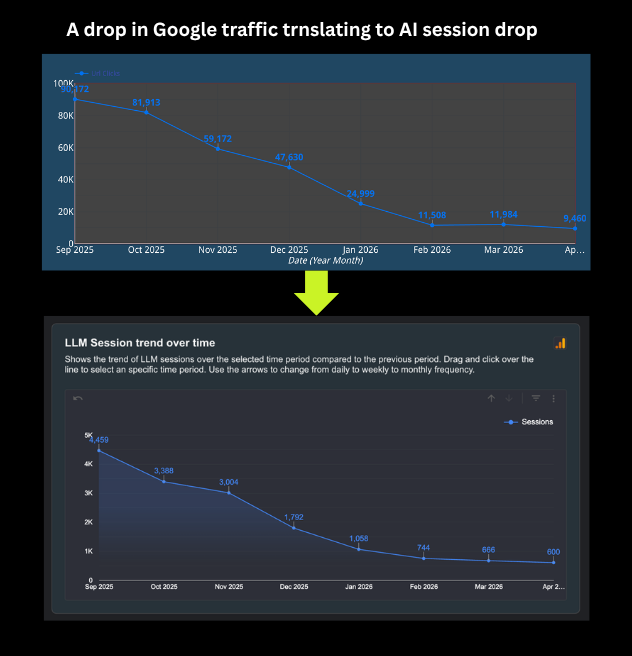
A second website lost around 60% of its Google traffic, and its presence in ChatGPT dropped from 28% to 15% for its top core theme.
On the other side, new companies just starting out with their organic programs saw better LLM presence and sessions when they applied AI best practices and focused equally on both channels from the start.
Why is Google and AI visibility interconnected?
While LLMs like ChatGPT, Claude, and Gemini generate text from trained data, they heavily rely on search engines to look up live, accurate, and updated information.
When a query triggers a web search inside an LLM, it breaks the query down into smaller, more specific queries. This process is called query fanout. It runs individual searches for each of those sub-queries, and the brand that appears most consistently across the pages retrieved for these different queries is the one that gets cited in the final response.
We're still not entirely certain whether that search is running on Bing's index, Google's index, or both but we've identified cases where pages indexed only in Google and not in Bing are still appearing in ChatGPT responses. The correlation is there.
So if you're losing visibility on search engines, it follows that you'll stop appearing in many of these query fanout results, which leads to a drop in AI visibility over time.
That said, it's not simply a case of "Google traffic dropped, therefore AI visibility dropped." The more accurate way to look at it is that the factors which determine how well you perform in Google are largely the same factors that determine how well you perform in AI search.
Stale or outdated content, no original research, poor content structure, weak topical coverage, these are things both Google and LLMs deprioritize. We've covered each of these in detail below, with specific fixes for each. The starting point is making sure you're checking all the boxes on these fundamentals.
Eight reasons your SEO isn't helping your AI visibility
1. Commodity content — no perspective, no source of truth
With the explosion of AI tools over the past three years, creating content has become a lot easier. But creating high-quality, valuable, expert-led content has become a lot harder.
Most companies have started using LLMs to generate content and we have no issue with that. The problem is that most companies also outsourced the research side to LLMs, which resulted in articles with zero value addition and zero unique perspective compared to whatever is already ranking.
The impact of this is the same on both Google and LLMs.
Google has been explicit that it rewards original thought leadership and content that genuinely adds value to the user. If your content doesn't offer anything beyond what the top three or four ranking pages already say, Google has no reason to rank you above them.
LLMs are pattern-matching across thousands of documents. If your content says the same thing as every other retrieved page and adds no unique perspective, there's no reason for an LLM to cite you or mention you. You become interchangeable.
The fix is to ensure that every piece of content you produce has a specific perspective or original angle that doesn't exist elsewhere. This doesn't necessarily mean proprietary stats in every article. It means the content should not read like a generic output and should have a point of view.
A few examples of what this looks like in practice.
- For top-of-funnel articles, add your own perspective on the topic rather than restating what everyone already knows.
- For pain point-solving articles, add value by giving the reader a better or less obvious way to approach the problem.
- For listicle or roundup articles make sure each tool is matched to a specific ICP, that no two tools have overlapping positioning, and that the USP, key features, pros, and cons of each are clearly laid out so the reader knows exactly which one fits their situation.
The goal for every piece of content is to give the reader a perspective they hadn't considered, and give them exactly what they came for.
2. The direct answer is buried
Kevin's analysis of 1.2 million search results and 18,012 verified ChatGPT citations found that LLMs don't process a page evenly.
44.2% of all citations come from the first 30% of the text. Citation probability drops off sharply after that, creating what the research describes as a "ski ramp" effect. Content in the footer accounts for only 6.9% of citations.
Burying a key definition or product feature deep in the content reduces its retrieval probability by 2.5x compared to placing it at the top.
The problem with most content is that the direct answer to what the user searched for is sitting three or four scrolls down after the introduction, after the context-setting, after a few subheadings.
This hurts in two ways.
- From the user's perspective, they won't get what they came for until they scroll past everything else.
- From the LLM's perspective, it's simply not going to retrieve an answer it can't find in the first 30% of the page.
Always put the core answer or definition at the very top. LLMs are looking for immediate classification of entities and facts, not a narrative build-up to the point.
3. Shallow topical coverage
This applies equally to Google and AI search.
On Google, building authority over a particular theme requires more than writing on the core keyword. You also need the supporting cluster pages around it.
Take CRM software as an example. Writing one page on CRM software alone won't get you there. You need pages on use cases of CRM, benefits of CRM, AI CRM, CRM challenges, CRM adoption, and so on. These are the supporting topics that sit under the same theme and together signal to Google that you have genuine depth on the subject.
LLMs work the same way, and this ties back to the query fanout process we covered earlier.
When a web search is triggered inside an LLM, it breaks the query into multiple smaller searches. To appear in those fanout results, your website needs coverage across the range of topics those sub-queries will surface.
If a user is searching for CRM software for a fintech company, you need content that covers that specific intersection.
The way to build this is to plan content around the ICP, the use cases, the verticals, and the adjacent problems that sit around your core theme. That's what creates the kind of depth that both Google and LLMs reward.
4. Unstructured content and the pronoun disconnection problem
Unstructured content has become a bigger problem since AI-generated content became widespread. A lot of AI-produced pages lack a proper header hierarchy or a clear narrative structure, which makes the content difficult for LLMs to retrieve and interpret accurately.
The second issue is pronoun disconnection. Most companies mention their brand name once or twice on a page and then switch to "we," "us," or "our" for the rest of it. The same happens with competitors. Instead of repeating the name, writers use "they" or "it." The problem is that LLMs break content into chunks and process it in pieces. When a chunk is extracted in isolation, the pronouns carry no context.
The fix is to use explicit noun references throughout the content. Name the concept, the brand, or the competitor in each new section rather than assuming the reader or the LLM will carry context forward from earlier in the page.
5. Citation staleness
An Airops study found that 60% of citations from commercial queries came from content updated in the last six months, and 70% of cited pages were updated within the last 12 months.
AI consistently prefers fresh, updated content.
The problem most companies face is that with AI making content production faster and easier, they are publishing more than ever. That pace creates a growing backlog of pages that never get updated. Content optimization tends to get deprioritized, or when it does get picked up, it happens at a much slower rate than new content is being published.
Over time, the percentage of pages with stale content quietly grows, because production velocity is far outpacing optimization velocity.
This doesn't only hurt AI visibility. The recent Google core updates have consistently hit websites with large amounts of outdated, stale content. The cost of ignoring optimization shows up in both channels.
6. Off-page SEO built for links, not authority
Traditional link building focuses on increasing domain authority and ranking for core keywords through building links with anchor text matching those keywords. This works reasonably well for Google, but it doesn't translate to LLMs.
Going back to the query fanout logic: when an LLM decides which brands to mention in a response, it's looking at the brands that appear consistently across the top cited pages for that query. It's picking up brand mentions, not keyword anchor text. So the off-page strategy for AI visibility should be anchored towards getting your brand name included in the pages that are already being cited most frequently in LLMs.
This is a different goal, and not many companies are focused on it yet. It's not about getting 1,000 backlinks from across the web. It's about getting your brand mentioned in the top 5% of cited pages, which account for 80% of all citations.
8. Inconsistent brand positioning across the web
This is one of the most recurring problems we see and one of the hardest to fix quickly.
LLMs form an understanding of your brand by looking at everything available: your website, press coverage, review profiles, social media presence, and brand mentions across third-party and competitor sites.
If these signals are inconsistent, the LLM ends up with an inconsistent picture of who you are and what you do. It can't confidently recommend your brand for a specific use case or niche if the signals it's picking up about your positioning contradict each other.
The fix is to document your positioning and messaging clearly, then roll it out uniformly across the web — starting with your own website and social media, moving to your listings and directories like G2 and Capterra, and then working towards third-party and competitor domains.
The playbook to build AI visibility
Step 1: audit your brand narrative before doing anything else
Understand what LLM currently says about you. Run your brand name through ChatGPT, Perplexity, and Gemini. Ask them to describe what you do, who you're for, and how you compare to competitors. Read those answers carefully.
Major things to look out for in the answers: Is the description accurate? Is it specific? Does it match how you'd describe yourself? Are there gaps? Is there outdated or wrong information?
This audit tells you what AI systems have already decided about you and where the narrative needs fixing. Look into the sources of these answers and identify the pages that have the information to be corrected or updated.
Step 2: pick one theme and build deep, then move on
Once you have completed the brand narrative, the next actionable step, which can be done in parallel with refining the brand narrative, is to finalize the theme or topic that we want to win in AI search and start taking actions to improve our visibility around it.
The process should start with:
- Identify the core theme we want to establish authority around.
- Identify the prompts and potential queries that users might search for under that particular theme.
- Start tracking these prompts to benchmark where we currently stand for that theme.
The major metrics we will track include:
- Presence — Our presence compared to competitors across relevant AI search results.
- Citations — The sources being cited in AI-generated answers, including:
- Our own website
- Competitor websites
- Third-party websites
- Social media pages
Once we start tracking these prompts, within approximately a week, we should be able to identify:
- The top-cited pages and domains influencing AI-generated answers.
- Our AI search presence compared to competitors.
- The topics and sources influencing the answers for our target prompts.
Based on these insights, we can then create:
- A content creation and optimization calendar focused on the topics and pages that have the highest potential to improve our AI search visibility.
- An outreach plan targeting the top pages and sources that are frequently cited but currently do not mention or reference our brand.
Step 3: track what's moving, not just what's published
Proper and consistent tracking of the strategy, execution, and results is essential to ensure that we are moving on schedule and staying on top of the trends and changes happening in AI search.
We don't need a complex tracking setup to get started. We can begin by tracking the essential metrics and gradually build on them as we start seeing meaningful results.
Start With Presence and Citations
The first step is to track our AI search presence alongside the presence of the top three winning companies for our target theme.
We should do the same for citations by tracking how frequently our brand and the top three competitors are being cited across the relevant prompts.
This will give us a clear view of whether:
- Our overall AI search presence is improving.
- Our share of citations is increasing.
- We are gaining ground against the leading competitors.
Connect Presence to Sessions
Once we start seeing an increase in our AI search presence, the next step is to determine whether this visibility is translating into website traffic.
We can track the sessions generated by the pages that are being cited in AI answers.
This allows us to establish a direct correlation between:
AI Presence → Citations → Sessions
In other words, we can understand whether an increase in our visibility within AI-generated answers is actually driving users to our website.
Connect Sessions to Leads
Once AI-driven sessions start becoming significant, the next step is to connect them to actual leads.
This can be done with a simple addition to our Booked Demo / Free Trial form by asking users:
“How did you hear about us?”
Adding an option such as AI search / ChatGPT / Perplexity / Gemini will help us identify leads that originated from AI search.
This allows us to connect the entire funnel:
AI Presence → Citations → Sessions → Leads
By tracking these metrics progressively, we can start with a simple setup and still build a clear picture of the actual business impact of our AI search strategy.
How Scale Theory approaches AI SEO
Scale Theory is an AI SEO agency for B2B SaaS startups and mid-market companies. We help B2B SaaS teams increase their visibility across both Google and AI search through a systematized approach to organic growth.
Our approach is built around four key principles:
1. A Systematized Approach to Organic Growth
We don't treat SEO or AI SEO as a collection of disconnected activities. We build a structured system that connects strategy, execution, measurement, and optimization to ensure every activity contributes towards the overall organic growth goal.
2. Our Own AI Visibility Platform
We have built our own AI visibility platform to help us track, monitor, and act on AI search performance.
This allows us to continuously monitor metrics such as AI presence, citations, competitors, and the sources influencing AI-generated answers, enabling us to identify opportunities and take action based on real-time insights.
3. Dedicated Workflows for Every Project
Every project has its own dedicated and personalized workflows based on the company's goals, ICP, industry, and existing organic presence.
This allows us to scale our execution without compromising on quality, while ensuring that the strategy remains relevant to the specific business we are working with.
4. Proprietary Research Over Generic Trends
We believe the best strategies come from first-party data, experimentation, and research, rather than blindly following what is already being discussed in the market.
We continuously conduct our own research and experiments to generate proprietary insights that can inform our strategies. This ensures that the recommendations we make are data-driven and research-backed, rather than simply based on the latest trends circulating on LinkedIn or other social platforms.

I help B2B SaaS companies grow pipeline and visibility through strategy-led SEO, AI-powered execution, and content aligned to buyer journeys across key touchpoints and platforms.. With over 5 years of experience, I’ve led execution across the entire organic funnel, delivering measurable results aligned with business goals.
.png)
